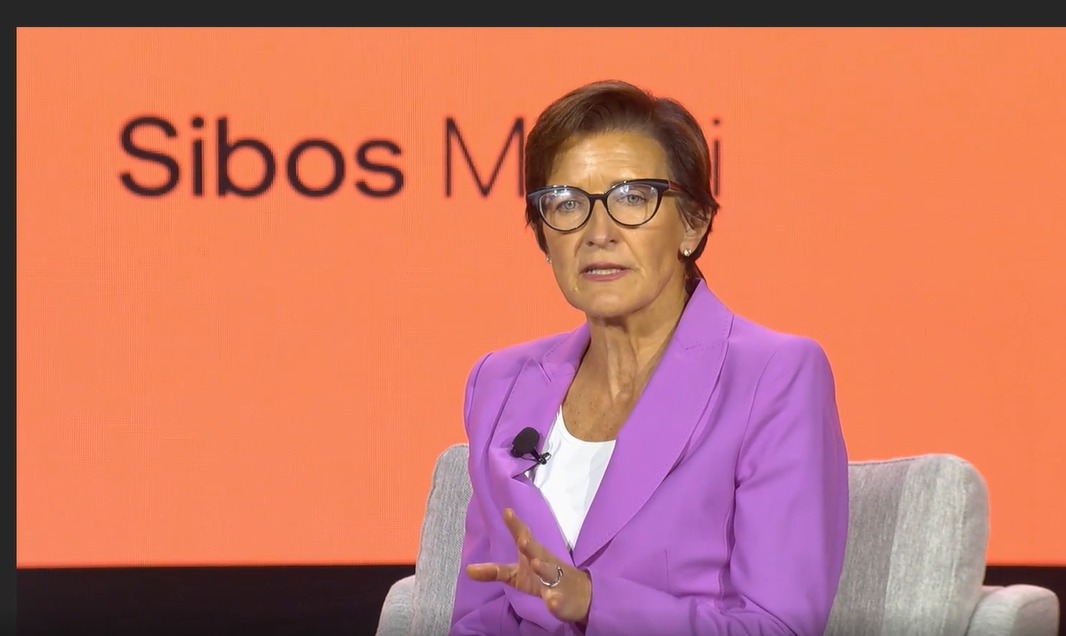
Jane Fraser, Chair and CEO of Citi, put the spotlight on the risks posed by the advancement of artificial intelligence agents in the financial sector during the opening session of Sibos 2026, held this Monday in Miami. Her message was clear: before allowing these systems to move from providing information to autonomously executing actions, it will be necessary to guarantee their identity, authentication, and oversight.
Fraser illustrated the technology’s potential with an everyday example. “I don’t trust my husband to do the grocery shopping, so I can’t wait to have an agent that doesn’t just build a list for me, but actually does it for me,” she joked.
However, the leap between recommending and acting introduces much greater risks. Authentication, she stated, is one of the issues that “keeps us all up at night.” The challenge consists of being able to verify that an agent is truly acting on behalf of a person, and that both the bank and the other participants in a transaction can confirm its legitimacy. “Until then, I am confident I won’t have wild agents without the right controls in place,” she affirmed.
A Control Layer for Citi’s Agents
Fraser explained that Citi has already developed a specific mechanism to control the deployment of AI agents within the institution: a layer known as ARC. “You cannot create an agent without going through ARC,” she noted. This infrastructure concentrates the control framework and observability layer necessary to verify that agents do what they were designed to do, and that their activity can be monitored at all times.
The Citi CEO even anticipated a shift in the supervision model. If traditionally a manager might supervise nine employees, in an environment dominated by AI agents the ratio could invert: a single agent could be subjected to nine different oversight mechanisms, many of them managed in turn by other agents. “It is very early days in those controls, as we can all see,” Fraser acknowledged.
The IMF Focuses on Cyber Risk
The risks associated with artificial intelligence were also present in the remarks by Dan Katz, First Deputy Managing Director of the International Monetary Fund (IMF), who pointed out that there is a broad debate on whether increasingly powerful AI systems might eventually demand new regulatory responses.
Among the most immediate threats, Katz placed cyber risks “at the top of the list.” AI, he explained, is transforming this domain by accelerating the speed, frequency, and scale with which vulnerabilities can be detected and potentially exploited.
For public policy makers, the challenge will be creating an environment that allows innovation to be harnessed without compromising the integrity and stability of the financial system. Fraser agreed in identifying cybersecurity as one of the great challenges of this new technological era. “We have a tsunami of patches that need to be applied right now, and we have to be very responsible in achieving that,” she stated.
Innovating Without Breaking Trust
Citi’s CEO extended this need for control to the financial system’s broader technological transformation. “If you move fast and break things, we are failing in our mandate,” she asserted. Contrasting with the well-known tech axiom of moving fast even if errors occur, Fraser maintained that financial institutions must innovate rapidly without jeopardizing the trust upon which the system rests. “If we break trust, it is a huge problem for the macro, for the markets, for everywhere,” she warned.
As the velocity of money increases, she added, “resilience and trust go hand in hand.” Citi moves roughly six trillion dollars daily, and Fraser foresees transaction volumes rising significantly as artificial intelligence gains ground in the economy. Clients, furthermore, demand round-the-clock, instantaneous services that are also safe and reliable. Fraser cited Citi Token Services’ digital deposit solutions as an example, which enable money transfers via blockchain technology and integrate with clearing capabilities available 24 hours a day, seven days a week.
The next step, she noted, will be for other components of the financial infrastructure to move toward continuous availability as well, including central banks. Fraser summarized the equilibrium that, in her view, should guide this transformation: “Let’s do it safely, securely, and fast.”