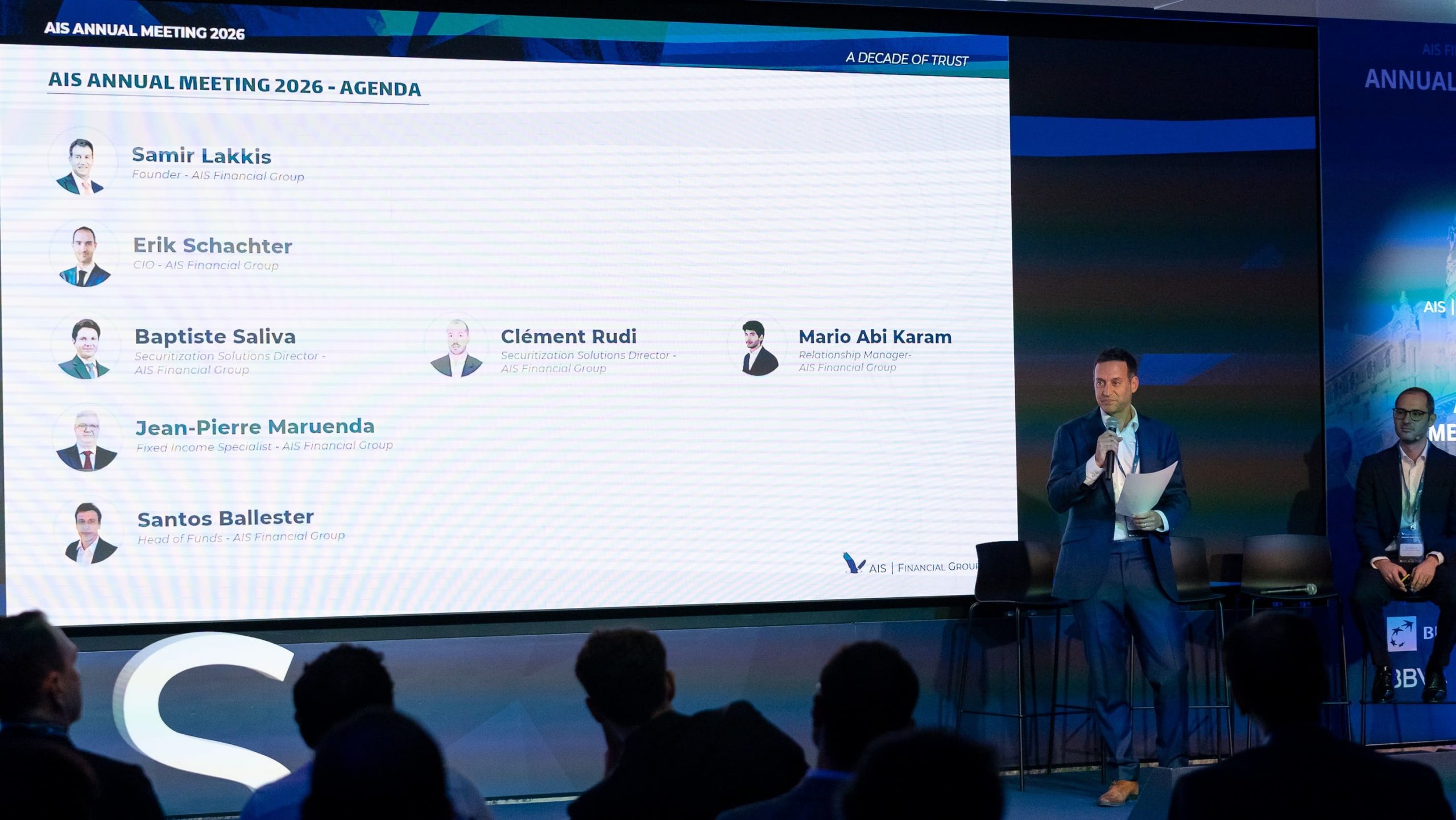
This marks the tenth anniversary of the launch of AIS Financial Group, and the boutique firm specializing in investment solutions celebrated it at its annual meeting under the slogan “A decade of trust.” Over the past decade, the company has grown from building its business around structured products to developing a financial platform active in securitization, funds, and fixed income, with an expanding international presence.
This evolution has also been accompanied by a greater commitment to technology, which AIS considers key to automating processes, expanding its service capacity, and scaling the business without sacrificing the level of customer service that has characterized the firm since its inception. Currently, the company offers access to multiple issuers, structuring, and execution across various asset classes, backed by an extensive network of providers.
Samir Lakkis, Founder and Director of Sales, opened the event by reviewing the transformation experienced by AIS over its ten-year history. He stated that AIS maintains its independence while having expanded both its platform, geographic reach, and provider network. Among the main milestones of this evolution, he highlighted the opening of an office in Miami and the increase in the number of providers in what he described as a record-breaking 2025, with more than 35 issuers.
New business lines have been added to this activity. Securitization has become one of the fastest-growing areas, allowing different types of assets or investment strategies to be transformed into tradable securities. The fund business has also gained greater relevance, both through the launch of proprietary strategies and through fund distribution and collaboration with external managers. Added to this is its fixed income activity, offering tailored execution solutions across the United States, Europe, and emerging markets.
Technology has become another pillar of this expansion. AIS has an in-house technology department developing internal and client-facing tools, including Phoenix and Akoura. “Technology allows us to automate more processes, improve the service we offer to clients, and, above all, scale the business much faster without losing the quality of service that has always been fundamental for AIS,” Lakkis explained.
Thus, the company has evolved from a model focused primarily on structured products to becoming a financial platform with a broader array of activities, maintaining its independence as one of the key elements of continuity during its first decade.
Securitization: A Vast Universe of Instruments Across Diverse Asset Classes
Baptiste Saliva and Clément Rudi, Securitization Solutions Directors, alongside Mario Abi Karam, Relationship Manager, delved into securitization solutions and AIS’s ability to turn diverse assets and investment strategies into tradable instruments. Since it began operating in early 2022, the platform has securitized over $1 billion in assets, roughly half of which correspond to unlisted underlyings. To tailor structures to the needs of each transaction, AIS also works with more than 30 institutional counterparties.
Mario Abi Karam explained that in recent years, the company has structured positions in real estate projects, pre-IPO companies like OpenAI, physical gold, and third-party managed equity strategies, turning them into tradable, bankable securities. The goal is to facilitate access and distribution for investments that, due to their complexity, private nature, or access barriers, might present greater obstacles for investors.
“In essence, investment managers arrive with ideas that may be complex, private, or difficult to access or distribute, and we make them bankable,” Abi Karam summarized.
The process begins with the asset or strategy provided by the manager—ranging from a loan, fund, or portfolio to real estate—and continues with the issuance of a specific vehicle for that mandate, which investors can subscribe to directly from their existing bank accounts.
The solution can be applied to a wide range of asset classes, from equities, derivatives, bonds, and commodities to private markets, private equity, real estate, structured products, or digital assets. AIS maintains vehicles in the Cayman Islands, Luxembourg, and Guernsey, with the choice depending on manager preferences, investor profiles, and tax considerations. The company also manages the infrastructure associated with the product, including documentation, subscriptions and redemptions, bank and custody accounts, and net asset value (NAV) calculations.
“In short, if you can describe a strategy, we can make it bankable,” Abi Karam emphasized, summarizing the platform’s value proposition.
Baptiste Saliva later focused on the flexibility of the infrastructure. AIS can adapt its structures to different types of assets and strategies, and in recent months, it has developed new processes powered by artificial intelligence. As he explained, these tools are helping accelerate the structuring and issuance process, allowing a project to typically launch in about two weeks, even for complex or illiquid operations.
Clément Rudi addressed the operational structure and the various participants involved throughout the lifecycle of the product. “There are many actors involved in this framework to ensure it is compliant, secure, and efficient,” he noted. AIS coordinates the capabilities of its legal, tax, compliance, and marketing teams, while the administrator performs the necessary checks on the certificate prior to issuance and throughout its lifespan.
The paying agent handles payments and facilitates the secondary market; the broker enables the manager to execute the strategy; and the distributor subsequently channels the product to qualified investors. Within this setup, “our role is to provide investment managers with the best tool and the best structure to implement the strategy, and you only have to implement it correctly according to the term sheet,” Rudi explained.
The frequency of NAV calculations ultimately depends on the underlying assets and can range from daily to quarterly, based on liquidity and the valuation frequency of the assets themselves.
Investment Ideas
Erik Schachter, CIO of the company, focused his presentation on AIS’s market outlook and, in particular, the importance the firm places on momentum when designing investment ideas. Schachter explained that AIS seeks to offer diversified proposals across sectors such as consumer, technology, financials, communications, and energy, tailoring opportunities to prevailing market conditions.
Regarding structures, around 60% of the proposed ideas are autocallables, though the firm also works with different participation mechanisms and payoff structures to diversify the solutions available to clients. According to data presented, 86% of AIS’s ideas in 2025 delivered positive returns, compared to 14% with negative returns.
Schachter stressed that analyzing an opportunity goes beyond identifying the attractiveness of a specific sector; it also incorporates momentum dynamics. “When we think of an idea, we think about the sector thesis, but it is also important for us to think about momentum,” he stated.
The reason, he explained, is that shifts in volatility can substantially alter the terms of an issuance. “It’s good to trade when the VIX is high, because you get a better coupon and better strikes.” In this way, two notes with seemingly identical parameters can yield different coupons depending on the market timing of their structuring. Using an example provided by Schachter, a VIX of 30 could yield a 12% coupon, whereas with a VIX of 20, the coupon dropped to 9%.
The manager cited a recent proposal tied to a DRAM memory ETF as a case in point. AIS launched the idea on August 5 with a 50% barrier and a 32% coupon. Two weeks later, the coupon had fallen to 22%—a ten percentage point difference that, according to Schachter, illustrates the significance of market timing when structuring these types of products.