Global wealth creation has surged at an extraordinary pace over the last five years. According to the new Wealth Sizing Model included in The Wealth Report 2026 by Knight Frank, the global population of Ultra-High-Net-Worth Individuals (UHNWIs)—defined as those with net assets exceeding $30 million—has expanded from 551,435 in 2021 to reach 713,626 worldwide.
As detailed in the document, this rapid expansion has been decisively dominated by the United States, which generated 41% of new ultra-high-net-worth individuals thanks to the depth and liquidity of its capital markets, as well as the powerful multiplier effect of the technology sector and artificial intelligence (AI). Meanwhile, Asia-Pacific and India are consolidating their positions as secondary drivers of structural growth.
Figures from the report reveal that, over the past five years, 89 people around the world crossed the $30 million threshold every single day. The strength of U.S. financial infrastructure will drive the country from concentrating 35% of global UHNWIs in 2026 to a projected 41% by the year 2031, adding more than 136,000 new ultra-high-net-worth individuals. To accommodate this relentless U.S. expansion, nearly every other country—including China, which will drop from its current 17% share to 15%—will see its global market share contract.
However, the report highlights clear geographical dispersion looking ahead, driven by rapidly maturing economies. Indonesia leads percentage growth forecasts, with a projected 82% surge in its UHNWI population by 2031. It is followed closely by Saudi Arabia and Poland (both above 60%), as well as Vietnam (nearly 60%), underscoring the speed at which new wealth hubs are forming, particularly in Southeast Asia and the Middle East.
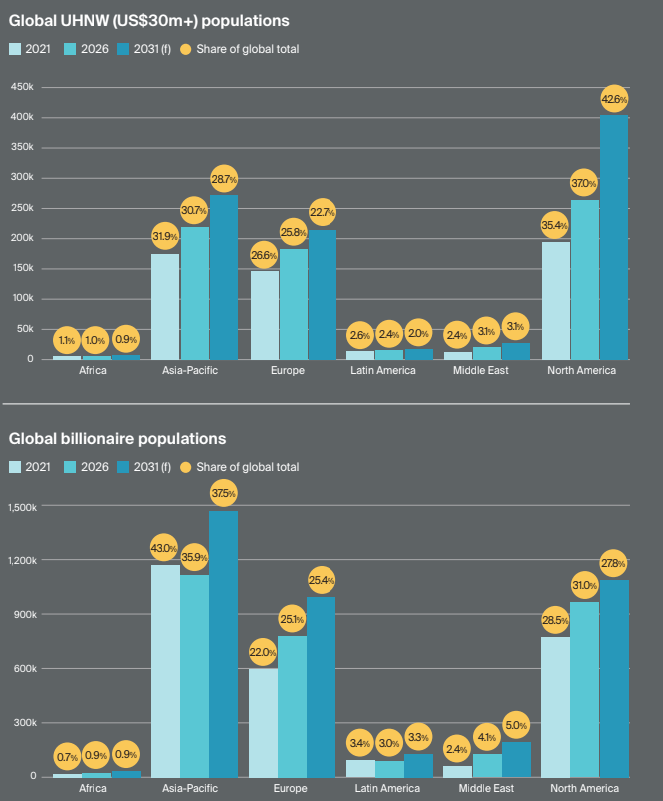
Global UHNWI and Billionaire Charts. Source: Knight Frank, The Wealth Report 2026
The billionaire segment confirms this shift toward global diversification. Although Asia-Pacific holds the highest total count (1,116 compared to North America’s 965), the fastest growth rates over the next five years will be registered in Saudi Arabia (+183%), Poland (+123%), Sweden (+81%), and Australia (+77%).
The Australian case stands out for its economic resilience and depth: its UHNWI population is projected to grow nearly 60% (reaching 26,095 individuals), supported by an ecosystem combining commodities with an increasingly sophisticated financial services and technology sector.
For its part, India represents a story of large-scale consolidation. After seeing its ultra-wealthy population skyrocket 63% between 2021 and 2026, the country is set to add an additional 27% by 2031, surpassing 25,000 UHNWIs. This progress reflects the transformation of its economy toward a model backed by a deeper equity market, greater private equity penetration, and increasingly established global investment networks.