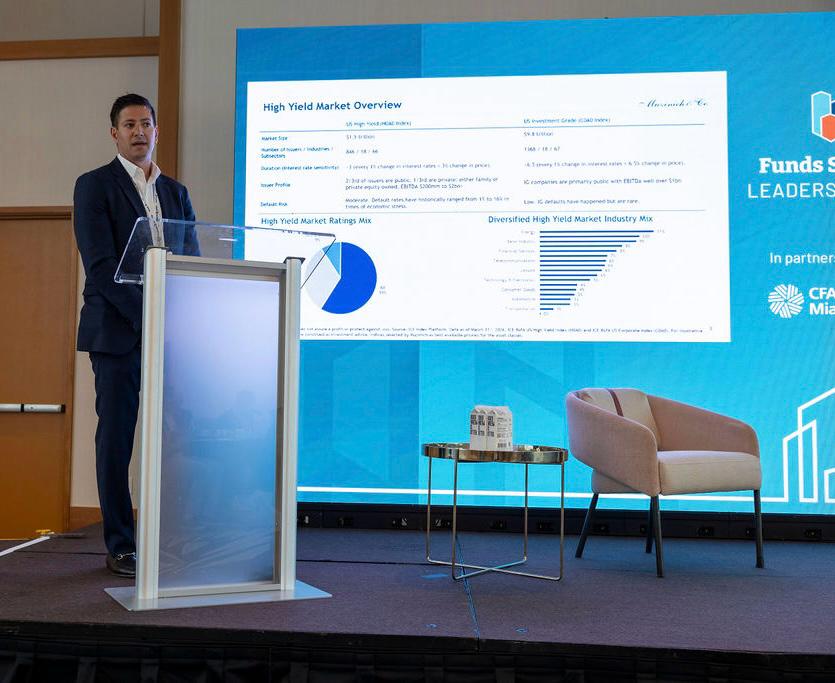
The high yield market in the United States shows an improved risk-return profile, according to John Colantuoni, portfolio manager on the high yield bond platform at Muzinich, a global asset management firm founded in 1988 that manages $42 billion across 18 offices worldwide. His core thesis rests on a structural argument: the credit quality of the market has improved steadily over the past 15 to 20 years, reducing default risk compared to previous cycles.
Within the framework of the Leaders Summit, a professional event in Miami organized by Funds Society in collaboration with CFA Society, Colantuoni provided an overview of the U.S. high yield market, noting that it represents $1.5 trillion in issuance, compared to $10 trillion in the investment grade segment, and includes more than 800 issuers. Nearly 60% of the bonds are rated BB, the highest category within the high yield universe, with a long-term average default rate below 2%. The BB index yield currently stands at 6.25%, above the historical average of 5.9%, with spreads at 230 basis points versus a historical average of 380 basis points.
The manager identified default as the central risk when investing in this segment. Over the past 25 years, he noted, the market has gone through four major peaks: the dot-com bubble (10% default rate), the global financial crisis (16%), the wave of defaults in the energy sector (5%), and the COVID-19 shock (7%). The likelihood of repeating those levels is low, according to Colantuoni, partly because the composition of the market has changed.
One factor explaining this improvement is the reduced presence of leveraged buyouts (LBOs). This type of borrower—with higher leverage and shorter time horizons than non-LBO public or private companies—accounted for nearly 40% of the market in 2006–2007, coinciding with the most severe default cycle during the financial crisis. Today, LBOs represent 15% of the total. Companies (publicly traded) with lower leverage due to equity market pressure on their balance sheets account for 65% of the market.
From a sector perspective, energy leads the high yield market with 11% share, although only 4% corresponds to oil and gas producers; the rest is energy infrastructure. Muzinich does not overweight crude producers, instead favoring infrastructure assets with recurring cash flows.
Another structural change highlighted by Colantuoni is the decline in the duration of issued bonds. While 10-year low-coupon issuances were previously dominant, the market now issues bonds with maturities of 5 to 7 years and higher coupons. Average duration has fallen from 4.25 to 3 years, reducing price volatility in the face of rising interest rates. In the most recent episode of market stress—linked to the conflict with Iran and inflationary pressure—high yield showed performance comparable to investment grade.
Since 2010, whenever the BB index yield has exceeded 6%, the average forward return has been above 8%, a data point Colantuoni used to support the market’s current attractiveness.
Accordingly, Muzinich’s strategy focuses on non-cyclical assets with recurring cash flows: energy infrastructure, telecommunications, aircraft leasing, real estate, and healthcare. During periods of volatility, the firm prioritizes companies with strong balance sheets over higher-risk assets. As a reference, BB-rated software bonds yield between 7% and 8%, compared to the segment average of 5.75%.
Among the risks being monitored, Colantuoni mentioned the conflict with Iran—whose impact is limited given that the U.S. is energy self-sufficient—exposure to the software segment (5% of the market) and data centers (2% of the index), and the higher concentration of LBOs in private credit, which reinforces the relative quality of publicly traded high yield.