What do a goalkeeper who played in 6 World Cups and a golfer who reached the 6th spot in the world rankings have in common? At first glance, their stories seem to belong exclusively to professional sports. However, their experiences offer lessons that also have a place in financial markets, business, and investment strategies: talent can open doors, but it is discipline, perseverance, and the ability to make decisions that allow one to stay at the top.
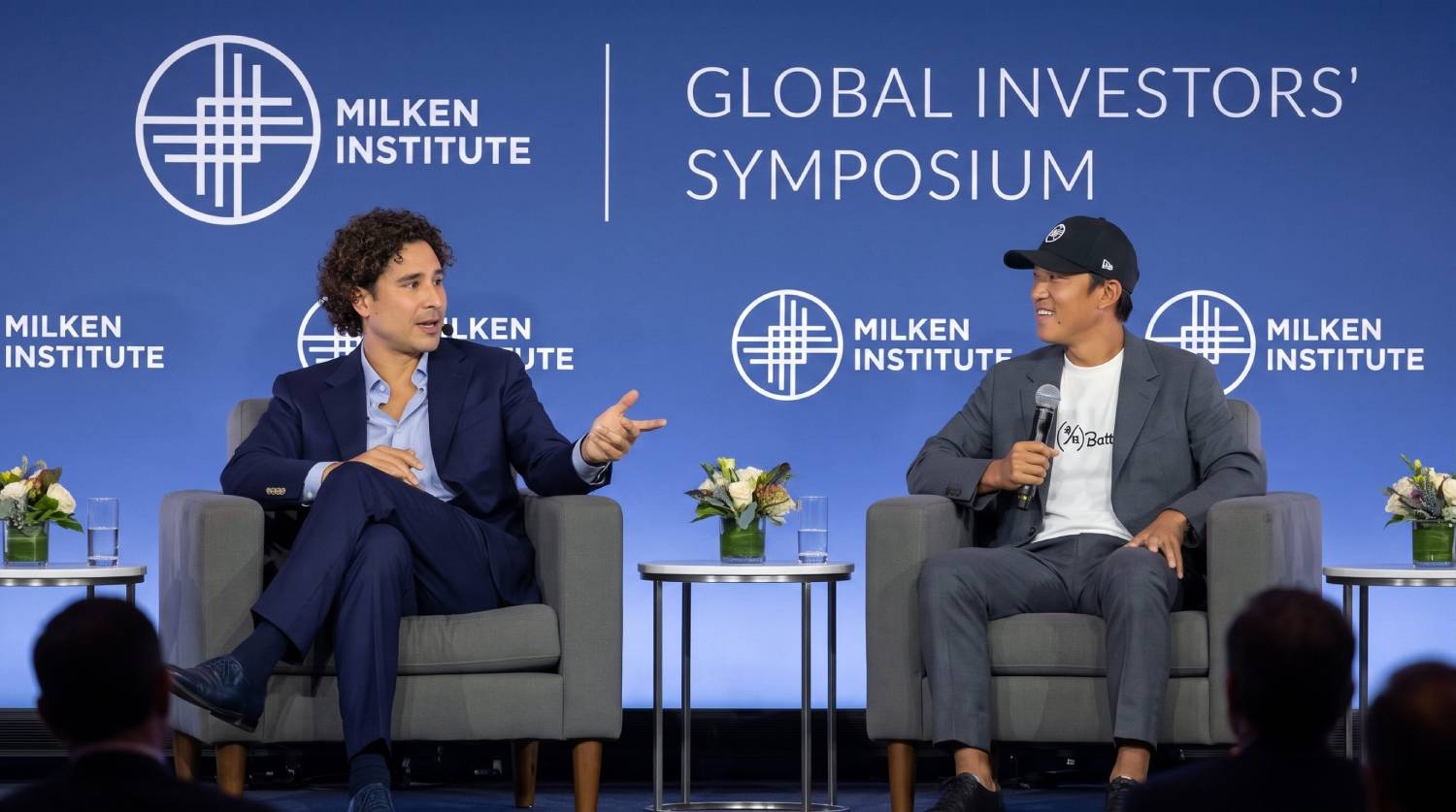
That was the essence of 2 conversations that Guillermo Ochoa and Anthony Kim held on October 28 during a gathering organized by the Milken Institute in Mexico City. Although their careers unfolded in different disciplines and their personal circumstances were vastly different, both agreed on a fundamental idea: success is not a final destination, but a process that demands preparation, learning, and the capacity to get back up after every setback.
The reflections of the former Mexican goalkeeper, whose career spanned more than 2 decades and took him to 6 World Cups, and of the American golfer, who reached the international elite before turning 25 and later faced a prolonged personal and professional crisis, make it possible to draw a parallel with the world of investing. In both arenas, outcomes depend as much on preparation as on how risk is managed, uncertainty is confronted, and mistakes are answered.
Memo Ochoa: building wealth also demands discipline and long-term vision
For Guillermo Ochoa, the end of his cycle as a professional footballer did not mean abandoning competition, but rather transferring what he learned over more than 22 years into a new stage: business, investments, and building a legacy. In conversation with Juan Manuel Valle, CEO of Afore Coppel, the former goalkeeper explained that one of his priorities after taking a period of rest was to become more directly involved in managing the wealth he had built during his career. A decision that, as he recounted, did not arise spontaneously, since during his years as a footballer he had sought to diversify his income streams and prepare for the moment he left the pitch.
Ochoa brought up a reality that often goes unnoticed in professional sports: athletes begin generating substantial income at very young ages, yet their earning capacity also ends much earlier than that of other professionals. As an example, he noted that a footballer typically experiences their peak earning years between ages 20 and 40, whereas other professionals may reach their highest economic capacity between ages 40 and 60 or 65. That difference forces athletes to think ahead about their financial future and understand that a high salary does not necessarily equate to solid wealth.
His strategy consisted of advancing gradually. He began with mutual funds, bonds, and fixed-income products, both short- and long-term; later he moved toward emerging companies and startups, in some cases through partnerships in which he participates as a partner rather than merely as a commercial brand ambassador. He also incorporated real estate investments and protection mechanisms such as life and major medical insurance.
The former national team player acknowledged that not all of his investments worked out. He recalled unsuccessful experiences in businesses such as gas stations, pyramid schemes, and startups, including a video game from which he expected substantial growth. Nevertheless, he emphasized that those missteps allowed him to identify risks, learn to evaluate opportunities better, and distrust proposals that promise extraordinary returns.
His philosophy, he explained, remains conservative. First he sought to build a solid wealth foundation and, once a degree of stability was achieved, began considering higher-risk investments. Experience also taught him to recognize when an opportunity does not match his profile and when it is better to stay on the sidelines of volatility. In that sense, he summed up one of his main financial lessons in a simple recommendation: save consistently and avoid unnecessary expenses.
Yet perhaps Ochoa’s most relevant reflection went beyond his own experience. He considered that Mexican sports has unfinished business in financial education, as many athletes do not know how to manage their income, where to invest, how to protect their wealth, or whom to turn to for specialized advice. He warned that some athletes end up losing their resources just a few years after earning them, whether due to lack of knowledge, investing in businesses they do not understand, or trusting the wrong people.
Consequently, he proposed fostering a culture of saving and wealth management starting at the youth development stages, incorporating tools to plan for retirement, purchase insurance, invest in real estate, and receive tax and financial advisory services. His purpose in this new chapter, he explained, is to help close those gaps through projects combining sports, education, technology, and business.
His closing reflection captured the shift in priorities: after dedicating a large part of his life to guarding a goal, he now wants to protect his family’s wealth and build a legacy that enables others to go further.
Anthony Kim: after hitting rock bottom, the importance of starting over
Anthony Kim’s story offers another perspective on perseverance and the ability to rebuild oneself. The American golfer, who rose to 6th in the world rankings before turning 25, enjoyed a meteoric career, yet also went through a particularly difficult personal period that kept him away from professional golf for more than 12 years.
In his conversation with Rodrigo Bettini, Managing Director at the Milken Institute, Kim recalled that his introduction to golf began when he was barely 2.5 years old, in an immigrant family whose parents held high expectations for his future. Behind his athletic upbringing was, above all, his mother’s sacrifice, having worked for years without vacations or days off to offer him opportunities she herself had never had.
That effort was one of his primary motivations. Kim acknowledged that much of his career was driven by the desire to repay his family’s sacrifices and enable his mother to stop working.
However, success arrived much faster than he was prepared to handle. Before receiving his first PGA Tour paycheck, he recalled, he was living on a futon in his coach’s basement and had barely $50 in his bank account. Then came the endorsements, the money, the recognition, and an environment in which, as he recounted, too many people told him everything he did was right. A lack of boundaries, bad company, and struggles with addiction and mental health ultimately led him into a dark period that kept him away from the sport for more than a decade.
Today, at 41 years old, sober and with a renewed outlook on life, Kim considers one of his greatest lessons to be understanding the importance of personal relationships and listening to those who genuinely want to help him. He admitted that in the past he pushed away people who pointed out his mistakes, while keeping close others who took advantage of his moments of vulnerability.
Rehabilitation also enabled him to develop a philosophy he now applies both to his personal life and to his return to professional golf: getting 1% better every day. Rather than focusing exclusively on major outcomes or goals difficult to control, Kim learned to set small, achievable objectives. It might mean spending several hours perfecting a shot, practicing putts, or completing a training session. What matters, he explained, is fulfilling the established purpose, regardless of whether immediate results are favorable.
That mindset also reshaped his relationship with defeat. He recalled that in his first tournament after returning to the LIV Golf circuit, he finished in last place, 33 strokes behind the leaders over 3 rounds. Although he admitted he remains a sore loser, he now understands that the outcome of a competition does not define a person’s worth nor should it become an obstacle to pressing forward.
His comeback, moreover, is driven by different motivations than his first stint as a professional. Sobriety, his wife, and especially his daughter gave him a different perspective on life’s priorities. Golf remains important, but being present for his family now comes first.
Kim also offered a recommendation for young athletes striving to reach the highest level: before focusing exclusively on winning, they need to build a foundation of personal stability they can fall back on when things go wrong. It is a lesson that can also be carried over into any professional field. Having a solid structure, surrounding oneself with trustworthy people, and developing habits that help navigate difficult moments can be just as important as talent or the opportunities that arise along the way.
Two disciplines, one shared lesson for investors
The experiences of Ochoa and Kim show that success takes different expressions, yet shares certain fundamentals. In sports, as in investing, talent and initial resources do not guarantee sustainable results. Discipline is needed to prepare, patience to wait for outcomes, intelligence to manage risks, and humility to acknowledge mistakes. Ochoa represents the importance of anticipating the future. He understood that his athletic career had an expiration date and that he needed to build wealth capable of sustaining his lifestyle beyond the pitch. His experience also demonstrates that diversifying, seeking advice, and not being seduced by extraordinary returns are fundamental decisions for protecting capital.
Kim, for his part, represents the capacity to rebuild. His trajectory serves as a reminder that even those who reach extraordinary heights can lose their way, and that coming back requires recognizing mistakes, changing habits, and establishing new priorities. His philosophy of improving 1% daily is, in essence, a wager on sustained growth rather than the pursuit of immediate results.
For an investor or a financial strategist, both stories carry a particularly valuable takeaway. The first is that generating resources is not enough: one must manage, protect, and grow them with a long-term vision. The second is that mistakes are part of the process, but the difference lies in learning from them and preventing them from becoming behavioral patterns.
There is also a lesson regarding one’s environment. Neither of them built his trajectory entirely alone. Ochoa recognized the importance of having advisors and people to guide him in his wealth decisions; Kim learned, after a difficult period, that surrounding oneself with people capable of telling the truth is indispensable to staying on course. In financial markets, where uncertainty, volatility, and high-pressure decisions are part of daily activity, those qualities take on special value. Knowing when to advance, when to wait, when to take on risk, and, above all, when to recognize that a decision was mistaken can make the difference between a successful strategy and a loss difficult to recover from.
In the end, the stories shared at the Milken Institute gathering left a reflection that transcends pitches and golf courses: true success does not consist solely of reaching the top, but of developing the ability to stay there, adapt when circumstances change, and find new reasons to keep moving forward. And perhaps that is the greatest overlap between a high-performance athlete and a good investor: both know that major victories are rarely built in a single day.