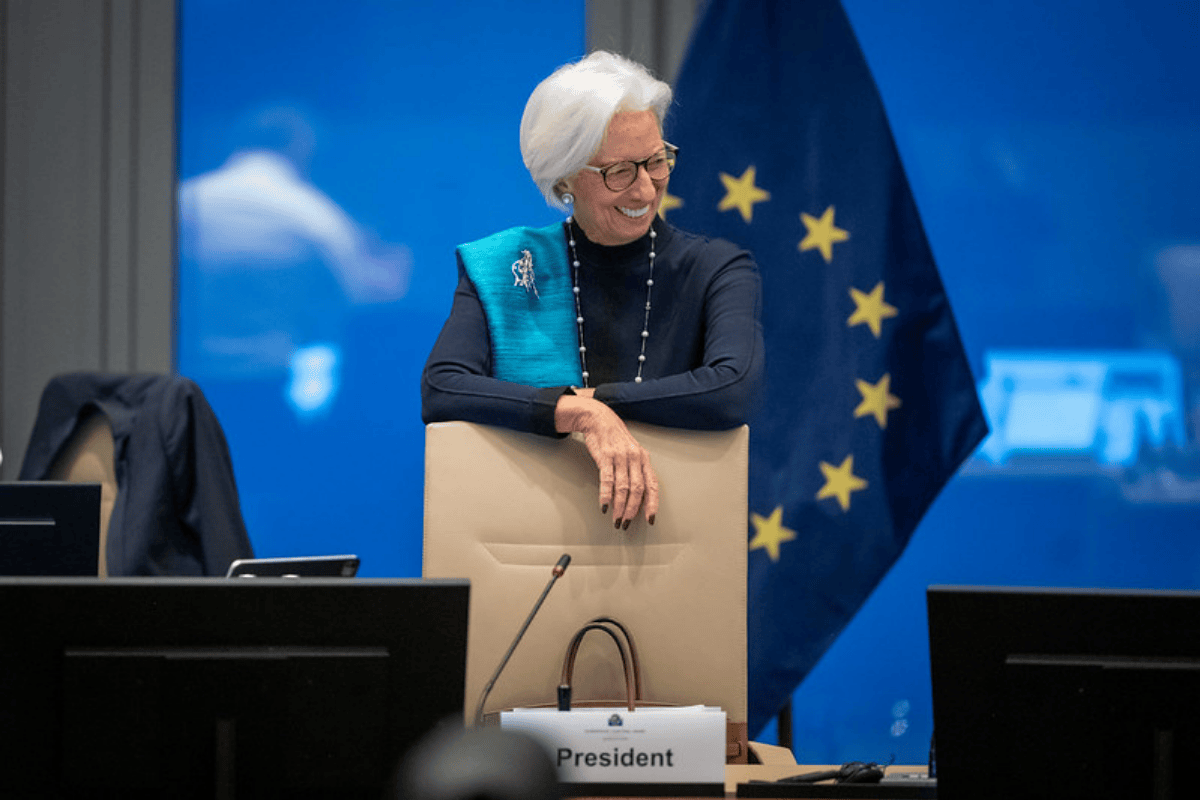
Christine Lagarde, President of the European Central Bank (ECB), tendered her resignation today, putting an end to months of speculation regarding her future and coinciding with a period of growing economic volatility and polarized electoral politics in Europe. Lagarde will step down from her post on February 7, nine months before her term officially concludes, granting current European Union leaders time to select her successor.
This decision comes at a moment when the ECB confronts inflation risks stemming from an oil shock triggered by the war in Iran, while a sharp surge in bond yields, particularly in France, threatens to dampen growth. “I leave this institution with the sense of having accomplished good work and that the ECB is prepared for the future,” stated Lagarde, 70, in a brief video shared on social media.
According to Reuters, sources close to the matter stated that Lagarde, a former French finance minister and former managing director of the International Monetary Fund, resigned to engage in political affairs both in France and globally. As ECB President, she was expected to maintain neutrality to protect the institution’s independence. Lagarde herself has not commented directly on these matters. The news agency notes that she has previously stated she would not run as a candidate for the French presidency, but would defend pro-European values in her home country “from whatever position” she deemed most effective.
European Council President António Costa stated that the process to select Lagarde’s successor will commence immediately. This appointment is likely to form part of a broader package of senior leadership roles at the ECB, including the Executive Board seat held by Isabel Schnabel, who will step down in early January, and that of Chief Economist Philip Lane, whose departure is scheduled for May. Former central bank governors of the Netherlands and Spain, Klaas Knot and Pablo Hernández de Cos, are widely regarded as the leading candidates to succeed Lagarde.
Expert commentary
Lale Akoner, Global Market Strategist at eToro, noted that Lagarde’s departure “adds uncertainty at an inopportune time,” with inflation running high and French sovereign bonds under pressure. However, she acknowledged that the muted initial market reaction suggests investors anticipate policy continuity rather than an abrupt shift in direction. She also considers the succession meaningful both for interest rates and for the ECB’s response to bond market strains. “Knot could be perceived as favoring a more restrictive policy and a higher intervention threshold; meanwhile, De Cos could be viewed as more willing to act. These perceptions could influence the euro and French bond spreads, although neither candidate decides monetary policy alone,” Akoner concluded.
For his part, Matthew Ryan, Head of Market Strategy at Ebury, agreed that the timing is far from ideal for the ECB, as “it comes against a backdrop where the war in Iran keeps inflation well above the central bank’s target, a situation likely to persist for some time.” Furthermore, he emphasized that European debt markets are also experiencing acute strains, with the yield spread between French and German bonds reaching its highest level since 2011.
He likewise considers Klaas Knot and Pablo Hernández de Cos to be the front-runners to succeed her. He views Knot as favoring tighter monetary policy that would likely bolster expectations of further interest rate hikes, potentially supporting euro appreciation. Meanwhile, he regards Hernández de Cos as possessing a more dovish monetary profile, likely placing greater weight on economic growth and debt market stability, “a consideration particularly relevant amid severe pressures on French sovereign debt.” Even so, he does not foresee the transition in the ECB presidency altering the near-term interest rate path, noting that while the president sets the institutional agenda, “ultimately their vote is just one within the Governing Council and rarely overrides consensus,” though he also acknowledged that a protracted succession process could introduce additional market volatility during a fragile juncture. “Therefore, the sooner the successor is announced, the better,” he concluded.
Meanwhile, Konstantin Veit, portfolio manager at PIMCO, does not rule out that, among the potential replacements, “preference may be given to a centrist candidate who mirrors the inclusive, consensus-driven leadership style demonstrated by Lagarde,” highlighting “the ECB’s steadfast commitment to a framework-based approach, reaffirmed in the 2025 monetary policy assessment, which tends to reduce individual influence.” Given that the reaction function is transparent and unlikely to change, he anticipates no significant investment implications resulting from Lagarde’s departure.
Similarly, Conor Parle, Eurozone Economist at Fidelity International, stated that both Hernández de Cos and Klaas Knot “would bring continuity to the helm of the ECB and are regarded as highly respected voices in economics and central banking.” However, should De Cos or Knot be appointed, he considers it probable that German and French officials would fill the remaining Executive Board seats.