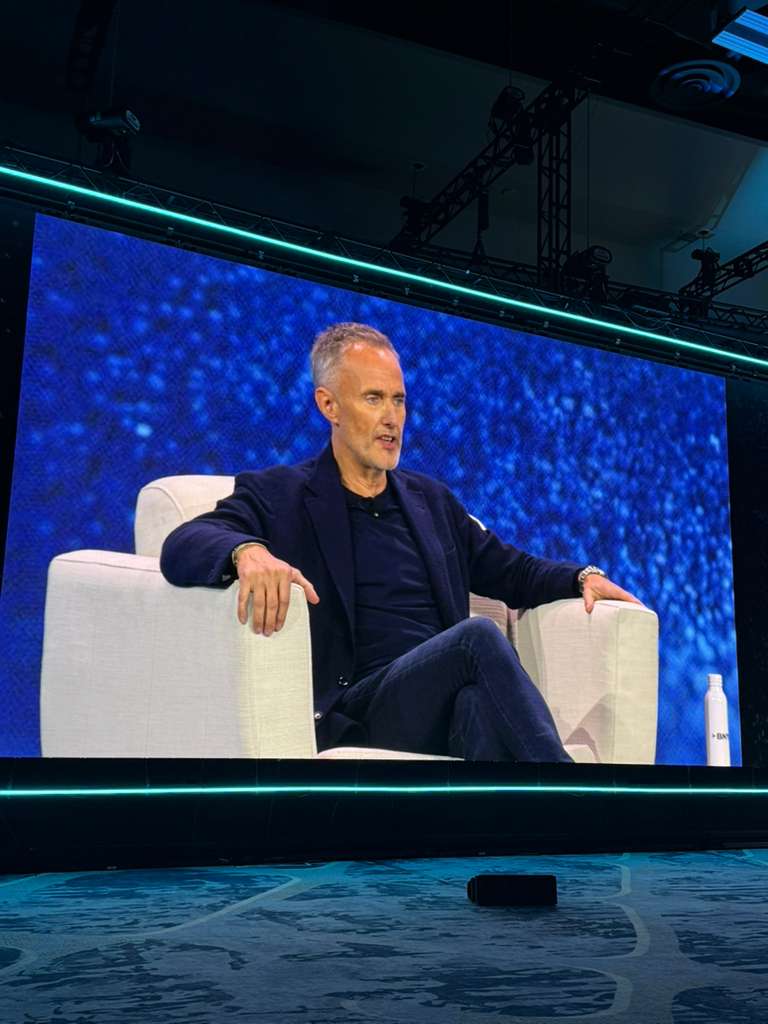
Phil Orlando, Chief Market Strategist at Federated Hermes, opened his presentation at INSITE 2026 with a historical perspective: from Eugene Black in 1933 to Jerome Powell, there have been eleven leadership transitions at the U.S. Federal Reserve, and the market tested every new chair without exception. “The market hits a rough patch, tests the new leader, and then recovers. By the end of the year, the new chair gains credibility,” he said.
The current transition, however, has several unique features that distinguish it from previous ones. The confirmation of the new chair was the closest in recent history, with a vote of 54 in favor and 45 against. In addition, Jerome Powell chose to remain a member of the Board of Governors after his term as chair expired on May 15, something that had happened only once before, with Marriner Eccles in 1948. This creates an unprecedented dynamic, with the outgoing and incoming chairs sitting at the same table. Finally, the meeting at the end of April recorded four dissenting votes, the highest number since 1982. The dissenters’ argument: the Fed should neutralize its bias in light of its dual mandate—inflation and employment—given that the labor market remains strong while inflation continues to exert upward pressure.
Against this backdrop, Orlando highlighted the critical calendar for the coming months: meetings on June 17, July 29, and September 16, with the new Federal Reserve chair’s inaugural speech at Jackson Hole, Wyoming, on August 28 serving as a pivotal moment. “That will be the moment when he presents his vision. We do not know what he will say or do, but the market will be paying very close attention,” he warned. His conclusion: there is a real possibility of turbulence during the summer.
Despite monetary policy uncertainties, Orlando remained constructive on the state of the economy. Combined retail sales growth in March and April reached 4.5% year over year, a result he described as solid. He acknowledged the argument of a bifurcated economy but downplayed it with a straightforward arithmetic exercise: the wealthiest 10% of the population accounts for approximately 50% of consumer spending, while private consumption represents 70% of GDP. Therefore, that top decile accounts for roughly one-third of GDP. “Stock prices are at all-time highs and home values have risen 50% from COVID lows. Sixty percent of Americans own stocks and property. They are doing well, and they are spending,” he explained.
Among lower-income households, recently approved tax reforms generated savings of approximately 18% year over year, enough to offset the impact of higher energy prices for roughly six months.
On the corporate side, Orlando highlighted the full expensing of corporate capital expenditures as the most stimulative element of the recently approved tax legislation. The result: productivity grew 3% over the last four quarters, well above the historical average of nearly 2% over the past five decades. Taking all these factors into account, he projected U.S. GDP growth of around 3% in 2027, significantly above the market consensus of approximately 2%.
On monetary policy, Orlando was direct. The two-year Treasury yield rose from 3.40%—the level at which pressure was mounting on the Fed to cut rates—to 4.10% currently, reflecting the energy supply shock and inflation. Looking at the data objectively, the more likely move would be a rate hike rather than a cut. However, he noted that the Fed typically does not react to temporary supply shocks. “The most likely outcome is that the Fed does nothing and waits for the energy situation and inflation to normalize,” he said.
Overvaluation, Not a Bubble: The Diagnosis and Strategy
Orlando firmly rejected comparisons with the technology bubble of the late 1990s. “These are real companies, with real products, real revenues, real earnings, and real valuations,” he said. Nevertheless, he acknowledged that valuations are ahead of fundamentals: his estimate for the S&P 500 is 20 times expected corporate earnings over the next 12 months, while the current multiple is around 22.5 times, implying that the market is trading roughly 12% to 13% above where it should be.
“Could there be a 10% correction during the summer and early fall? Absolutely. But we are nowhere near the 85% collapse we saw in the Nasdaq between 2000 and 2003,” he added.
In terms of asset allocation, Federated Hermes maintains a six-percentage-point overweight in equities relative to its benchmark—66% in stocks and 34% in bonds and cash—but Orlando was specific about where that exposure should be concentrated. Not in mega-cap technology stocks, which trade at 30 to 40 times earnings, but in sectors trading closer to 14 or 15 times earnings: domestic large caps, small caps, and emerging markets. These sectors also offer dividend yields of between 3% and 5%.
“If technology falls 20% or 30%, those sectors might decline only 5%, partially offset by dividends. The key is to stay invested but remain focused on valuation,” he summarized. In fixed income, he noted that the bond market has reacted more clearly than equities to the rebound in inflation: the yield on the 10-year Treasury rose from around 4.33% to nearly 4.70%.
The Election Cycle: The Dip That Is Always an Opportunity
To conclude, Orlando placed the current environment in historical perspective. Over the last 80 years of S&P 500 history, the two middle quarters of the U.S. midterm election year have historically been the weakest, partly because the party in power typically loses seats. This year also combines a Fed leadership transition with a midterm election cycle, a combination that has occurred only six times in the last 93 years and has always been accompanied by a market pullback of roughly 10% during the middle of the year.
But that weakness has also consistently represented a buying opportunity: from the market bottom in those years, equities went on to post sustained gains over the following two and a half years. “If I am right and there is a dip over the next quarter or two, that will be the time to buy with conviction. I believe we will be back at all-time highs before year-end,” he concluded.