
While much of the industry conversation revolves around artificial intelligence, tokenization, or the growth of private markets, a far deeper transformation is receiving less attention. It isn’t happening in investment products, but in the business model of asset management firms.
For years, an asset manager’s growth followed a relatively clear logic: develop a differentiated strategy, structure the right investment vehicle, and distribute it among target investors. That model drove the industry’s growth for decades.
However, today’s environment presents different challenges.
The Global Asset Management Report 2026 from Boston Consulting Group (BCG) shows that global assets under management reached a record high of USD 147 trillion in 2025. But the most relevant finding in the report isn’t the size of the market. It’s the shift in the nature of competition. BCG notes that a significant portion of the industry’s recent growth has been driven by financial market performance, while organic growth remains one of the main challenges for asset managers. As a result, the ability to develop new distribution channels, improve operational efficiency, and adapt business models will be a decisive factor for growth in the years ahead.
Global assets under management (AuM)
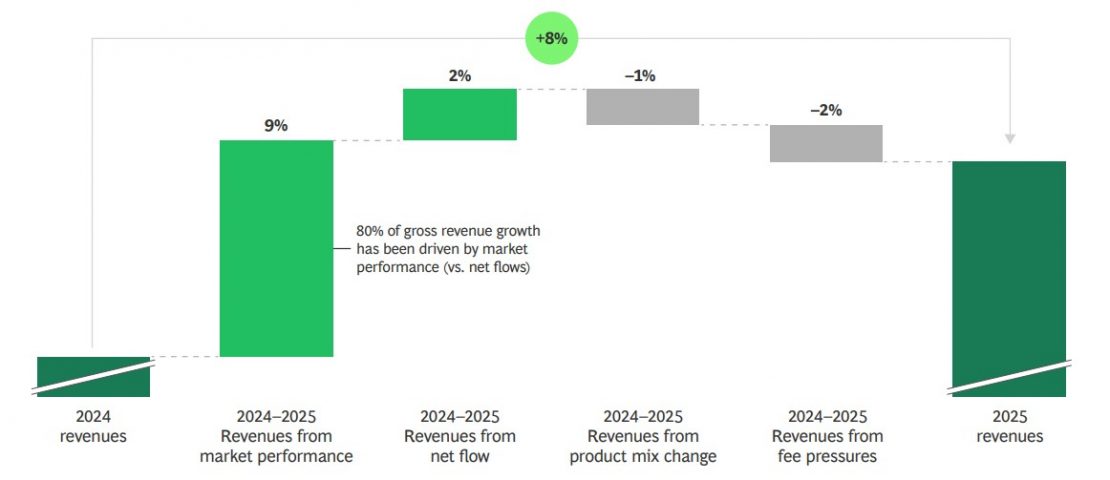
Source: Boston Consulting Group, Global Asset Management Report 2026.
This shift has an immediate consequence: The conversation is no longer centered exclusively on investment products, but on the capabilities that allow asset managers to grow, adapt, and compete in an increasingly complex environment.
Evolution of asset managers’ business model
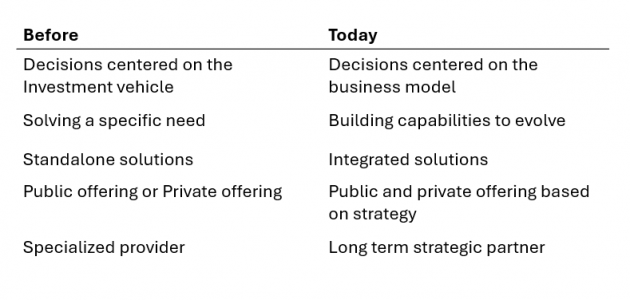
This shift explains why the questions asset managers ask today are different. It’s no longer enough to identify the most suitable vehicle to launch a strategy. The real challenge lies in building organizations capable of adapting as markets, investor needs, and distribution channels evolve.
The same strategy can start through a private offering vehicle, later expand its international reach, or evolve toward public offering structures as its commercial or regulatory objectives change. The strategic decision is no longer the vehicle itself, but the ability to evolve without having to rebuild the operating model at each stage.
This transformation aligns with what McKinsey calls the “great convergence” of asset management. In its analysis, the firm explains that traditional boundaries between different management models are blurring, and that asset managers are demanding increasingly integrated capabilities to respond to an environment where specialization coexists with the need for greater flexibility, efficiency, and international reach.
Convergence” between traditional and alternative management
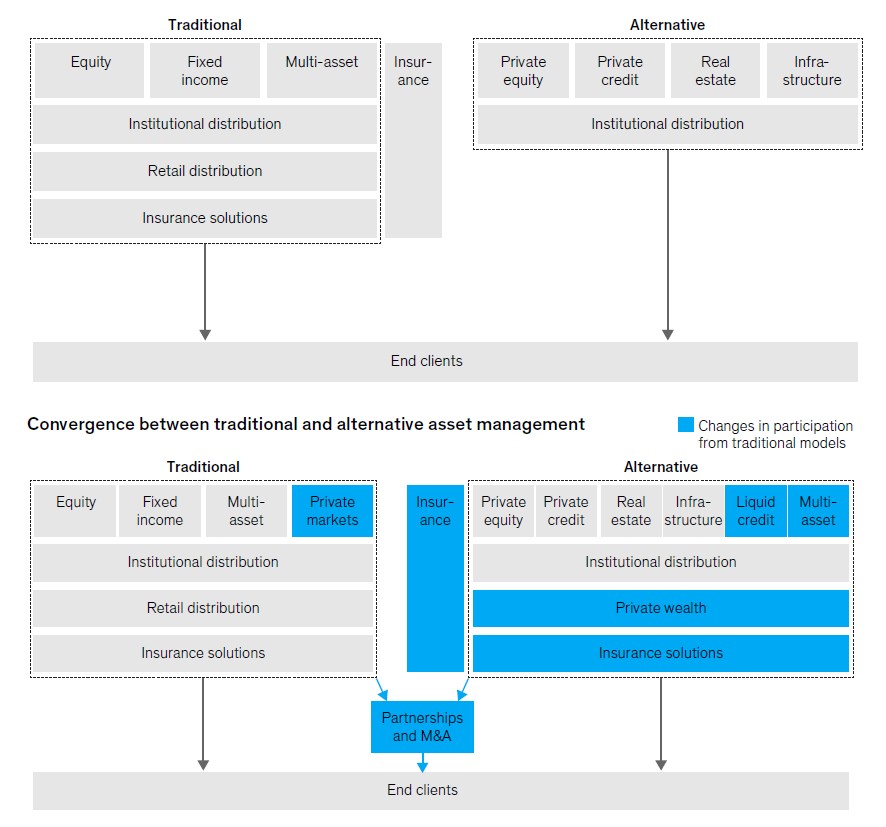
Source: McKinsey & Company, Asset Management 2025: The Great Convergence
More than a convergence between public and private markets, we’re witnessing a convergence in how asset management firms are built. Managers need operating models ready to incorporate different investment vehicles, respond to different jurisdictions, and adapt with agility as strategies and markets evolve.
This shift also explains why the industry is evolving from specialized providers toward platforms with broader, more integrated capabilities. Demand is no longer focused solely on solving a specific need, but on having partners capable of supporting a strategy’s development throughout its entire lifecycle.
The evolution of asset management shows that the challenge for asset managers is no longer just about developing better investment strategies. The real challenge lies in building business models capable of adapting with agility to new markets, different investor profiles, and increasingly global distribution channels. In this context, the ability to combine different investment vehicles within a single strategy is no longer just an operational advantage. It has become a competitive one.
Responding to this transformation requires platforms capable of integrating different capabilities within a single operating infrastructure. With that vision, FlexFunds, together with Leverage Shares and Themes ETFs, has developed a global end-to-end solutions platform that integrates:
- Public and private offering investment vehicles
- ETPs listed in Europe
- ETFs listed on Nasdaq
- Institutional reporting capabilities.
This gives managers, advisors, and institutions access to a more efficient, scalable infrastructure aligned with international market standards, supporting the evolution of their investment strategies.
For more information, please contact our experts at info@flexfunds.com