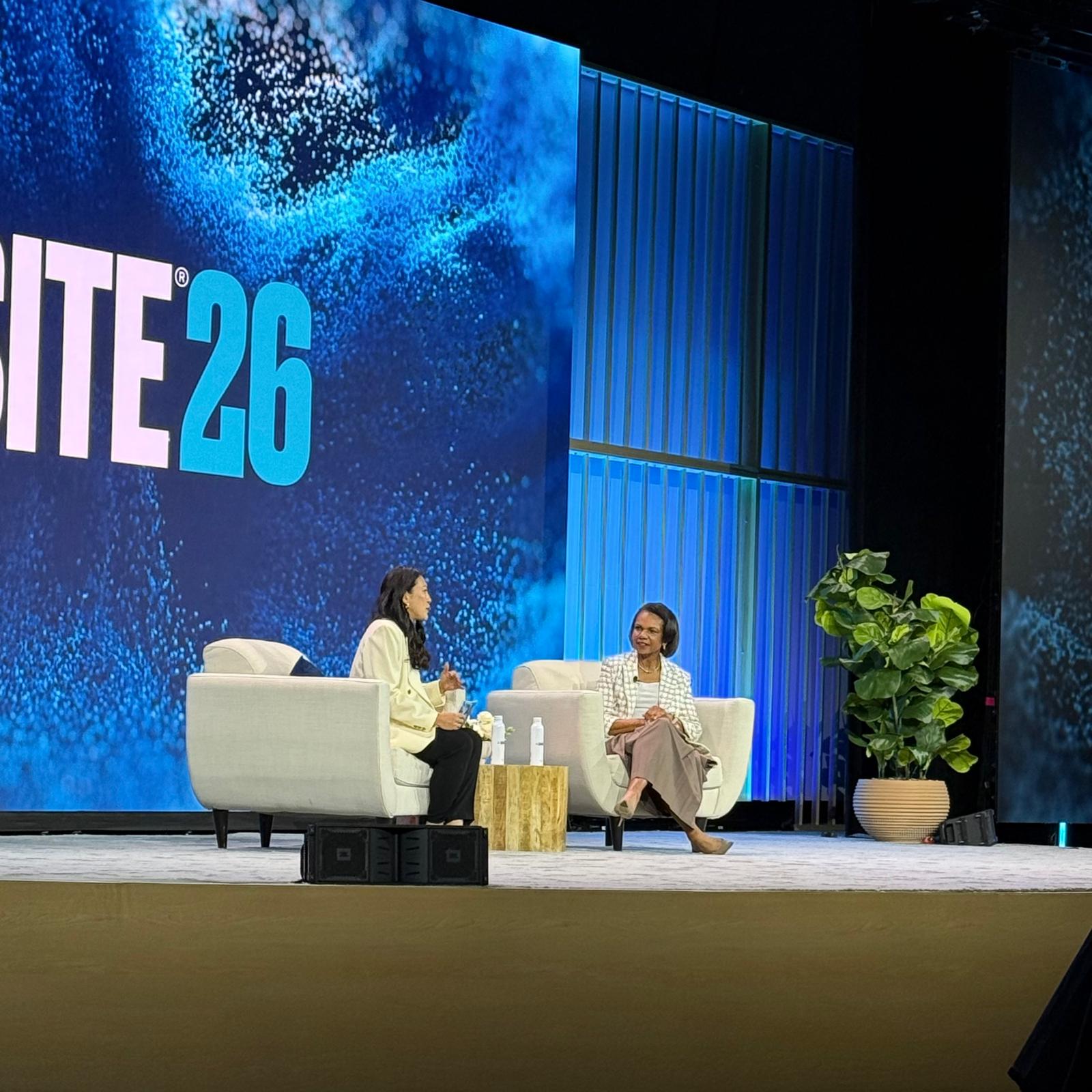
Former U.S. Secretary of State Condoleezza Rice argued that the world is undergoing a profound transition away from the international order built after World War II, and that artificial intelligence (AI) represents the greatest technological disruption within that reconfiguration. Rice spoke before financial industry executives at INSITE 2026, an event organized by BNY, where she analyzed the new geopolitical landscape, the risks facing the West from China’s technological advances, and the challenges AI poses for education and institutional leadership.
“For nearly 80 years, we had a system that progressively moved toward an international economy that was not zero-sum. My growth did not come at your expense,” said Rice. That system, she argued, is breaking down, driven in part by the inability to integrate China as a cooperative actor within the global order.
Rice noted that Xi Jinping stated in 2015 that China would surpass the United States in frontier technologies such as AI, and that since then the Asian country has behaved more like a challenger to the system than a participant in it. Added to this is a domestic backlash in the United States against 80 years of globalization, with broad segments of the population who did not benefit from the model now calling for manufacturing to return home. “There is a recalibration underway, and we are somewhere in the middle of that recalibration,” she said.
On artificial intelligence, Rice was direct: it is a two-horse race, and she wants a democracy to win it. Her argument is not only technological but also political. It will never be possible to predict all the problems AI will create or all of its power, she warned, which is why it is preferable for its development to occur in an open society, with investigative journalism and institutional checks and balances. Regarding China, she was categorical: it will manage AI very differently from a democracy, just as it did with COVID, hiding problems and lying about them.
The former official acknowledged that the United States holds an advantage in cutting-edge innovation, partly thanks to restrictions on exports of advanced chips to China. But she warned: “We make a mistake if we believe everything China does is simply copying.” As an example, she cited DeepSeek, the Chinese AI model that shook the sector at the beginning of 2025. All national security experts were stunned, she said, but no AI scientist was surprised because “they were reading the academic papers.” Rice also emphasized that none of the company’s scientists studied outside China, revealing the strength of its domestic research ecosystem.
She identified two areas where China has an advantage over the United States: the speed of AI adoption and the global spread of its low-cost, open-source models, which are expanding worldwide more rapidly than American models. In light of this, Rice called for preserving the U.S. innovation ecosystem and advocated minimal regulation. She proposed a framework aligning the interests of major infrastructure providers, frontier-model developers, and the federal government in order to avoid what she described as “an AI 9/11,” without slowing innovation.
The debate over AI has also reached the classroom. Rice, a professor at Stanford University, argued that students must learn how to use AI agents with judgment: as assistants to critical thinking, not substitutes for it. If the agent does all the work, the brain stops exercising itself, she warned. She cited a recent article documenting how instant access to information reduces the practice of analytical thinking: where someone once tried to remember the date of the Crimean War, they now simply perform a search. Rice said this phenomenon will force a rethinking of teaching methods and the way organizations train their employees.
Rice also warned about a troubling domestic trend: Americans are more skeptical of AI than any other population in the developed world. She attributed this skepticism to the prevailing narrative that technology will destroy jobs, increase energy consumption, and threaten people. “With that narrative around AI, is it any surprise that people are nervous about such a powerful technology?” she asked. To illustrate the point, she recounted the story of an 11-year-old daughter of a friend who was remarkably polite to her chatbot. When her father pointed out that it was only a program, the girl replied: “When they come for us, I’ll be on the list of people who were nice to it.”
At the conclusion of her remarks, Rice described AI, robotics, synthetic biology, and space exploration as “civilizational technologies.” If future generations can look back and say these technologies were managed wisely, given their immense power, then humanity will have met the greatest challenge of its time, she argued. The former U.S. official also warned that the answer is not to lay off workers and replace them with agents, but rather to explore combinations that enable greater productivity with the same number of people, enhanced by AI tools.