Global financial assets reached a record €268.4 trillion in 2025, marking an 8.6% increase despite a complex economic and geopolitical landscape, according to the 17th edition of the Allianz Global Wealth Report, which tracks household assets and liabilities across nearly 60 countries.
Wealth creation effectively ran on “autopilot,” driven primarily by equity markets—which accounted for 4 out of every 5 euros of added wealth—while net savings dropped 5.4% to €4.1 trillion. However, inflation significantly tempers this record: while nominal financial assets have expanded by nearly 50% since 2019, real growth stands at just 23%, leaving real purchasing power barely 5% above its 2021 levels.
“Global wealth reached another record in 2025, but that is only half the story. Since 2019, nominal financial assets have grown by 50%, but in real terms, adjusted for inflation, they have grown by only 23%. The situation is worse in Western Europe, where financial assets in real terms are up just 0.5% compared to 2019. That compares to 21% in North America and 70% in China,” noted Ludovic Subran, Chief Economist and Chief Investment Officer at Allianz.
Portfolio Asset Allocation Makes the Difference
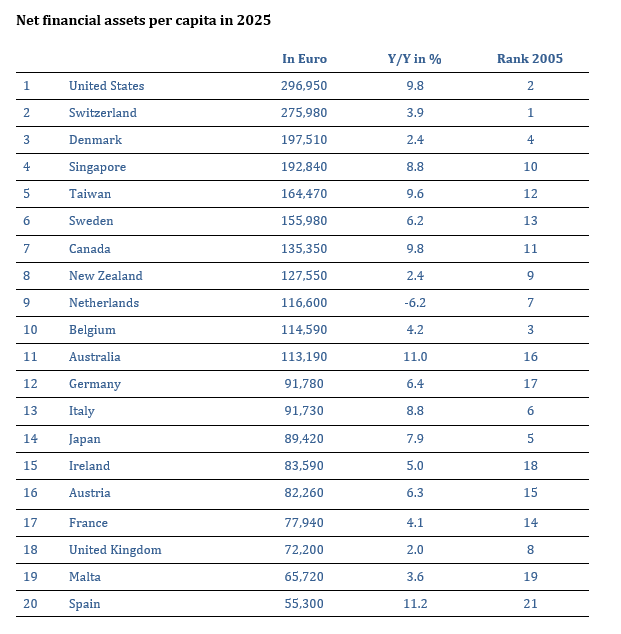
Developments in 2025 underscored the growing importance of household asset allocation. On a global scale, securities increased by 12.4%—more than double the growth rate of bank deposits (5.7%) or insurance and pensions (5.0%)—pushing securities to an all-time high of 46.9% of global financial assets. North American households, with 60.7% of their portfolios invested in securities, benefited the most from market performance, generating 51.4% of total global wealth growth.
This structural difference becomes even more pronounced over the long term: over the past decade, asset appreciation accounted for 71% of total financial asset growth in North America, compared to just 36% in Western Europe, illustrating the long-term impact of investing capital versus keeping savings in low-interest bank accounts.
AI as the Next Driver of Wealth—and New Vulnerabilities
Allianz Research estimates that global financial assets could grow by roughly 9% in 2026. Over the medium term, however, the backdrop becomes increasingly challenging due to slower economic growth, persistent inflation, global economic fragmentation, and elevated sovereign debt levels. In this environment, artificial intelligence could emerge as a decisive catalyst for the next phase of wealth creation. “Productivity and profitability gains associated with this technology could support asset returns, though growing reliance on markets driven by AI expectations also introduces new vulnerabilities,” the report states.
The firm notes that with the S&P 500 up nearly 95% since late 2022, a significant portion of recent wealth expansion relies on elevated valuations and AI-driven expectations. According to calculations by Allianz Research, a 25% correction in the S&P 500 could wipe out approximately $27 trillion in U.S. household wealth during the year of impact—equivalent to nearly 14% of their total net worth. Such a pullback would drag on consumer confidence and spending, tipping the U.S. economy into recession.
Furthermore, the advancement of AI raises distributional questions regarding who participates in the wealth generated by this transition. “AI could become the next major driver of wealth, but the key question is who will hold a stake in it. As AI potentially shifts more value creation toward capital, broader participation in capital returns alongside policies supporting worker adaptation will be essential to ensure the AI wealth dividend is shared more widely,” stated Katharina Utermöhl, Head of Thematic and Policy Research at Allianz Research.