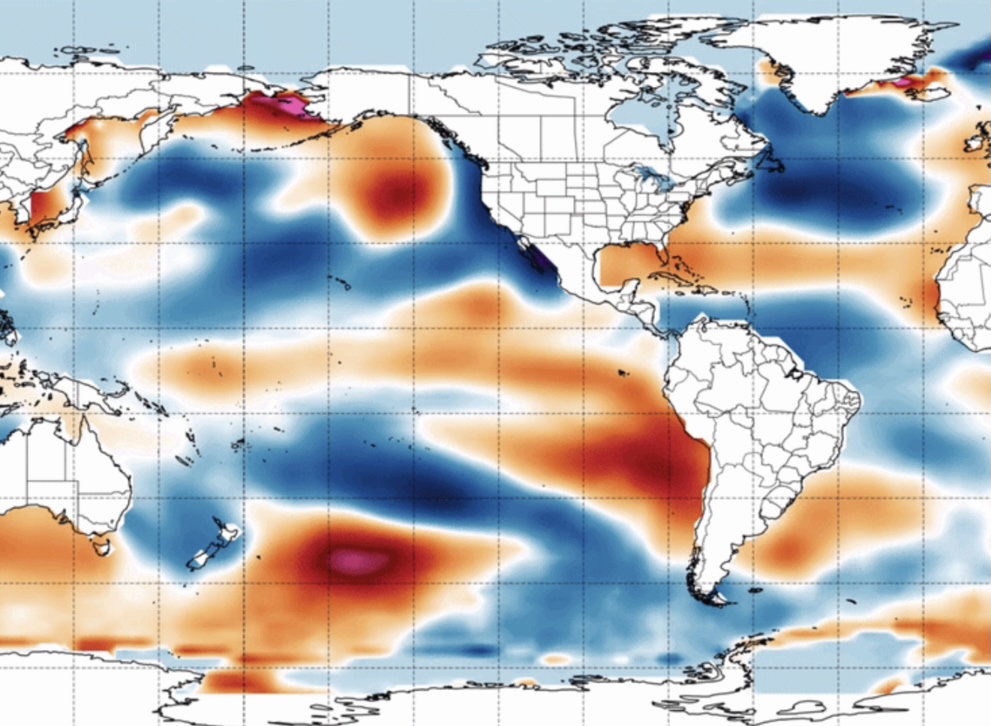
With anxieties over a strong version of the El Niño phenomenon confirmed, markets are preparing to deal with the economic impacts across Latin American countries. The consensus is that there will be widespread consequences due to the disruption of markets such as energy and agriculture, but also areas where opportunities could arise. Furthermore, financial sector actors point out that not all countries in the region experience this climate phenomenon in the same way or with the same intensity.
United Nations analyses warn of an El Niño of historic magnitude. Estimates from the National Oceanic and Atmospheric Administration (NOAA) assign a probability of over 90% that the phenomenon will reach a very high intensity during the northern autumn-winter period (spring-summer in the Southern Hemisphere). What’s more, they place the probability of it reaching a historic level—the so-called Super El Niño—at 69%.
Economic impacts are going to be deeply heterogeneous and persistent, according to comments by the Economic Commission for Latin America and the Caribbean (ECLAC) in a recent report. The entity anticipates a real GDP contraction, inflationary pressures, poverty, and critical vulnerability in key sectors such as energy, fishing, agriculture, and certain infrastructure.
Neuberger shares the view that the ocean warming phenomenon can have “substantial” consequences. Disruptions in agricultural production, food security, and power generation can feed inflation, against a backdrop where consumer prices are already trending upward with the jump in oil and the prolonged conflict in the Middle East.
A Second Phase of the Phenomenon
“It is expected to have an impact in two phases. The first has already been taking place this year,” says Jorge Espada, co-founder and Managing Partner at Valoro Capital. The first relates to the warming of waters and climate, mainly affecting primary activities.
In the case of Peru—one of the countries that tends to be most affected by El Niño—sectors like fishing were hit, impacting anchovy production, among others, as well as certain crops like mango, both for export and domestic consumption.
Now, concern is linked to the second phase of the phenomenon, a period expected to extend between November of this year and March of next year. “We are watching what could be the second phase, which is expected to be the strongest,” Espada explains. This stretch, associated with heavy rains, could damage infrastructure and cause road closures.
This generates larger losses, he adds, “damaging the economy’s payment chain,” though he also notes that both businesses and the government are taking measures to prepare, especially in specific areas.
All in all, the expectation is that the impact will be widespread. ECLAC calculations point to an extreme El Niño generating a cumulative loss of at least 2% of regional GDP over a three-year period, “half of which will be concentrated in the first year following the climate event.” At the same time, they expect the effect on households could increase poverty in Latin America by up to 4.8 million people toward the end of the decade, compared to a scenario without the climate phenomenon.
Main Effects
“Countries in Latin America and Southeast Asia tend to be among the most exposed. Economies like Peru, Ecuador, Colombia, Indonesia, and the Philippines are particularly sensitive given their exposure to agriculture, fishing, and weather-dependent energy infrastructure,” Neuberger notes. Ecuador, for example, gets 78% of its energy from hydroelectric sources, meaning a severe drought could affect energy supply, driving up prices and impacting growth.
On the other hand, some countries could even benefit, as rainfall patterns could support agriculture and power generation. “Argentina, for example, where agriculture represents around 50% of exported goods, benefits from heavier rains in its agricultural heartland of the Pampas,” the asset manager indicated in a recent market commentary. Paraguay could also benefit on the energy side.
The financial sector could also be affected by El Niño, although “it is still too early to gauge the impact,” as highlighted by JPMorgan. Banco do Brasil, for instance, is seen as the most exposed firm, given that agribusiness is linked to a third of its credit portfolio. However, since clear performance trends in soybeans and corn have not emerged in previous cycles, “it is too early to determine a direction.” For now, they anticipate the company will continue to be impacted.
Among insurers, they identified India’s IRB and Brazil’s BB Seguridade Participações as the most exposed to the climate risk associated with the phenomenon, followed by Porto Seguro, also Brazilian. “We recall that agricultural business insurance primarily protects against production losses, rather than price fluctuations,” they emphasized in a recent report.