Next week the results of the U.S. midterm elections will become known, and while waiting, speculation is mounting regarding the possibility of new coordinated attacks against Iran between the U.S. and Israel. Several Gulf states have reportedly been asked to prepare for a new, brief, and intense offensive against Iran following the legislative elections.
Much like the U.S., Israel also faced an electoral process—its 6th since 2019—with an uncertain outcome: on the eve of the election, neither the Netanyahu bloc nor that of the opposition (Gadi Eisenkot) appeared positioned to secure the 61 seats required for a parliamentary majority. The results confirmed this stalemate, leaving the country facing political deadlock and potentially another election cycle in which Netanyahu could have stronger prospects of forming a coalition government. Although their political agendas differ on how to address the Iranian issue, both agree on the core objective: halting Tehran’s nuclear development.
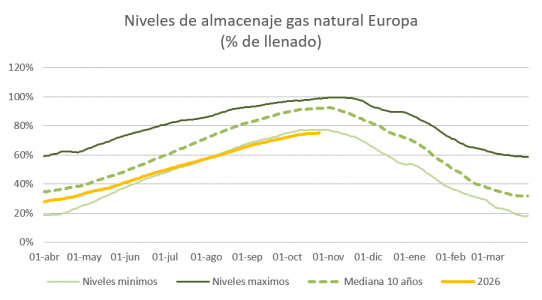
In this context, Brent crude hovers around $115 per barrel, and the futures curve has driven the 12-month forward price from $70 to $89 since July. While crack spreads have compressed since September, higher crude prices will push refining margins upward again. This represents one of the primary risks heading into year-end, particularly for Europe, where macroeconomic surprises are rapidly deteriorating and TTF natural gas prices approach €100/MWh—142% above June lows—just as winter begins and storage inventories sit below historically normal levels (75%, compared to a 5-year average between 86% and 89%). In the U.S., the improvement in consumer confidence is likely fleeting under these conditions, having been built on an approximate 6% drop in retail gasoline prices over the past month.
Equities: a favorable year-end if escalation is avoided
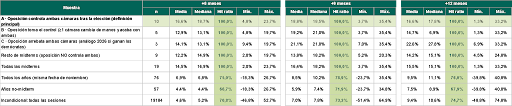
If an attack is limited or does not materialize, the year-end could prove very constructive for equity investors. Despite several headwinds—renewed concerns around AI capex and ROIC, crude oil near $115, a rebound in Treasury yields, and modest widening in credit spreads—the S&P 500 has held very close to record highs, and average historical track records following U.S. midterm elections remain overwhelmingly favorable for equity buyers.
Artificial intelligence: demand outstrips supply, but financing concerns persist
Doubts surrounding the AI trade have resurfaced once again. Rising long-term yields and their implications for funding costs across new data centers, fears over whether revenue will materialize before capital is depleted (and whether return on invested capital will prove sufficient), and competition for limited capital have weighed on tech valuations. Recent examples include capital raising of up to $95B, a $40B financing agreement through an off-balance-sheet vehicle leasing GPUs, and a similar $63B structured facility arranged with major institutional lenders to supply ASICs to Anthropic.
Compute demand continues to outpace supply. This is the clearest takeaway from Q3 earnings from Microsoft, Amazon, and Alphabet, as well as Oracle’s fiscal Q1 results, despite sharp subsequent pullbacks. The market is increasingly shifting focus away from raw technology momentum and adoption velocity toward the economics underpinning that demand, penalizing 3 core factors: return on invested capital (even as ROIC for these firms hovers around 30%), the duration of negative free cash flow profiles, and capex funding structures.
Anthropic’s S-1: real demand, profitability, and an immense compute commitment
The official announcement of Anthropic’s initial public offering and the publication of its S-1 registration statement (containing the prospectus alongside previously non-public operational data) provide a catalyst for renewed market optimism. In response, the Philadelphia Semiconductor Index rebounded off its 200-day moving average support, posting its strongest single-session gain since September. Even CoreWeave found brief relief, despite public commentary questioning the viability of the neocloud business model.
The S-1 filing represents some of the most concrete public evidence to date that enterprise-level AI demand is real. Revenue surged from $41M in 2023 to $16.286B in the first half of 2026, followed by a reported Q3 revenue figure of $16.8B (+45% quarter-over-quarter). Customer concentration is diversifying: clients generating over $100,000 annually expanded from 950 to 11,900 in 1 year, roughly 250 accounts now spend over $10M, net revenue retention hovers around 900%, and the revenue contribution of the top 5 clients declined from 36% to 21% over 2 quarters. Enterprise penetration remains low, suggesting substantial runway ahead, with Fortune 500 customers allocating less than 0.1% of their aggregate spend to Claude.
Crucially, this demand is showing operating leverage. Gross margin—factoring in accounting choices such as expensing model training costs exceeding $60B under R&D—reached 85% for the half-year. Furthermore, compute expenses declined from 2.5 times revenue in early 2025 to 48% in Q2 2026, a period in which the company posted positive GAAP operating income, challenging the narrative that frontier AI operates purely at an economic deficit.
Conversely, the firm is heavily positioned for continued exponential growth, with roughly $855B in total compute commitments, representing approximately 13 times current annualized revenue. These commitments, predominantly non-cancelable, were contracted 12-18 months in advance across cloud and chip suppliers including Google, Amazon, Microsoft, and Broadcom. For hyperscalers, this provides significant order-book visibility; for Anthropic, it introduces substantial operating leverage risk if top-line growth decelerates before absorbing that capacity, alongside enormous upside if projected demand is realized.