
Democrats have secured larger-than-expected majorities in the House of Representatives and the Senate in the U.S. midterm elections. Politically, analysts note that the magnitude of the outcome will carry repercussions for the 2028 primaries across both parties. Looking at the markets, trading opened slightly lower—Eurostoxx futures down 0.2%, S&P down 0.2%, and Nasdaq down 0.3%—against the political backdrop of the U.S. midterm elections, a decisive Democratic victory, and Trump’s low 37% approval rating amid a marked increase in the cost of living.
The election outcome has been described as a major wave sweeping across the U.S. electoral map overnight, flipping historically Republican strongholds including Texas, South Carolina, and Kansas—a shift unseen since 1932. Although vote counting has not fully concluded across all districts, Donald Trump has lost control of both the House of Representatives and the Senate.
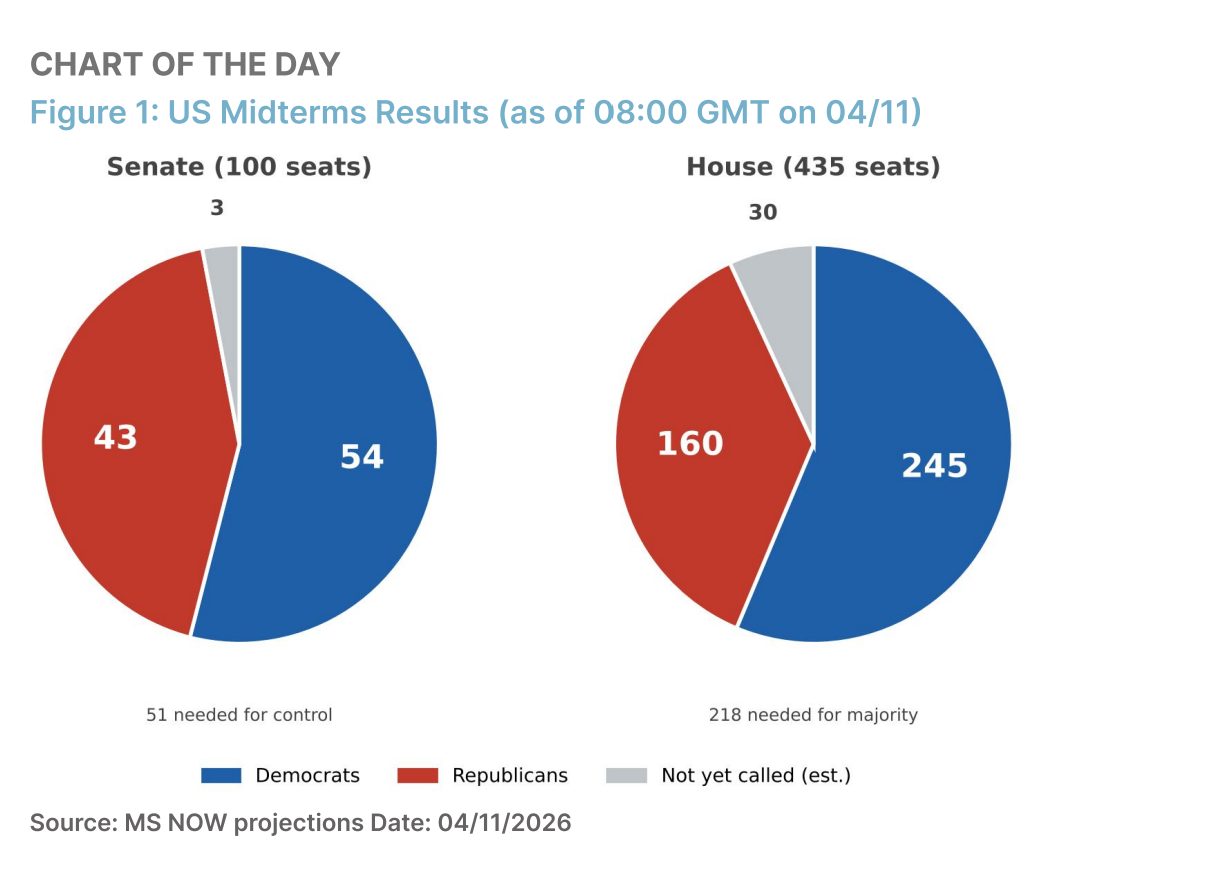
This marks the most severe midterm defeat suffered by an incumbent administration since 1946, though it comes as only a partial surprise given that Trump’s disapproval had reached historic highs amid backlash against his immigration policies, conflicts with institutional norms, and, above all, the military confrontation with Iran. Having campaigned on combating the high cost of living, the administration paradoxically pursued policies that contributed to rising inflation—first through tariff escalation and subsequently by launching a military campaign in Iran. This vulnerability was leveraged by Democrats, who centered their campaign on household purchasing power to reclaim control of Congress.
Political analysis
A Democratic Congress will subject the administration’s policy agenda to heightened oversight, though the president has already signaled readiness to deploy the executive veto against legislative initiatives. The executive branch will retain wide-ranging foreign policy authority, including subsequent operational decisions regarding Iran. The frequent use of executive orders across immigration and trade also constrains the scope of legislative shifts in those areas.
Even so, the sheer scale of the electoral sweep could expand the ambitions of congressional Democrats. Initiatives targeting increased federal oversight of artificial intelligence and data center development, alongside measures promoting clean energy deployment, are widely expected. However, passing statutory legislation will require bipartisan cooperation in the Senate to overcome the filibuster and survive a presidential veto, narrowing the probability of passage.
A fundamental question remains open: whether these midterms reflect a transient voter reaction driven by immediate frustration with administration policies, or structural evidence of a durable realignment in the Democratic electoral map.
More political than market impact
The 2026 midterms carry broader political ramifications than immediate market consequences as Washington transitions from unified Republican control to divided government. Financial markets extensively priced in this outcome across much of 2026, suggesting that the near-term reaction may remain measured.
Regarding Treasuries, divided government does not inherently produce fiscal consolidation. A large share of the fiscal stimulus associated with the One Big Beautiful Bill Act is already in motion, while persistent deficits and heavy debt issuance schedules are likely to keep upward pressure on yields. Simultaneously, AI-related capital expenditure continues to drive capital demand, as hyperscalers and technology firms issue substantial debt to finance infrastructure expansion. At the same time, divided government could ease political pressure on the Federal Reserve, dampening the risk of an overly loose monetary stance.
The most notable market impacts are likely to emerge at the sector level. AI infrastructure and data center operators could face increased bipartisan regulatory scrutiny, potentially weighing on investor sentiment and delaying capital deployment schedules even in the absence of major statutory changes. Financials could see the tailwind of deregulation fade as divided government creates friction around prospective supervisory rollbacks. In housing and residential construction, market activity remains constrained by the spread between current mortgage rates and the low rates locked in by existing homeowners—a structural dislocation unlikely to be resolved through legislative action alone.
Ultimately, these midterms may do little to alter the macro forces driving financial markets. For investors, ongoing fiscal pressures, increasing competition for capital, and targeted sector-level policy shifts will prove far more decisive than the headline election outcome.
The economy, growth, and corporate earnings under divided government
Regarding what the loss of both congressional chambers means for the broader economy and markets, divided control could provide some fiscal restraint by limiting additional discretionary public spending. Conversely, a commanding Democratic performance could introduce headwinds for segments like artificial intelligence through heightened regulatory efforts.
One potential volatility catalyst would involve legal challenges or disputes surrounding election results, given prior rhetoric questioning institutional integrity. A strong Democratic showing could also temper sentiment across mega-cap tech and AI, where legislative scrutiny is expected to intensify. However, divided government serves primarily to rebalance political leverage in Washington, constraining aggressive, highly partisan policy initiatives once the new Congress takes office on January 3, 2027. Market participants also continue to closely monitor developments in the Iranian conflict as a major macro variable.
For asset allocators, congressional composition matters, but the next directional move across assets will remain anchored in GDP growth, inflation dynamics, and benchmark interest rates. Narrower headroom for fiscal stimulus could weigh on headline growth, while renewed debate surrounding corporate taxation and high-earner brackets could introduce sector-specific dispersion. While U.S. equities have historically rallied following midterm elections as political clarity improves, elevated equity valuations and higher baseline bond yields leave less room for a post-election valuation rerating, placing greater emphasis on underlying corporate earnings growth.
Divided government may provide support for Treasuries by restraining unconstrained fiscal expansion, though inflation trajectory and Federal Reserve policy will remain far more influential for fixed-income markets than the electoral outcome itself, with any further spike in energy commodities compounding the inflation outlook.
The dollar’s trajectory
Analysts are focused on what this electoral realignment implies for the greenback. The U.S. dollar has softened moderately following the outcome. The modest currency depreciation reflects limited immediate legislative policy shifts. While heightened regulatory uncertainty may pose mild headwinds, it is countered by the perceived stability of institutional checks and balances. In the near term, restrictive monetary policy settings and secular capital inflows into AI infrastructure continue to underpin the dollar.
A check on expansionary fiscal policy could curb upward pressure on U.S. sovereign debt issuance and Treasury yields, dampening the relative yield appeal of the currency.
However, the election result does not represent a structural trend reversal for the dollar, given that market pricing had already broadly discounted a divided government outcome. Federal Reserve policy, broader U.S. economic resilience, inflation prints, and developments in the war with Iran will remain the primary drivers of the currency’s trajectory. Investor attention is set to pivot quickly back toward incoming macroeconomic data, particularly the upcoming U.S. employment report on Friday.