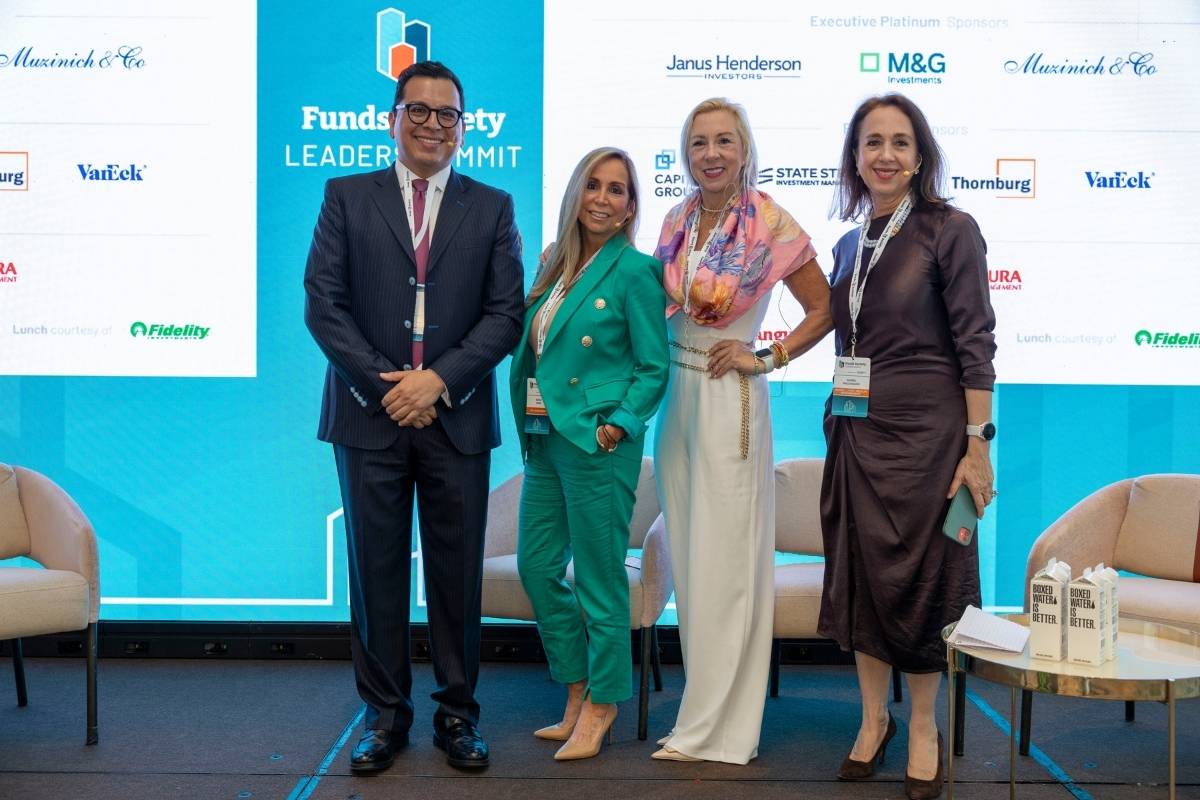
In a context of profound transformation in the wealth management business, the panel “Challenges and Opportunities in Wealth Management” brought together international segment leaders in Miami to analyze the forces reshaping the industry, from regulatory pressures to demographic and technological changes.
Moderated by Luis Arocha, Business Development Manager at Capital Group, the panel stood out not only for the level of experience of its participants—Rocío Harb (IPG), Catherine Lapadula (UBS), and Maribel Maldonado (Merrill Lynch), but also for the consensus around a key point: the business is going through a structural, not cyclical, moment.
From the outset, Arocha framed the conversation within a broader trend: the geographic shift of financial power. “Twenty-five years ago, if you wanted to influence global wealth, you went to New York or Wall Street. Today, many of the key conversations about international capital and cross-border wealth are taking place in Miami,” he stated.
A more complex business: regulation, margins, and technological disruption
Catherine Lapadula, Managing Director and Market Executive International at UBS, outlined a challenging landscape marked by multiple simultaneous fronts. “The challenges are not only related to the market. They are structural, regulatory, and generational,” she noted.
From her perspective, increasing global regulatory pressure—with frameworks such as MiFID II, FATCA, or CRS—has significantly raised operational complexity. “International is not a hobby. It’s like pregnancy: you either are or you aren’t,” she warned, emphasizing that compliance will continue to intensify.
This is compounded by margin compression driven by transparency. “Wealth managers have to justify their fees. Price is the only issue in the absence of value,” she stated, highlighting that differentiation will come from service, advice, and tailored solutions.
Lapadula also pointed to the dual impact of technology: “Fintechs and robo-advisors are both an opportunity and a threat,” although she clarified that the ultra-high-net-worth segment will continue to demand highly personalized advice.
The feminization of wealth and generational transition
One of the panel’s most relevant points was the ongoing demographic shift. “For the first time in history, we have what we will call the feminization of wealth,” Lapadula stated. “Trillions of dollars will change hands over the next 10 to 15 years… and a large portion will go to women.”
The implication for the industry is direct: “If you’re not talking to the wife, the girlfriend, or the daughter, you’re missing out,” she warned, noting that communication and approach must adapt to new wealth decision dynamics.
Talent, compliance, and artificial intelligence
Rocío Harb, Director and Branch Manager at IPG, agreed that regulation remains one of the main challenges, especially in an environment of accelerated technological innovation. “The business evolves and regulation increases, and that is always a challenge,” she explained. In particular, she highlighted the integration of artificial intelligence under strict compliance frameworks: “Incorporating AI into our daily routine while continuing to comply with regulations will be a major challenge.”
This is compounded by competition for talent in a market like Miami. “There are wonderful institutions with talented people. For us, the focus is on ‘white-glove’ service and on growing advisors,” she noted.
AI and the risk of losing the human touch
From a more behavioral perspective, Maribel Maldonado, International Wealth Management Advisor at Merrill Lynch, focused on the client relationship in the era of artificial intelligence. “AI is intelligence on demand,” she said, anticipating more informed and demanding clients. However, she warned of a growing risk: “Dependence on AI is leading to a lack of personal touch.”
In this sense, she emphasized that the advisor’s value is not diluted but redefined: “Nothing is more important to clients than being able to trust you to help them interpret all these changes.”
Miami: from emerging market to structural capital hub
One of the clearest points of consensus was Miami’s role as a new nerve center for international wealth management. Maldonado traced the city’s historical evolution: “Miami went from being a small enclave to a global cosmopolitan center,” and projected that “it will be one of the 20 richest cities in the world in the not-too-distant future.”
Lapadula went further by describing a structural shift: “Miami is not just a trendy city. It is a reorganization of capital. Capital lives here, is managed here, and is capitalized here.”
This phenomenon responds to a “flywheel effect,” she explained: the arrival of wealth drives real estate investment, which attracts more capital and, in turn, wealth managers. “For the first time, firms are coming to where the clients are,” she noted.
Alternatives: from niche to structural component
In terms of investment, the panel highlighted the growth of alternative assets as a key differentiator. Harb explained that IPG bet early on this trend: “Our clients needed something beyond the 60/40 portfolio,” which led to the development of proprietary solutions such as IPG ALTS.
Maldonado reinforced the idea from a structural perspective: “In the United States, there are 200,000 companies and only 5,000 are publicly listed,” making the integration of private markets increasingly logical. She also emphasized the democratization of access: “Minimums have dropped considerably… we are going to see a clear movement in that direction.”
From UBS, Lapadula proposed a balanced “barbell” approach, combining real assets, high-quality fixed income, and private markets, with an emphasis on liquidity in a more volatile environment.
Work-life balance: an evolving challenge
The panel closed by addressing a cross-cutting issue: the balance between personal and professional life, especially in a historically demanding industry. Harb was direct: “Do we really balance? Maybe not,” acknowledging personal sacrifices, especially in early stages.
Lapadula summarized her approach in one phrase: “I delegate tasks, not time,” prioritizing key moments both personally and professionally.
For her part, Maldonado proposed a pragmatic formula based on three decisions: “Deal with it, Delegate it, or Discard it,” also highlighting that technology has expanded the possibilities for balance. The final consensus pointed to a broader cultural shift, where family and work dynamics are evolving toward a more collaborative model. “It’s a team sport,” Lapadula concluded.