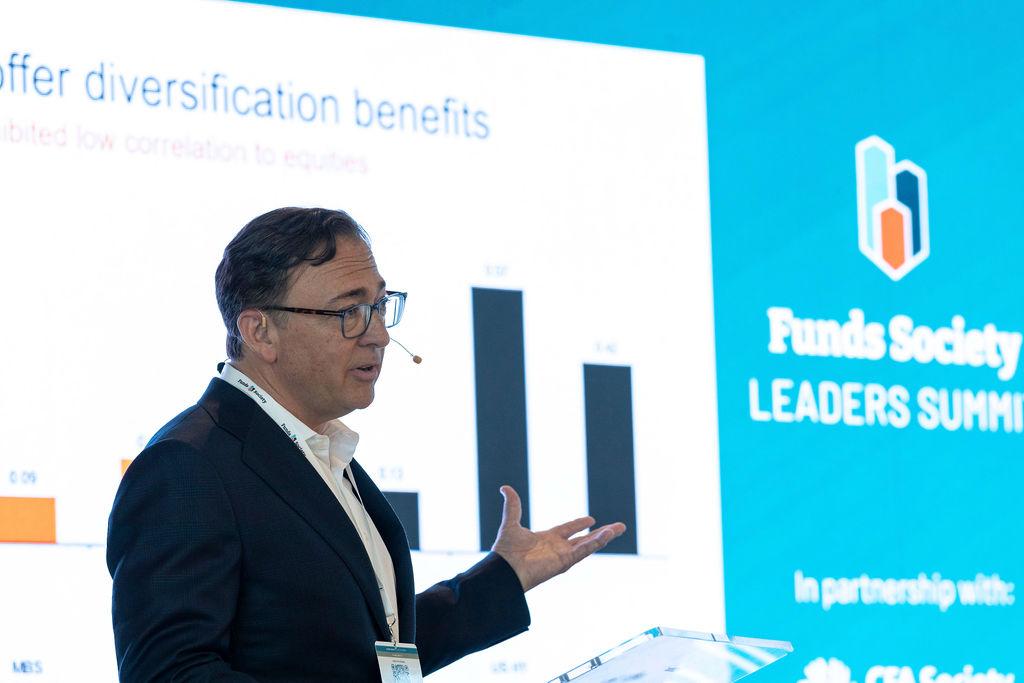
As part of the Leaders Summit, a professional gathering in Miami organized by Funds Society, Dennis Deane, fixed income strategies manager at Janus Henderson Investors since 2025, analyzed two key segments of the securitization market: triple-A CLOs and agency mortgage-backed securities, and outlined a macro scenario without surprises, with a prevailing higher-for-longer environment, in a context of war in the Middle East, concerns about artificial intelligence disruption and its implications for credit.
“We had a higher-for-longer rates stance and that has not changed,” Deane said at the start of his presentation. He also described a landscape where the 10-year Treasury remains stable unless a deep recession emerges: “I find it hard to imagine a scenario in which 10-year yields fall significantly, given the situation with energy prices. Unless, of course, one assumes we are heading into a recession. That is not our view. So the firm’s overall view is a steep yield curve, or at least relatively stable 10-year yields. Obviously, forward expectations for Fed rates have declined significantly,” he noted.
On technological and geopolitical risks, he emphasized that the market tends to overreact: “I have seen very negative artificial intelligence disruption scenarios for credit. They are extreme scenarios. They do not represent the base case. Most base cases foresee only moderate increases in defaults. For investors in triple-A CLOs, that is not really a concern,” he said.
CLOs triple A
The core of the presentation focused on the risk structure of triple-A CLOs. Deane analyzed three aspects: default risk, liquidity, and the likely investor experience. Regarding the safety of triple-A CLOs, he stated: “There has never been a default in this segment, neither before nor after the crisis.” He attributed this resilience to the subordination structure: “To impact a triple-A investor, corporate defaults—adjusted for 30% recoveries—would need to exceed 50%. As a reference, at the worst point in 2009, defaults were only around 10% and the five-year cumulative did not exceed 16.7%,” he said, concluding bluntly: “A 50% scenario would be unprecedented; if it were to occur, the collapse of CLOs would be the least of your problems.”
Regarding the second point, one of the more technical aspects highlighted by the Janus Henderson manager was the behavior of the secondary market. “Average annual volume in CLOs had been around $4 billion. In March, the first two weeks exceeded $10 billion in triple-A tranches alone,” he explained.
This reduced bid-ask spreads and improved market depth even in ETFs: “Markets function well. They worked during Liberation Day and they continue to function,” he said, adding: “Even in 2020, with carry, returns were positive.”
Deane presented a historical series based on a base price of USD 100, without carry. “The red line—triple-A CLOs—remained stable. The low was around USD 95.5 in 2020. With carry, even that year delivered positive returns.” He argued that this stability is explained by three combined factors: ultra-low duration (~0.2), structural seniority, and recurring purchases by banks and insurers during downturns. “When dislocations occur, sophisticated investors step in. That is the natural dynamic of the asset,” he stated.
While some segments of the market seek to position AAA CLOs as cash equivalents, Deane made a professional distinction: “It is not cash. I am uncomfortable calling it a cash alternative. But as an ultra-short duration instrument with high-quality carry, it is entirely appropriate.”
In his presentation, Deane also recalled that, during last summer, reports circulated about alleged irregularities in the origination of auto loans linked to Tricolor Auto Group, a lender specialized in subprime auto credit. That news raised concerns about the integrity of securitized assets in general. To ease concerns, he cited an audit conducted by Fifth Third, lender and collateral reviewer: “They reviewed all the collateral of more than 120,000 auto loans and found two missing chassis numbers. That is the real scale of the issue. It can happen, but it is not widespread.”
Mortgage-Backed Securities: the other end of the portfolio
After the CLO-focused section, Deane moved on to agency MBS, where Janus Henderson Investors manages two core vehicles: the active ETF JAAA and the MBS fund JMBS, with more than USD 7 billion. In this section, he stated: “When you buy a mortgage-backed security, you are buying a bond with a prepayment option. That is based on the fact that implied volatility tends to overestimate realized volatility.” He explained: “The least efficient long-option holder in the world is a homeowner. It takes dozens of calls from the bank and a conversation at a party to decide to refinance. That is the optionality I want to sell.”
The manager also explained that the compression of spreads in 2025 was driven by lower volatility and coupons more aligned with current rates. “Spreads compressed from 145 bps. Then they widened to 125 bps due to geopolitical events. It is a moderate adjustment,” he said. One of the bottlenecks for tighter spreads was the lack of bank demand following the 2022 crisis: “Banks had unrealized losses and their deposits were not growing. That slowed purchases,” he noted.
However, Deane indicated that this dynamic is changing: “With rates declining in the second half of last year, banks are returning. And more favorable risk requirements under Basel III help.”
On agency purchases (~USD 200 billion), he said: “They are not a compression catalyst. They are a ceiling. When spreads widen, they buy. That is their technical role.” He also outlined an ideal rate structure: “A steep curve and an anchored 10-year.”
Deane summarized the optimal setup for MBS as follows: “The curve must be steep. And the 10-year must remain stable. If rates fall too much, mortgages prepay, duration collapses… and you do not capture the Treasury rally.”
Regarding return expectations, he maintained a narrow range: “An 8.6% return like last year is unlikely. But 6%–6.5% is reasonable if volatility normalizes.”
Deane closed with a structural allocation proposal:
- Short end of the curve: “For stable carry, minimal duration, and very high quality, triple-A CLOs are extremely efficient.”
- Long end: “Agency MBS are high-quality assets. The guarantee is implicit, but the market prices it as if it were explicit. And that will not change.”