The World Cup ended just a few weeks ago. Fans celebrated the champion, the cameras stopped rolling, and brands began preparing for the next sports season. From the capital markets’ perspective, however, the most interesting match is just getting started.
What remains once the competition ends isn’t just the sporting results. Broadcasting contracts, sponsorship agreements, brand licenses, commercial rights, and other assets capable of generating income for years to come all remain in place. The relevant question for asset managers and financial institutions is no longer how much money sports move, but what characteristics that income must have to become an asset with value for the capital markets.
The answer marks an important distinction. The market doesn’t finance the excitement a club or tournament generates; it finances the capacity of certain economic rights to produce identifiable, predictable, and legally protected cash flows.
The transformation of sport into a global industry worth hundreds of billions of dollars has been closely tied to the development and protection of intangible assets. The World Intellectual Property Organization (WIPO) notes that trademarks, copyright, and broadcasting rights are essential tools for protecting and commercializing the economic value of sport through licensing, merchandising, and commercial agreements.
This evolution is also reflected in the numbers. The world’s 20 highest-earning football clubs generated a combined €12.4 billion during the 2024/2025 season, according to the 2026 edition of the Deloitte Football Money League. Of that total, €5.3 billion came from commercial activities, €4.7 billion from broadcasting rights, and €2.4 billion from stadium-related revenue.
Figure 1. Distribution of revenue among leading football clubs (2024/2025)
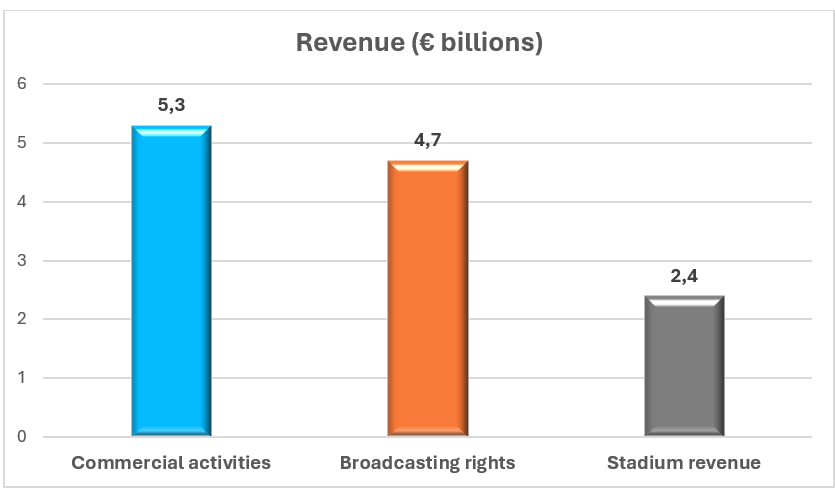
Source: Deloitte Football Money League 2026
Beyond their sheer size, these figures reveal a fundamental point: modern sport has significantly diversified its revenue sources. This diversity doesn’t automatically turn that income into financeable assets, but it does broaden the universe of economic rights worth analyzing from a capital markets perspective.
When a revenue stream becomes a financial asset
From an asset manager’s perspective, the real value doesn’t lie in the stadium, the crest, or a team’s popularity. It lies in the quality of the cash flow.
The methodologies developed by agencies such as Fitch Ratings to evaluate transactions involving sports franchises, leagues, and facilities show that the analysis centers on certain revenue streams’ capacity to support financial obligations.
Broadly speaking, several attributes increase a revenue stream’s appeal for potential financial structuring.
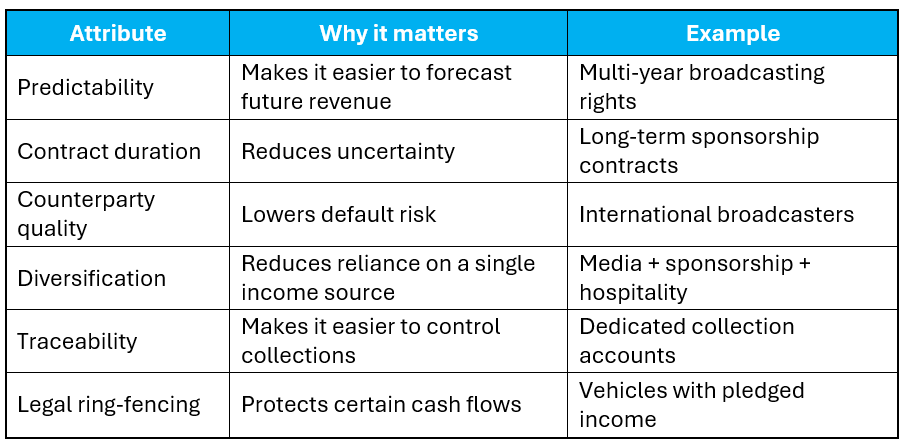
These attributes help explain why two sports organizations with similar revenue levels can have completely different financial profiles. A multi-year broadcasting contract with a high-quality counterparty offers very different stability than income tied exclusively to ticket sales or sporting performance.
The role of asset securitization
This is precisely where securitization becomes relevant.
Far from creating value on its own, asset securitization makes it possible to structure certain economic rights and turn them into financial instruments backed by future cash flows. In other words, it converts income that would be received over time into financing capacity today.
For sports organizations, this can offer an alternative way to finance infrastructure, refinance debt, develop new business lines, or accelerate growth projects without relying exclusively on traditional bank financing.
That said, a transaction’s viability depends less on the organization’s fame and more on the quality of the underlying cash flows, the legal structure, and the protection mechanisms built in for investors.
A practical case: Inter Milan
These concepts stop being theoretical once you see them applied to a real transaction. One of the most illustrative examples is Inter Media and Communication S.p.A, the company created to manage certain broadcasting and commercial revenue for FC Internazionale Milano.
More than just financing a football club, the transaction shows how certain economic rights can be organized through a structure designed to give investors a clearly identifiable repayment source. In 2017, the company issued €300 million in senior secured notes aimed at institutional investors. It followed up in 2022 with a new issuance of €415 million, with proceeds used mainly to refinance existing debt and strengthen the group’s financial structure.
What makes this transaction interesting isn’t just its size. The structure was backed by identifiable income from broadcasting and sponsorship contracts, managed through specific collection and protection mechanisms for noteholders. This approach partially ring-fenced those cashflows from the rest of the club’s operating activity and gave investors greater visibility into the repayment source.
The case shows that the capital markets don’t simply finance a prestigious sports brand. They finance structures backed by economic rights whose stability and traceability can be objectively analyzed.
A lesson that goes beyond sport
The sports industry is an excellent laboratory for understanding a broader capital markets trend.
Increasingly, economic value is concentrated in intangible assets capable of generating recurring income: content, intellectual property, commercial contracts, or exploitation rights. Securitization offers a tool for channeling part of that value into the capital markets through structures designed to turn future cashflows into financing today.
Sport illustrates this shift with particular clarity. Not because it’s an exceptional industry, but because it shows how markets no longer look only at physical assets, but at the capacity of certain economic rights to produce stable, structurable cashflows.
The World Cup may be over, but it leaves behind a lesson that goes beyond sport. As industries generate a growing share of their value from contracts, intellectual property, and other economic rights, the challenge for the capital markets shifts from identifying physical assets to understanding the quality of the cashflows those assets can generate.
In that context, securitization represents much more than a financing alternative. It’s a tool that connects certain income-generating assets with investors seeking identifiable, structured, and transparent cash flows.
Markets don’t invest in the excitement of sport; they invest in the quality of the cashflows that excitement can generate. Perhaps that’s the main financial lesson the World Cup leaves behind: The match ends on the pitch, but the real economic value continues long after the final whistle.
About FlexFunds
For more than 15 years, FlexFunds has worked alongside asset managers and financial institutions to design solutions that facilitate access to the capital markets through investment vehicles built to international distribution standards.
The evolution of industries like sports shows that financial structuring and securitization continue to expand the possibilities for turning certain economic rights into financing and investment solutions. Understanding the nature of the underlying cashflows and selecting the right structure is a key element for the success of this type of transaction.
To learn more about FlexFunds’ asset securitization program, visit www.flexfunds.com or contact our team of specialists.