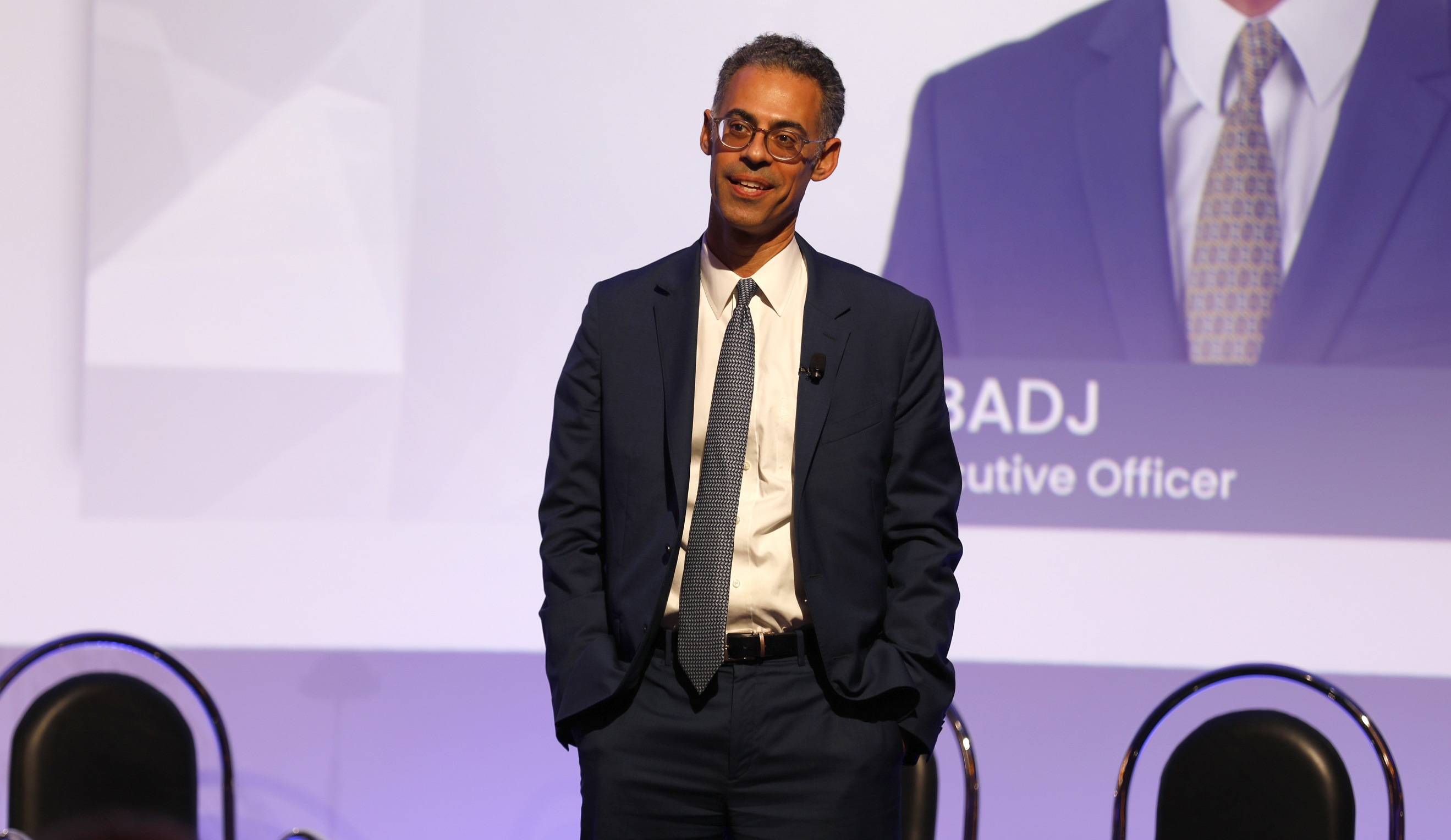
Ali Dibadj, CEO of Janus Henderson, used the opening of the Janus Henderson Investment Summit—the asset manager’s annual event for investors and clients, held in September this year for the first time in Rome, Italy—to highlight three fronts where he believes the firm is more innovative than many realize: active ETFs, tokenized funds, and artificial intelligence. During his presentation, he used the Italian capital as a metaphor for the company itself.
Dibadj asked attendees to explore the firm as they would the Italian city: “I would like you to think of Janus Henderson a bit like Rome, in the sense that we have a foundation that began 92 years ago, upon which we continue to build,” he maintained, adding: “You may know us for one thing, but consider getting to know us for something else as well.”
As he recounted, the firm was founded in 1934 with a single client in the United Kingdom, where it maintains its headquarters, and since then has invested “in things others were not investing in”: the first British railways, the electrification of London, and lightbulbs. Thirty-five years later, it began operating in the United States, where it bet on the first personal computers, the first fiber-optic cables, and later, the internet. “Different, new, and innovative things,” he summarized.
Among the Top Ten in Active ETFs
“We are very innovative in many ways,” Dibadj stated. In exchange-traded funds, he contended that Janus Henderson is one of the top ten active ETF providers in the world and ranks among the top three or four in active fixed-income ETFs.
The CEO framed this positioning within the weight of fixed income in their business, which already accounts for 30% of the total and, as he explained, continues to grow. Along with CLOs and securitized products, it is a area where the firm sees opportunities in an environment of persistent rates and yields. Dibadj also outlined an organic and inorganic growth strategy that includes ETFs, portfolio analysis for clients, private asset distribution, and asset-backed securities, with the goal of finding “differentiated areas” for clients and advisors.
At the same time, he highlighted the manager’s position in tokenized funds: “We are one of the top five providers of tokenized funds worldwide. I bet you didn’t know that about Janus Henderson.” He added: “We believe it is an area of the future where we can be leaders, and we would love for your clients to participate with us.”
Regarding artificial intelligence, Dibadj maintained that the firm relies heavily on it, but with a different approach from the one he believes dominates the sector: “Not just to cut costs, not just to gain productivity, not just what everyone else is saying.” It applies it, he explained, “to deliver for you,” focusing “on client service” and “on better investment performance. That is what matters to you, and that is what matters to us.”
He placed technology among the company’s “core beliefs”: “We believe technology will change absolutely everything and we have to be prepared for that, for you and for your clients.” He added that the attendees’ clients “are asking more of them” and want to work with their teams, and that the manager must support them in that task while its own costs—like those of the entire industry—continue to rise.
A Private Company, with More Room to Invest
To finance these initiatives, Dibadj explained, the firm decided that “as a public company it is harder to do so,” and this year it went private. “We feel a bit less quarterly pressure. We can invest and be creative again, investing with a return for you and for your clients,” he stated. His premise, he said, is simple: “If we deliver for our clients, everything will be fine.”
The CEO maintained that Janus Henderson was the fastest-growing asset manager over the last four years, “faster than many of the other major companies,” attributing this to the attendees and their clients. He added that the company was able to add new people to its teams and provide room to invest in existing staff.
The Context: Three Persistent Trends
According to Dibadj, these strategic bets are supported by trends the firm identified “before they were obvious” and that will remain relevant “for many years to come.”
The first is geopolitical realignments, which the firm began speaking about nearly five years ago: “Not a day goes by without us hearing about instability, deglobalization, broken supply chains.” The second is lifestyle changes, involving AI, aging populations, healthcare, and working arrangements: “How often are people on Zoom calls now, and how much were they ten years ago?”
The third is the return of the cost of capital, something that, he recalled, “four or five years ago people didn’t think would happen.” It implies higher yields and, therefore, more fixed income, but also selection: “When there is no cost of capital, there is no differentiation. That differentiation,” he assured, “will come and happen as rates and yields remain persistent,” creating a divide between the haves and the have-nots.
At the conclusion of his presentation, Dibadj placed the manager at $500 billion in assets under management, with 64 strategies exceeding $1 billion each, 2,000 employees, and 75 million clients worldwide. About 350 people are dedicated exclusively to researching investment strategies, and another 450 focus on client service.
In closing, he referred to the firm’s identity and the “&” symbol: “It is the ‘together’ part. The ‘together’ is you and us. That is how we operate, that is how we think.” Along those lines, he invited attendees to share how the company can improve, “because it is about the &. It is about you.”