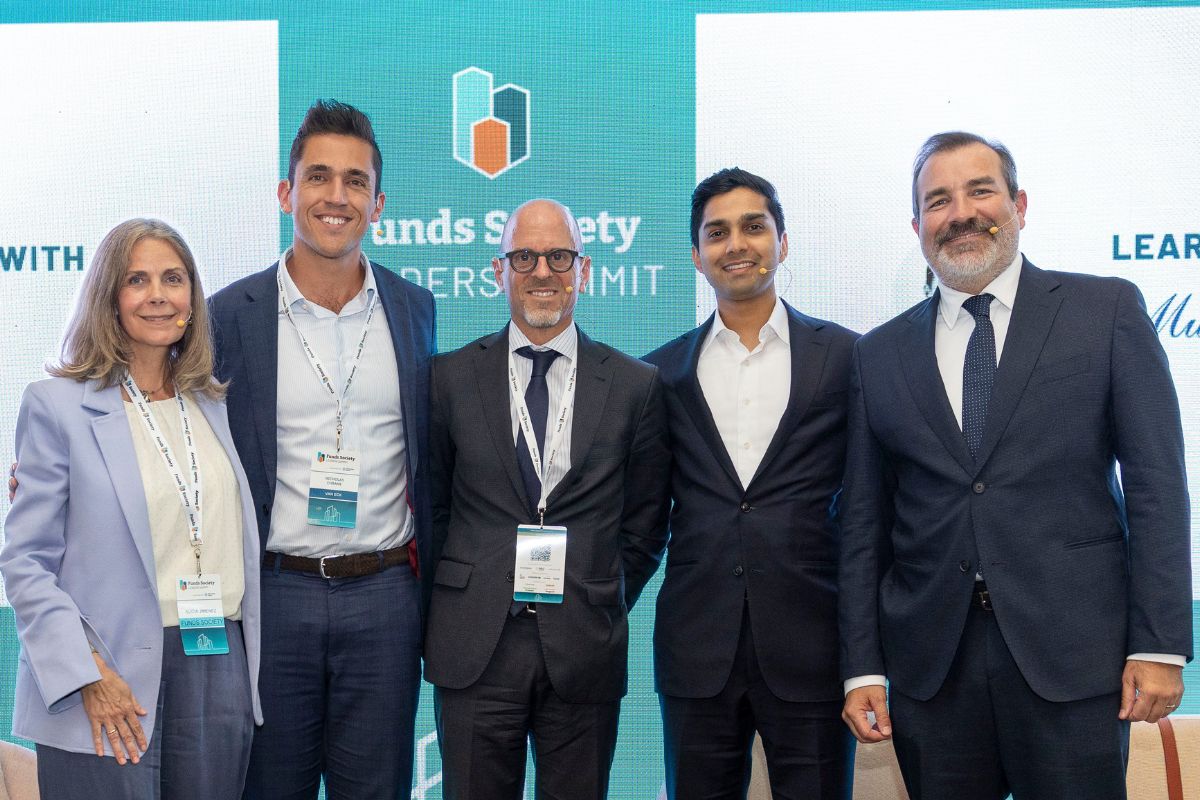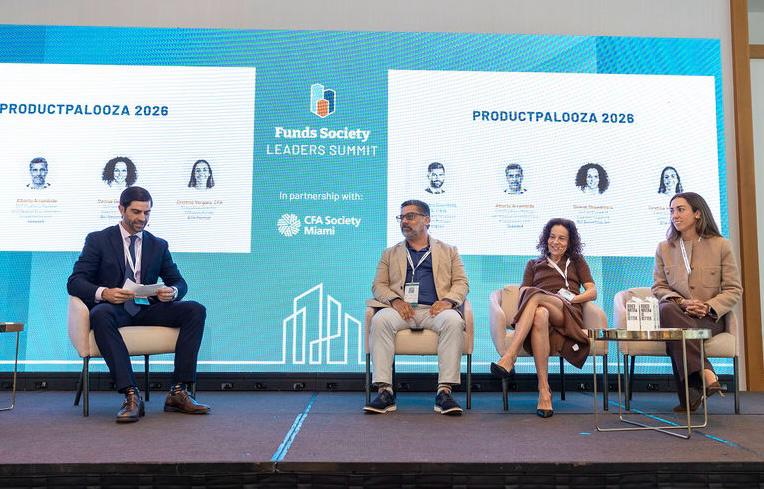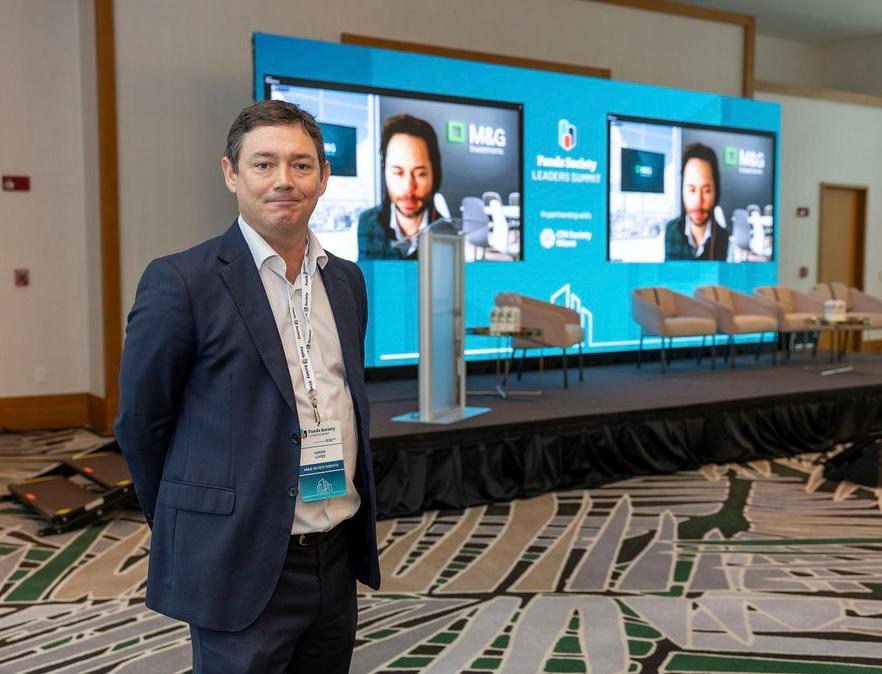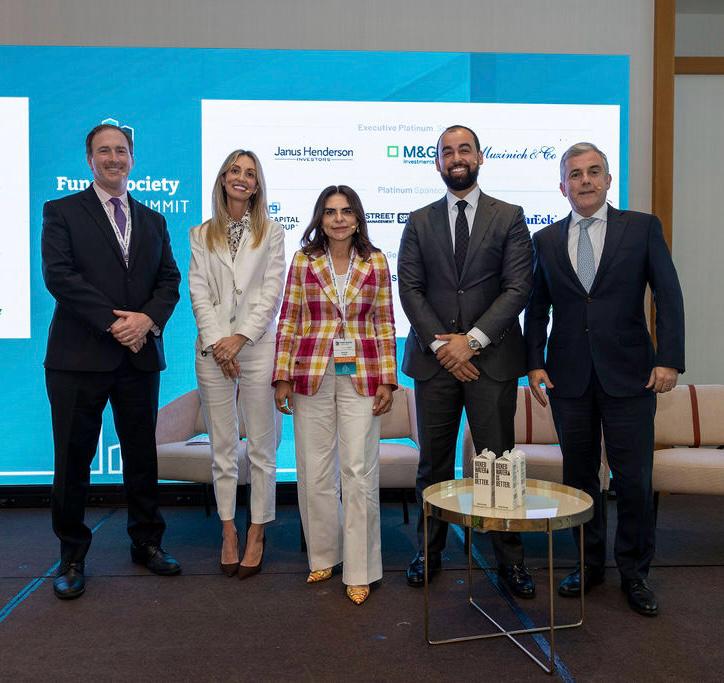
The evolution of international clients, increasing wealth sophistication, pressure on traditional fee models, and the importance of organizational culture shaped the discussion of the panel composed of leaders in the international wealth management business during a specialized industry conference held as part of the first edition of the Funds Society Leaders Summit in collaboration with CFA Society Miami.
The panel was composed of Paula Alvis, Branch Manager at Osnorian Lane; Marlen López, Senior Wealth Advisor at the López Private Wealth Group, part of Excelsis Global Private Wealth; Nicholas Terlonge, Branch Manager at Raymond James; and Jesus Valencia, Director at Florida International Market at UBS.
The session was moderated by Jonathan Schumann, Head of International at Thornburg Investment Management.
During the opening, Schumann noted that the participants are responsible for revenue growth, profitability, regulatory oversight, recruitment, and corporate culture within their organizations, describing them as the “CEOs” of their respective local franchises.
Generational shift and new client priorities
One of the main topics addressed was the transformation of the client base in the global wealth management business.
Marlen López highlighted that, after 25 years in the industry, she observes a significant generational transition within entrepreneurial and high-net-worth families. According to her, younger generations show a greater willingness toward growth and a lower aversion to risk compared to previous generations.
“The previous generation often operated from a mindset of scarcity or fear of losing wealth. Young people today seek growth and are open to different types of investment,” said López.
She added that, to connect with this new client profile, her firm has integrated Artificial Intelligence (AI) tools into daily operations. In particular, she mentioned the use of Jump AI to analyze conversations and gain deeper insight into the wealth objectives of new family generations.
For his part, Jesus Valencia noted that high-net-worth families today are “more global and sophisticated than ever,” with growing demand for holistic advice and institutional capabilities.
Valencia also highlighted two structural trends: the feminization of wealth and the digitalization of financial services. He explained that, to respond to these needs, UBS relies on international specialists in wealth structuring, lending solutions, liquidity management, and family office services.
Nicholas Terlonge agreed that family and wealth structures have become significantly more complex.
“The days of static structures are over,” said the Raymond James executive, noting that it is now common to find structures domiciled in one jurisdiction while beneficiaries live in different parts of the world, requiring greater regulatory and operational flexibility from investment platforms.
Pressure on fees and greater value of advice
In the block dedicated to the economics of the wealth management business, participants agreed that the industry is undergoing a strong transformation driven by fee compression and the growing value of specialized advice.
Jesus Valencia summarized the phenomenon by noting that “beta is getting cheaper while advice is becoming more valuable.”
The UBS executive explained that clients show greater willingness to pay for differentiated and sophisticated offerings, particularly in segments such as private equity, private credit, and real estate, where the advisory component carries greater weight.
“The business is moving away from product and toward relationships,” he stated.
Nicholas Terlonge added that firms today compete for the “same share of client attention,” especially in the offshore market, where U.S. advisors compete directly with local players in investors’ home countries.
He also indicated that there is growing demand for financing and lending solutions, forcing firms to continuously evolve to remain competitive.
Marlen López explained that her practice has shifted toward a predominantly fee-based model, which currently represents 95% of her business. She also noted that they are transitioning from a fixed structure based on assets under management (AUM) to a tiered structure, with the goal of competing more efficiently in the ultra-high-net-worth (UHNW) segment.
Culture and talent as strategic factors
Regarding recruitment and talent development, Paula Alvis stated that corporate culture and authenticity are fundamental elements for attracting the right professionals.
“Talent begins with culture and honesty about who we are,” said the Snowden Lane executive, who emphasized the importance of recognizing support staff and building teams aligned not only with corporate goals but also with human values.
Nicholas Terlonge defined recruitment as a “full-time contact sport” and emphasized that cultural fit should take priority over technical skills.
“I prefer to hire the person and teach the skill,” he said.
He also underscored the importance of supporting professional development from early stages, particularly in operational areas, where small gestures of recognition can have a significant impact on talent retention and motivation.
Recommendations for new generations
When addressing advice for young professionals seeking to enter the global wealth management business, Jesus Valencia recommended developing both technical capabilities and emotional intelligence.
“It is difficult to compete at the highest level without a balance between analysis and emotional quotient,” he said.
He also suggested quickly obtaining regulatory licenses such as the SIE (Securities Industry Essentials) and Series 66 (Uniform Combined State Law Examination), as well as building networks and maintaining patience in an industry he described as meritocratic.
Paula Alvis, for her part, encouraged younger generations to remain authentic, understand all operational processes of the business, and take on new challenges before falling into comfort zones.
Organizational culture as a competitive advantage
In the final part of the panel, participants agreed that internal culture has become a strategic differentiator for wealth management firms.
Marlen López explained that her organization promotes initiatives focused on work-life balance, including annual offsite retreats to strengthen bonds among colleagues.
Nicholas Terlonge stated that culture cannot be “outsourced” to headquarters and must be built daily in each local market. He added that leadership should be reflected in everyday details such as punctuality, professionalism, and closeness to teams.
Jesus Valencia reinforced this idea by noting that leaders must intervene when they detect inappropriate behavior. “What you allow, you promote,” he said.
Finally, Paula Alvis summarized her view by stating that “culture is difficult to explain but easy to feel,” and affirmed that her goal is to build organizations based on human connection and a sense of belonging.