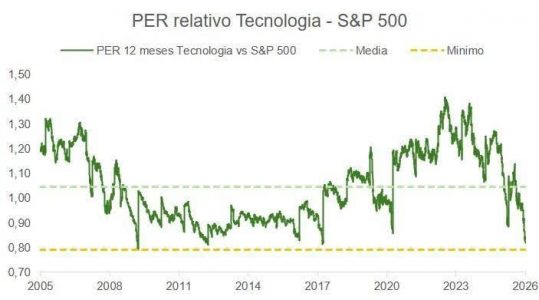
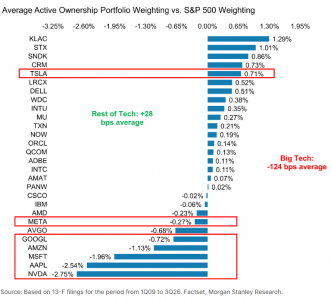
The end of the correction of recent weeks may be near. Renewed doubts about the profitability of massive AI infrastructure investments and their monetization, the Democratic victory in the midterm elections, and Jensen Huang’s rocky departure from Nvidia have resulted in a healthy correction within a market segment that showed excessive investment concentration. After the adjustment, the valuation of the U.S. technology sector relative to the S&P 500 sits near 20-year lows. According to a recent Morgan Stanley report, at the end of the third quarter, and despite excessive concentration in certain component and hardware companies, major names and hyperscalers remained underweight in institutional investors’ portfolios.
More Data Center Regulation After the Elections
As we explained last week, concern over a moratorium on data center construction in states like Texas, Ohio, and Virginia seems exaggerated, although it is likely—given the shared stance of both parties on the matter—that the regulatory framework will tighten and, above all, that a concrete plan will be required to avoid driving up electricity prices. States with Democratic governors will concentrate nearly 80% of planned and under-construction computing capacity.
As the midterm election results have made clear, the priority of U.S. voters in both parties is the rising cost of living and improving purchasing power. Democrats have no interest in a confrontation with major technology companies, nor do they hold the 2/3 majority in Congress needed to override a presidential veto. They will have to respond to promises made to their base with stricter regulation, but they need investment to generate wealth and position themselves ahead of the White House race. They know that a data center’s location depends more on tax facilities and incentives than on latency.
Trump and Republicans, meanwhile, will seek to rebuild political capital ahead of the 2028 presidential election. The president will veto any regulatory proposal or measure that harms U.S. technological leadership against China or could weigh on economic growth. It is worth remembering that investment in software and computer equipment accounts for slightly more than 5% of GDP.
Nvidia Without Huang: Solid Results and Valuation at Lows
As Nvidia Chairman Harvey Jones has explained, Huang’s departure is due to “personal behavior incompatible with the company’s code of conduct, standards, and cultural norms” and not to concerns over the company’s involvement in chip smuggling to China. It has not been proven so far that Alice Huang—a former Megaspeed executive, unrelated to the founder—is a spy, and it seems more likely that the leak of the affair is tied to Marco Rubio’s positioning as a Republican candidate for the 2028 presidential election. The Washington Post, citing a single source familiar with the matter, claims that Marco Rubio drafted a memorandum on Huang’s extramarital relationship based on a CIA report, whose conclusions he reformulated in stronger terms.
SEC or FBI investigations may continue to cap price recovery capacity, but Tuesday’s earnings presentation cleared up relevant financial doubts for fiscal years 2027 and 2028. Colette Kress, interim CEO, though in a more measured tone than her predecessor, also signaled her intention to continue supporting customers and suppliers, with guarantees representing a maximum exposure of $118B and another $32B in commitments to neoclouds—a risk to monitor over the medium term, though not in the short term.
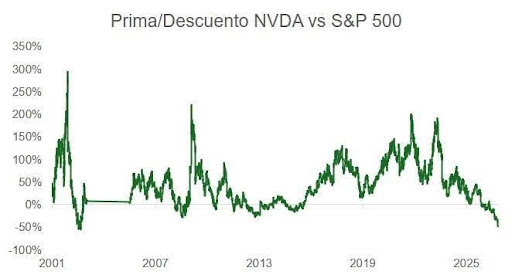
Nvidia’s valuation was attractive before Huang’s departure and is now far more compelling. Its P/E ratio on fiscal 2028 earnings is already in single digits, its discount relative to the S&P 500 stands at levels reached after the bursting of the dot-com bubble, and the stock sits among the cheapest 15% of the MSCI World equity index. Sales grew 103% year-over-year, with gross margins close to 75% (74.8%), although fourth-quarter guidance puts them between 71% and 72% due to the Rubin ramp-up, and management revised upward projected revenue growth for fiscal 2028, from 70% to 75%.
And although the company’s chairman has categorically ruled out Huang’s return, prediction markets still assign around a 35% probability to him returning before the end of 2027.
Implications of Huang’s Departure for AI
For Huang, Nvidia is more powerful when demand is spread out rather than concentrated among hyperscalers. Amazon (AWS) with Trainium and Alphabet (GCP) with its TPUs already offer (or are preparing to offer) their chips to third parties, competing directly with Nvidia. Meta is developing its own. The former CEO and co-founder’s strategy was to facilitate the growth of neoclouds through financing agreements and foster the rise of open AI models. For example, amid accelerator supply bottlenecks, Huang gave supply priority to CoreWeave, committed to purchasing $6.3B in capacity from it over the next 6 years, and invested another $2B in its shares. In the realm of open models, he launched the Nemotron Coalition, publicly argued that banning them would harm U.S. interests, and agreed to buy Hugging Face for $12.9B.
His strategy was working. In its earnings presentation, Nvidia explained that the ACIE segment (AI clouds, industry, and enterprise, which includes neoclouds) rose from 31% to 44% of data center revenue in 1 year, while frontier model labs (OpenAI, Anthropic…) will represent around 15% of data center revenue this year.
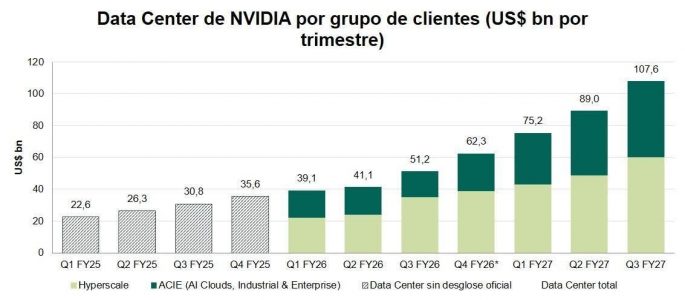
If Colette Kress follows through on her commitment to “remain disciplined and selective” in capital deployment, neoclouds will struggle to grow rapidly and continue taking share from hyperscalers. And if Washington tightens controls on access to chips and advanced computing—the Bureau of Industry and Security (BIS) has just imposed a mandatory license for exports to Indonesia, Malaysia, Singapore, Thailand, and Brazil, in an attempt to cut off China’s access to advanced computing—Amazon, Microsoft, Meta, or Alphabet will gain bargaining power in chip purchases and face less competition in computing supply.
Amazon (holding 14.7% following the IPO, which could reach 23.8% if it converted all its notes) and Alphabet (13.7%) also hold substantial stakes in Anthropic, and major AI labs will temporarily face less pressure from Chinese open models, which are increasingly viewed as insecure in the enterprise sphere.
In a recent study (July 2026), commissioned by Ubicloud and conducted by Superagent, the security of Claude Opus 4.8 was evaluated against 3 open models (DeepSeek V4 Pro, Kimi K2.6, and Nemotron 3 Ultra) in 2 ways. On public benchmarks, which function like a multiple-choice exam with fixed questions, Kimi and Nemotron finished practically tied with Claude, with only DeepSeek lagging behind. The picture changed when using another model as an automated attacker. This attacker rehearsed an attack, learned from each refusal, shifted tactics, and also inspected each model’s internal reasoning, not just its visible response. As a result, the 3 open models dropped between 35 and 44 points while Claude fell only 5, though the authors themselves caution that this adaptive index is indicative.