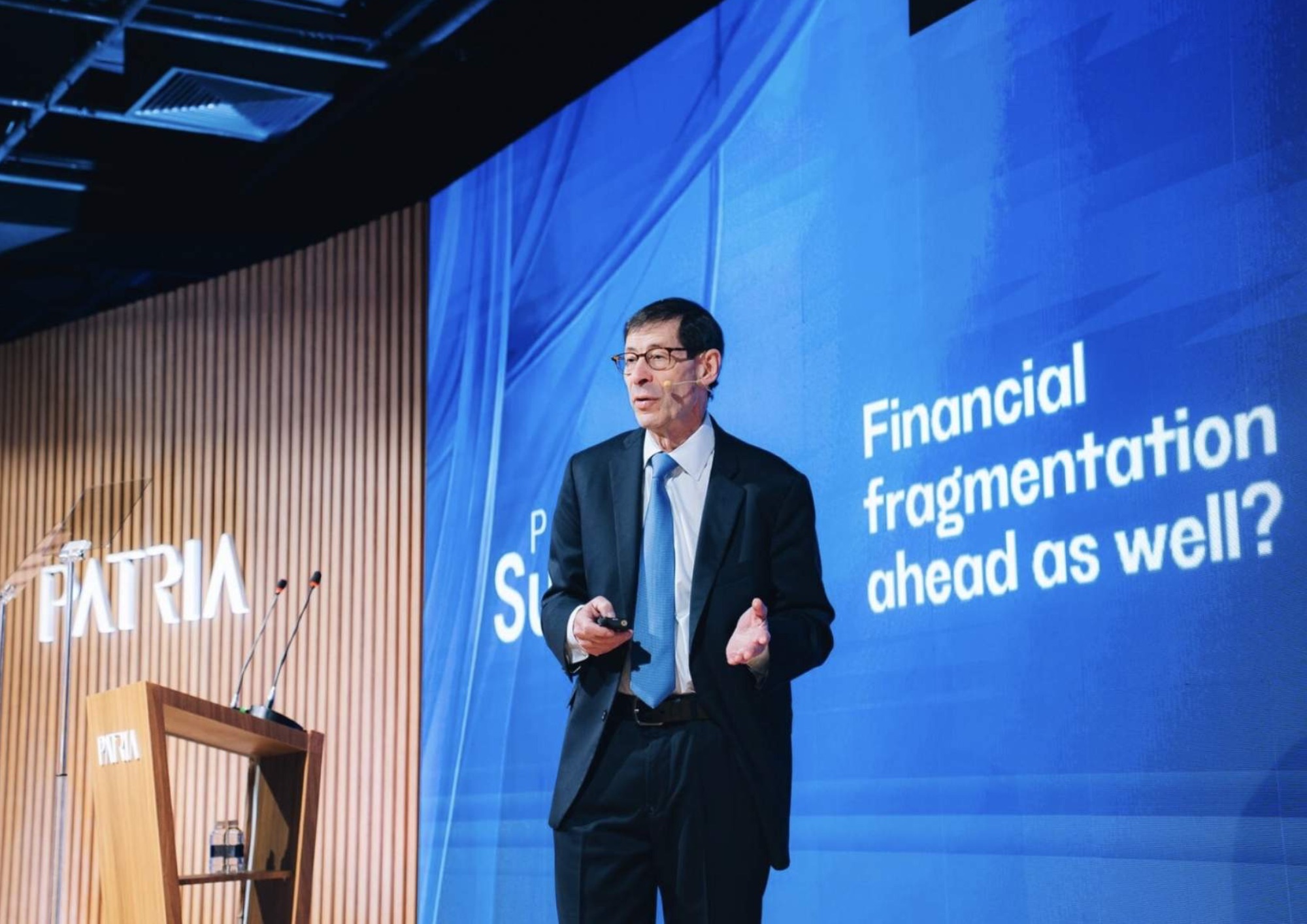
Latin American investors may find some of the best opportunities of the coming years within the region itself, assesses Maurice Obstfeld, former Chief Economist of the International Monetary Fund (IMF). Speaking at the Pátria Summit in São Paulo, he pointed to the benefit that rising commodity prices have brought to local economies and the possibility that a greater share of global energy production will migrate toward Latin America.
The issue arose when Luis Fernando Lopes, partner and Chief Economist at Pátria, read an audience question about where to look for portfolio opportunities. Obstfeld recalled how closely tied Latin American economies are to the U.S. economy. “The situation in the United States is very risky, in my view, over the next 2 years,” he said. Furthermore, he sees a risk of decision-making paralysis under a divided government and expects uncertainty to persist in Europe as well.
For Obstfeld, higher commodity prices have already favored the region. Energy represents a longer-term opportunity. “It may be that a much larger portion of energy production migrates toward this continent,” he stated. This shift could itself be a consequence of the fragmentation of the global economy. “It is very possible that many of the best opportunities will become more local than global in the coming years.”
When discussing what countries in the region can do, Obstfeld described the agreement between Mercosur and the European Union as “an important achievement.” He then turned his attention to decisions governments can make on their own. “The priority has to be internal reform and domestic development,” he said. He cited informality as an example. Bringing workers into the formal economy can generate revenue gains. Creating conditions for businesses to grow and become more dynamic, he added, can raise productivity.
Washington’s Limits in the Dispute with China
“I think we can say that the hegemony of the United States has definitely ended,” Obstfeld stated. He attributed this shift both to China’s weight in global trade and to the inward turn of U.S. policy. In his judgment, attacks on scientific research and universities in the U.S. tend to weaken the country in its competition with China.
Latin America offers a test for the Donald Trump administration’s ambition to regain U.S. commercial primacy in the region. Washington would like to push Beijing away, the economist said. “I think that is not going to happen. I think the ties with China are too deep.” Obstfeld recalled the case of Javier Milei’s Argentina, a Trump ally. In August, the Argentine and Chinese central banks renewed their currency swap agreement and extended its term from 3 to 5 years.
Obstfeld sees room for countries to negotiate with both powers. “I think it is more likely that there will be a large group of countries navigating between these giants,” he said. In Latin America, he expects most governments to succeed in balancing both relationships and avoiding open conflicts.
From Trade to Capital Restrictions
The first sign of this division appears in trade routes. Obstfeld cited a Bank of France study that grouped countries by geopolitical affinity. Trade fell sharply between blocs and grew modestly within them. This helps explain why the shift in partners is more visible than any decline in the global total. “We see similar realignments in foreign direct investment around the world,” he stated.
For those investing abroad, the risk is that governments will also impose barriers on the movement of money between countries. “I believe trade tensions will inevitably lead to more restrictions on financial flows,” he said. In the United States, he cited the debate over imposing a tax on foreign capital inflows. In his assessment, the measure would reduce the U.S. current account deficit, but it would raise interest rates in the country.
Another channel is the Federal Reserve’s swap lines, through which other central banks can obtain dollars. Fear that access to them could be conditioned on political interests is leading countries to try to reduce their reliance on dollar funding, according to the economist. “There is a fear that financial ties could be weaponized,” he stated.
The Weight of Interest on Brazilian Debt
Long-term real interest rates have returned to levels close to those of the early 2000s, Obstfeld observed. What makes the current moment particularly difficult for governments is the volume of debt on which these interest rates apply. In Brazil, he said, the cost appears directly in public accounts. “The Brazilian government’s deficit is due, for the most part, to interest payments. There is a small primary deficit.”
The distinction matters because the primary balance measures the budget balance before interest payments. When the real cost of financing remains high, it widens the overall deficit and increases debt. Expecting economic expansion to solve the problem brings an additional difficulty. “Anyone counting on growth to solve fiscal problems is in denial, because growth is also going to push interest rates higher,” he stated.
For Brazil, Obstfeld sees a potential gain in the opposite direction. Speaking about the country’s indebtedness, he said that “adopting a sustainable fiscal trajectory could have a huge positive impact on growth.”
The Credit Behind Data Center Expansion
Investment in artificial intelligence is also putting upward pressure on interest rates, according to Obstfeld. The shift he highlighted over the past year lies in how projects are financed. Major cloud computing providers have turned to credit to supplement cash generated from operations. Some are raising funds in foreign currencies to avoid higher interest rates in the U.S. They are also using long-term leases to finance off-balance-sheet investments, he noted.
For the economist, AI is already driving global growth. What remains open is whether it will produce a 1-off productivity jump or a sequence of breakthroughs capable of sustaining gains. For companies taking on debt today to build data centers and buy equipment, the difference matters. “It is far from clear that expected future revenues will actually justify these investments,” he said.
The risk for governments, he added, is having to respond to a crisis when debt service already consumes part of their budgets. “If there is some kind of financial crisis tied to AI, fiscal policy will be more constrained than ever in trying to deal with the fallout,” Obstfeld stated.