Mexico’s AFORE pension funds have more regulatory capacity than ever to invest in alternative assets. The challenge is no longer capital availability—it is the supply of institutional-quality investment opportunities capable of absorbing long-term pension capital. This shift has important implications for both Mexico’s private markets and international alternative asset managers, particularly those active in private equity, secondaries, private credit, infrastructure, real estate, and other private market strategies. Under the current regulatory framework, AFOREs may allocate up to 30% of their portfolios to structured assets. The framework has evolved significantly over the past two years.
While the original 20% allocation remains predominantly internationally oriented, regulators approved an additional 10% allocation in October 2024 with a much stronger domestic focus. In practice, this means that roughly two-thirds of the total capacity remains available for international investments, while approximately one-third is intended to support local opportunities. The objective is to strengthen financing for the Mexican economy while preserving the global diversification that AFOREs have developed over the past decade. If successful, the new framework could channel additional capital toward infrastructure, energy, real estate, private credit, and other sectors capable of generating long-term economic growth.
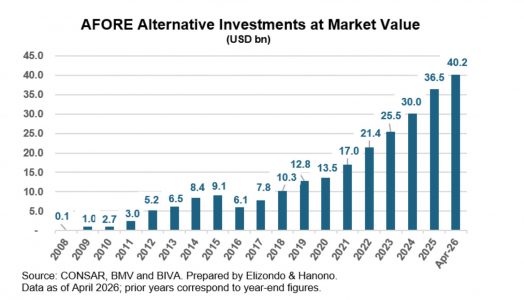
As of April 2026, AFOREs managed approximately US$500.2 billion in assets. They held roughly US$39.3 billion in private equity investments at market value, representing 7.8% of assets under management. When unfunded commitments are included, my own estimates suggest total exposure to alternative assets reaches approximately 16.6%—already approaching the original 20% regulatory threshold. The challenge, however, goes well beyond expanding regulatory limits.
AFOREs need more than attractive projects. They require institutional investment platforms with experienced management teams, strong governance, proven execution capabilities, proven exit track records, and the operational scale necessary to deploy hundreds of millions of dollars efficiently. In today’s more selective environment, demonstrated liquidity generation and realized returns have become just as important as the underlying investment opportunity. The same discipline applies to international investments. Over time, AFOREs have increasingly concentrated commitments with global managers that possess institutional-scale organizations, deep investment teams, and long-established track records.
Paradoxically, although regulatory capacity for alternative investments has expanded, actual portfolio allocations have not followed the same path. Combined exposure to CKDs (Mexico’s domestic private markets vehicles) and CERPIs (vehicles primarily used for international private market investments) declined from approximately 8.9% of portfolios in December 2024 to around 8.3% by the end of April 2026.
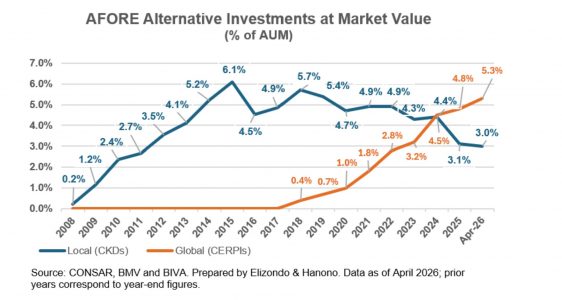
More importantly, the composition of those investments has changed considerably. In 2024, allocations were almost evenly split between domestic and international strategies. Based on my estimates as of March 2026, international exposure has increased from approximately 4.5% to 5.3%, while domestic exposure has declined from about 4.4% to roughly 3.0%. This shift should not necessarily be interpreted as a growing preference for international assets. Rather, it reflects the limited availability of domestic investment opportunities capable of absorbing institutional capital at scale.
Since 2024, issuance of Trust Stock Certificates (CEBURs) has accelerated, broadening access to private equity strategies for insurance companies, private banks, and other institutional investors through exchange-listed vehicles. These instruments complement the investment structures traditionally used by AFOREs—namely CKDs and CERPIs—and reflect the continued evolution of Mexico’s private markets ecosystem.
Ultimately, Mexico has largely addressed the regulatory side of the equation. The next stage will depend on whether the domestic private markets ecosystem can consistently generate investment opportunities with the scale, governance, quality, and risk-return profile required by institutional investors. Regulation can create investment capacity, but only a robust pipeline of institutional-quality opportunities will translate that capacity into higher allocations to Mexican alternative assets.
Opinion column by Arturo Hanono, Senior Advisor in Mexico for Alpine Capital Advisors