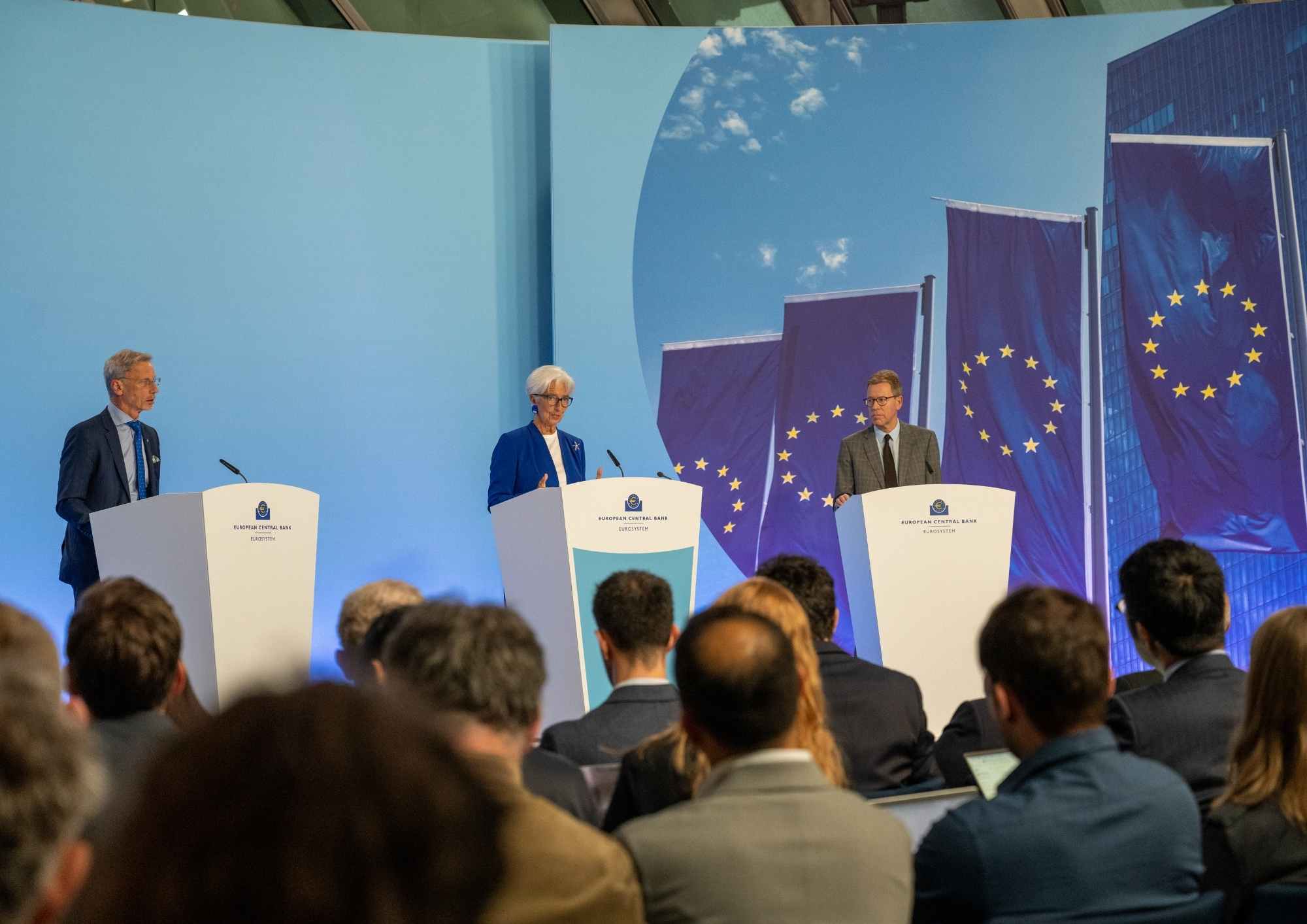
The Governing Council remains committed to setting monetary policy in a way that ensures inflation stabilizes at its 2% medium-term target. In line with this commitment, the Governing Council has decided to raise the ECB’s three key interest rates by 25 basis points. The war in the Middle East is generating inflationary pressures, and the decision to increase interest rates is appropriate across the various scenarios assessing the possible evolution of the shock and its impact on the euro area’s medium-term outlook.
The baseline scenario in the latest Eurosystem staff projections foresees headline inflation averaging 3.0% in 2026, 2.3% in 2027, and 2.0% in 2028. Inflation excluding energy and food is projected to average 2.5% in both 2026 and 2027, and 2.2% in 2028 under this scenario. Compared with the March projections, staff have revised upward the baseline inflation forecasts for 2026 and 2027 due to a higher projected path for energy prices, which is expected to pass through to food, goods, and services inflation to some extent.
The baseline scenario projects economic growth to average 0.8% in 2026, 1.2% in 2027, and 1.5% in 2028, implying downward revisions for 2026 and 2027 due to a more pronounced impact of the war on commodity markets, real incomes, and confidence.
The outlook remains uncertain, with upside risks to inflation and downside risks to economic growth. The full implications of the war for medium-term inflation and growth will depend on the intensity and duration of the energy price shock, as well as the magnitude of its indirect and second-round effects. This uncertainty is also reflected in the wide range of inflation and growth outcomes across the updated illustrative scenarios prepared by Eurosystem staff. These scenarios will be published alongside the staff projections on the ECB’s website.
With today’s decision, the Governing Council remains well positioned to navigate the uncertainty caused by the war. It will continue to closely monitor developments and follow a data-dependent, meeting-by-meeting approach in determining the appropriate monetary policy stance. In particular, the Governing Council’s interest rate decisions will be based on its assessment of the inflation outlook and the risks surrounding it, taking into account incoming economic and financial data, underlying inflation dynamics, and the strength of monetary policy transmission. The Governing Council is not pre-committing to any particular rate path.
ECB Key Interest Rates
The Governing Council has decided to raise the ECB’s three key interest rates by 25 basis points. Accordingly, the interest rates on the deposit facility, the main refinancing operations, and the marginal