As geopolitical risk and structural uncertainty reshape global portfolios, family offices are placing a greater emphasis on resilience. According to the UBS Global Family Office Report 2026, most respondents are planning strategic changes to their portfolios, increasing currency diversification, and deepening their investments in artificial intelligence.
According to Benjamin Cavalli, Head of Strategic Clients and Global Connectivity at UBS Global Wealth Management, the latest edition of the report shows that family offices continue to adjust their portfolios gradually and methodically, diversifying across asset classes, currencies, and regions while maintaining exposure to long-term themes such as artificial intelligence, albeit with greater selectivity. “Many are considering reducing their exposure to the U.S. dollar or planning greater regional diversification, but North American assets still clearly account for the largest share of allocations,” he says.
According to the report’s findings, geopolitical conflicts have become the leading risk in both the short and long term, while concerns over rising global debt levels and recession risks continue to increase. In response, family offices are adopting a prudent, medium-term approach, prioritizing diversification across asset classes, currencies, and regions rather than making abrupt changes to their allocations.
Notably, for the first time, 60% of family offices plan to change their strategic asset allocation over the next 12 months, the highest level ever recorded by UBS. According to the report, developed markets remain the backbone of portfolios, but family offices are allocating increasing amounts of capital to emerging market equities and alternative assets such as infrastructure, while reducing exposure to real estate. At the same time, they are making targeted diversification adjustments, reflecting a disciplined, long-term investment mindset.
The report also highlights a significant shift in currency positioning. “Sixty-five percent of family offices expect confidence in the U.S. dollar’s reserve currency status to weaken, and many are reassessing their exposure to assets that are listed or denominated in U.S. dollars,” the report states.
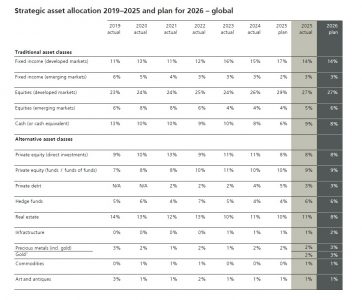
According to the firm, this is driving broader adoption of multi-currency strategies, with the euro and the Swiss franc emerging as preferred alternatives. Regionally, North America continues to account for the largest share of allocations, although family offices are actively seeking to reduce concentration risk. Increasingly, they plan to raise their exposure to Asia-Pacific, Greater China, and Western Europe, reflecting a structural shift toward greater regional diversification.
A Regional Focus on Both Sides of the Atlantic
These are the broad conclusions that apply across the family office universe. However, the findings become more nuanced when examined through a regional lens. For example, U.S. family offices display the strongest home-country bias globally, with 88% of portfolios allocated to North America. According to the report, this reflects confidence in the depth, liquidity, and resilience of domestic capital markets despite global uncertainty. “While AI continues to lead investment themes at 65%, respondents are also showing growing interest in defense and security infrastructure (39%) and infrastructure investments more broadly (35%), possibly reflecting geopolitical considerations and growth opportunities,” the report notes.
According to UBS, despite global diversification trends, U.S. family offices remain relatively insulated, with portfolio strategies centered more on domestic strength than on geographic rebalancing. Nevertheless, they are not immune to broader shifts, including increased awareness of currency risk and structural market changes, although to a lesser extent than their counterparts in other regions.
In the case of Latin American family offices, allocations are comparatively more diversified, with 60% exposure to North America and 23% allocated within Latin America itself. “They are among the most active family offices globally when it comes to rethinking portfolio strategies, with 61% planning changes to their strategic asset allocation, above the global average,” the report states.
In the region, thematic priorities are centered on artificial intelligence (77%), infrastructure (55%), and energy and resources (45%), reflecting a combination of technology-driven growth opportunities and exposure to real assets. According to UBS Global Wealth Management, this dual focus may stem both from a global search for investment opportunities and from the region’s familiarity with resource-related investments, positioning Latin American family offices as relatively dynamic investors with a global outlook.
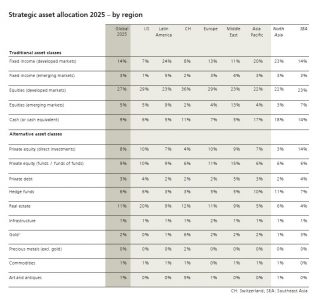
Looking at Europe, European family offices—excluding Switzerland—are among the most active globally when it comes to reassessing their portfolios, with 67% planning changes to their strategic asset allocations, one of the highest levels worldwide. Although North America remains the largest allocation at 45%, European investors are actively rebalancing toward Western Europe and Asia-Pacific, reflecting a strategic effort to reduce concentration risk. Artificial intelligence leads thematic allocations at 57%, followed by infrastructure (33%) and energy and resources (33%), demonstrating a balance between growth themes and structural investments. “These entities are at the forefront of portfolio repositioning, apparently driven by valuation considerations, currency diversification, and evolving global risk dynamics,” the report notes.
As for Switzerland, family offices maintain balanced and internationally diversified portfolios, with 50% allocated to Western Europe and 37% to North America. According to the report, their investment approach places a strong emphasis on stability, diversification, and innovation, with key themes including artificial intelligence (59%), energy and resources (41%), and automation and robotics (38%).
Compared with their global peers, Swiss family offices are moving at a more measured pace, with 43% planning allocation adjustments. Their portfolios stand out for their balanced exposure across both regions and themes, suggesting an approach focused on long-term resilience and technological transformation.
Dynamics in the Middle East and Asia
Turning to other regions of growing importance, family offices in the Middle East exhibit the highest level of planned portfolio changes globally, with 82% intending to adjust their strategic allocations.
According to UBS Global Wealth Management, their portfolios remain anchored in North America (50%), while also maintaining meaningful exposure to Western Europe and the Middle East, reflecting a hybrid investment approach. Their leading investment themes include artificial intelligence (50%), AI-enabled healthcare (35%), and infrastructure (30%), indicating strong interest in both technological adoption and regional development priorities. The region stands out for its proactive and high-conviction approach to capital reallocation, likely driven by a combination of opportunity-seeking behavior and the need to navigate global uncertainty.
Meanwhile, family offices in North Asia are highly technology-oriented and display significant global diversification, with substantial exposure to North America (47%) and Greater China (25%). AI adoption ranks among the highest in the world at 74%, complemented by strong interest in AI-driven healthcare (49%) and energy and resources (34%).
“Seventy-one percent of family offices plan to make changes to their asset allocation, suggesting a proactive willingness to reposition portfolios in response to evolving global conditions. Overall, North Asia stands out for its strong conviction in technology-led growth and cross-border diversification, balancing regional expertise with the pursuit of global opportunities,” the report states.
Finally, family offices in Southeast Asia are the most focused on artificial intelligence globally, with 88% already invested in the theme, the highest percentage of any region. Portfolios maintain significant exposure to North America (58%), while increasingly allocating capital to Greater China and Asia-Pacific, reflecting deeper regional integration. “Eighty-one percent plan to adjust their strategic asset allocation, suggesting an active approach to global economic and geopolitical changes. Beyond AI, the leading investment themes include energy and resources (50%) and automation and robotics (44%), reinforcing Southeast Asia’s position at the intersection of technology adoption and industrial transformation,” the UBS report concludes.