Despite the message of caution delivered by the main central banks in developed markets following this week’s meetings, experts from international asset managers believe that, for the rest of the year, the path of interest rates will inevitably be shaped by developments in the Middle East.
In their view, central banks around the world are adopting a “wait-and-see” stance in the short term, given the risk of stagflation stemming from the conflict in the Middle East. “In the coming months, the uneven impact on growth and inflation across countries will determine the next monetary policy paths,” recently noted Alessia Berardi, Head of Global Macroeconomics at the Amundi Investment Institute.
In her latest analysis, Berardi anticipated what unfolded this week: “The Federal Reserve will delay, rather than reverse, easing in order to protect the most vulnerable households, while the European Central Bank will face a more pronounced trade-off between inflation and growth and will maintain its stance over the coming quarters. Meanwhile, the Bank of England will extend its pause in the easing cycle, and in Japan, affordability measures from the Takaishi era should help moderate inflationary pressures, with the Bank of Japan expected to resume its gradual rate-hiking path over the summer.”
The Fed: higher uncertainty
For its part, the Fed, which also left rates unchanged, delivered a clear message: geopolitical risks are adding a higher level of uncertainty to both sides of its mandate. Beyond that, however, there were few changes in what remained a largely consensus-driven statement. “At the press conference, Chair Powell sought to provide cautious and measured guidance, emphasizing the need not to overreact to current developments and noting that ‘it is too early to know how they will affect the data,’ while stressing that uncertainty is exceptionally high. He also highlighted the importance of maintaining credibility in controlling inflation, particularly from the perspective of expectations,” said Max Stainton, Senior Global Macro Strategist at Fidelity International.
In his view, Powell made it clear that the Committee is comfortable adopting a wait-and-see approach as the impact of the conflict unfolds, and stressed the need for goods inflation to moderate significantly over the course of the year. “He was explicit in stating that any bias toward future rate cuts remains conditional on that progress materializing,” he adds.
For Deborah Cunningham, Chief Investment Officer for Global Liquidity Markets at Federated Hermes, the Fed’s decision to keep rates unchanged remains the most appropriate stance. She argues that the current conflict with Iran does not come close to the scale of disruptions seen during the COVID-19 pandemic, nor is it comparable to the 2008 global financial crisis, and therefore does not justify rate cuts of several hundred basis points.
“At the same time, inflation, even if energy prices stabilize, remains well above the Fed’s 2% target. This leaves open the possibility of a modest rate hike, although this does not appear to be the most likely scenario as long as alternative solutions for the safe distribution of oil and gas continue to progress or the conflict is resolved within a reasonable timeframe,” Cunningham notes.
What has not gone unnoticed are the Fed’s updated economic projections. Specifically, the median path in the Summary of Economic Projections still points to an additional 25 basis point cut in both 2026 and 2027, unchanged from December. In addition, inflation forecasts were revised upward, particularly for 2026 and 2027, alongside somewhat stronger real GDP growth projections for 2027–2028 and the long term (2.0% versus the previous 1.8%), possibly reflecting productivity gains linked to AI. “This upward revision helps explain why the central tendency for the long-term neutral rate increased slightly to 2.9%–3.6% (from 2.8%–3.6%). Notably, none of the 19 FOMC members expects rate hikes this year, and only one does for 2027. In this context, it was somewhat surprising that Chair Powell noted at the press conference that ‘the possibility that the next move could be a hike was discussed,’” said Martin van Vliet, member of the Global Macro team at Robeco.
ECB: ready to intervene in an energy crisis
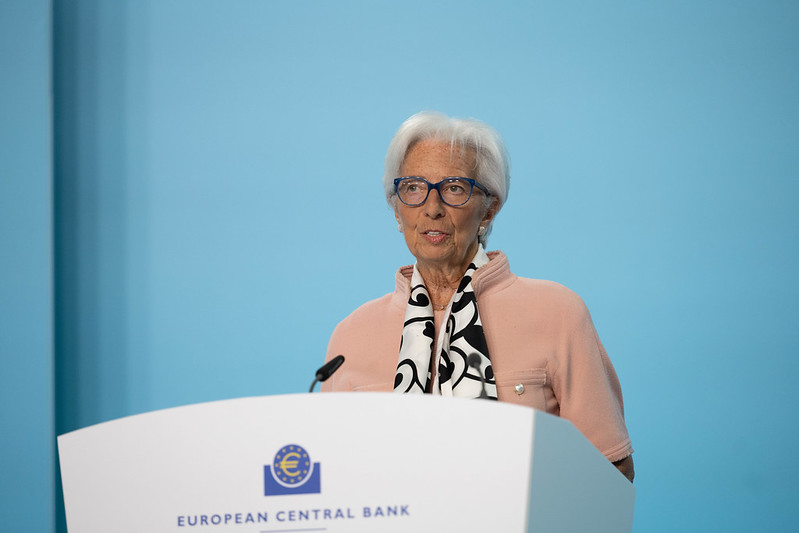
In the case of the European Central Bank (ECB), it kept rates unchanged at 2%, highlighting a balanced risk outlook between inflation and growth, as well as the need to closely monitor the conflict in the Middle East. Lagarde pointed to resilient domestic demand and inflation well anchored at target, but reiterated the willingness to intervene in the event of energy crises.
For Ulrike Kastens, Senior Economist at DWS, the key point is that the ECB has already incorporated the initial effects of rising energy prices into its growth and inflation projections. “As a result, short- and medium-term inflation outlooks have deteriorated significantly, and core inflation forecasts have also been revised upward,” she notes.
“The new projections show slightly higher and more persistent inflation above target in the medium term, while growth estimates have been revised downward, reflecting the negative impact of higher energy prices on real income. The ECB’s guidance was less restrictive than markets expected, maintaining a flexible approach with decisions taken on a meeting-by-meeting basis,” adds Antonella Manganelli, CEO of Payden & Rygel Europe.
A relevant point is that, although Lagarde highlighted the differences compared to 2022, she also made it clear that the ECB would do whatever is necessary to ensure price stability in the medium term. According to Konstantin Veit, Portfolio Manager at PIMCO, the ECB will be attentive to indirect effects on core inflation and will closely monitor inflation expectations.
“For now, we only expect hawkish communication, but we believe the threshold for the ECB to completely overlook a period of above-target inflation is somewhat higher than before 2022. Different starting conditions, a monetary policy less anchored to a central scenario, and a reduced reliance on macroeconomic models could lead to a more flexible ECB. If the ECB were to act later this year, we do not expect it to raise rates beyond what is already priced in by markets,” Veit concludes.
The BoE: unanimity
In line with other monetary institutions, the Bank of England (BoE) kept rates unchanged at 3.75% as it waits to assess the impact of the war in Iran. “There was a time when it seemed certain that the BoE would cut rates at this meeting, but given the conflict with Iran, it is not surprising that the institution decided to hold them. What stands out is that all policymakers voted in favor of keeping rates unchanged, showing that even the more dovish members of the committee want to see how the conflict evolves before resuming cuts,” said Luke Bartholomew, Deputy Chief Economist at Aberdeen Investments.
According to Bartholomew, while labor market data show that wage growth continues to moderate, there are strong arguments for cutting rates at some point. “Now that the inflation outlook appears more complex, the BoE will focus on anchoring inflation expectations. Therefore, although the hurdle for returning to rate hikes is very high, the economy could face a long wait before the next rate cut.”
According to experts, the combination of geopolitically driven increases in energy prices, more persistent inflation risks, and the Monetary Policy Committee’s cautious communication has effectively ruled out a rate cut in March. “The message has been one of strong data dependence and increased vigilance, in line with markets pricing out key rate cuts in 2026,” adds Martin Wolburg, Senior Economist at Generali Investments.
SNB and the strength of the Swiss franc
The Swiss National Bank (SNB) has also followed this trend, keeping its policy rate unchanged at 0%, in line with expectations. According to Roger Rüegg, Head of Multi-Asset Solutions at Zürcher Kantonalbank, the recent strength of the Swiss franc does not appear sufficient to justify a return to negative interest rates. “After reducing its interventions in the foreign exchange market to weaken the currency throughout 2025, the SNB also adopted a cautious stance in the first quarter. In particular, with respect to the U.S. dollar, its relationship with the U.S. government is likely influencing this approach,” the expert notes.
In Switzerland’s case, concerns about the conflict are different, as inflation currently stands at 0%. “Medium-term price stability is supported, among other factors, by falling electricity prices, moderating rental inflation, the strength of the currency, and contained growth in wages and economic activity,” Rüegg adds. In this context, it is expected that the SNB’s policy rate will remain at 0% until the end of 2026.
BoJ: keeping the door open to hikes
Finally, the Bank of Japan (BoJ) also kept its policy rate unchanged, leaving the reference rate for the money market at around 0.75%. According to experts, the key takeaway was that the BoJ stated the Japanese economy continues to recover moderately, albeit with some signs of weakness, and noted that core inflation had been above 2% but has recently eased toward that level due to factors such as government measures to reduce energy costs. “The fundamental scenario for continuing monetary policy normalization and further rate hikes remains valid, but the combination of pending data and changing geopolitical risks suggests a wait-and-see approach at this meeting,” said Gregor M.A. Hirt, CIO of Multi Asset at AllianzGI.
The central bank also adopted a more cautious tone given the global environment, highlighting market volatility and rising oil prices following increased tensions in the Middle East, and noting that their impact on growth and inflation will need to be monitored. However, it reiterated that, if its economic and price outlook materializes, it will continue to gradually raise interest rates.