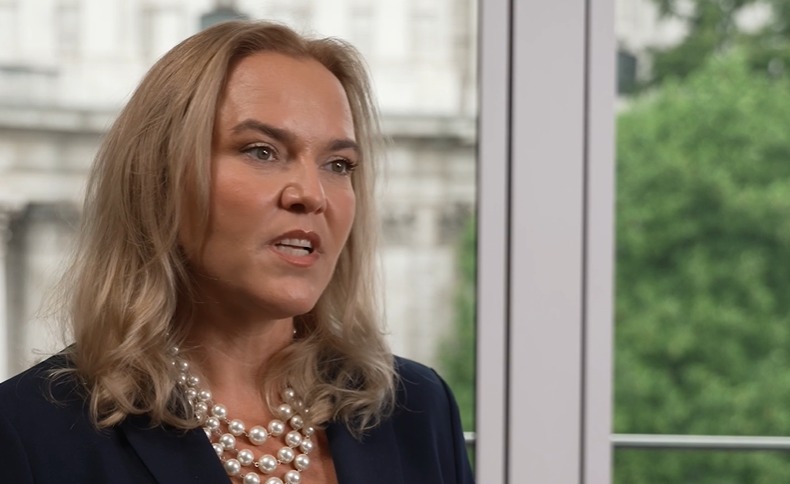
Global fixed income is going through an extraordinary period due to the simultaneity of reinforcing factors: an energy shock that has yet to stabilize, stickier-than-expected inflation, and private credit that has grown faster than the system can absorb. That is the diagnosis presented by Pilar Gómez-Bravo, Co-CIO of Fixed Income at MFS Investment Management, at a meeting with investors in Miami.
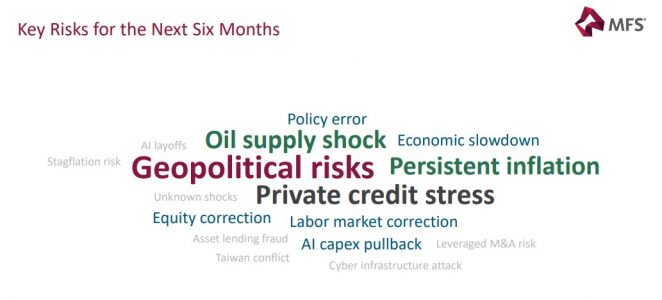
The executive shared a document titled “The Three Body Problem: A Pragmatic Approach to Investing in 2026,” which describes an environment of persistent volatility and rising risks. “Central banks, which were expected to diverge, are no longer going to do so. Basically, they are not going to do anything. And hopefully they won’t, because if they do, they could break the balance,” she explained.
The market environment, then, is marked by a common denominator: three forces colliding at the same time, generating a pattern of instability that is difficult to anticipate.
Energy: the shock that moves faster than monetary policy
The energy component is the most immediate and the most political. Gómez-Bravo reviewed the historical record: shocks of 139% during the invasion of Kuwait, 58% after the war in Ukraine, 28% in Syria, and a recent 79% linked to the escalation with Iran. While these episodes “tend to be short-lived,” their effects on inflation are immediate.
The sensitivity of the global market, she explained, is concentrated in a few geographies: Asia receives nearly 90% of the crude that flows through the Strait of Hormuz, and Europe remains highly dependent on gas. A prolonged shutdown would have uneven but profound consequences. “Trump may control the narrative, but Iran controls the physical supply of oil. If there is no physical supply, every day counts and it is difficult to control prices,” she emphasized.
The risk, she said, is that a supply shock derived from the conflict ends up turning into a growth shock. “If this lasts beyond four weeks, markets will begin to price in growth problems, not just inflation,” she warned.
Inflation: a much less linear slowdown
The second vertex is inflation persistence. Although some data show improvement, the pace of adjustment remains slow. In the United States, the short end of the curve is the only segment anticipating a stronger impact from the conflict, while the long end remains anchored.
The MFS expert’s presentation highlights that fiscal policy continues to be expansionary, with high deficits across all major developed economies. This is compounded by an unprecedented wave of corporate capex, driven by the artificial intelligence ecosystem and major digital infrastructure providers.
This massive investment push also has financial implications. Gómez-Bravo put it bluntly: “The problem arises the day they fail to meet earnings expectations and have to refinance all that debt.” She added a reflection that summarizes her view: “Why should I finance AI companies? Let shareholders do it—they are the ones who receive the upside.”
Today, she explained, the market is still absorbing record issuance without difficulty: hyperscalers could reach $400 billion in new debt this year, approximately half of net investment-grade supply. But the challenge lies not in the present, but in sustainability: “Today there is no problem—there is capacity to absorb all AI supply—but in two or three years there could be a financing problem.”
Private credit: rapid growth and early signs of stress
The third body in collision is private credit, whose growth has been so rapid that it is beginning to generate its own side effects. Global banks have increasing exposure to non-depository financial institutions, and several markets are showing patterns previously seen ahead of periods of stress.
Gómez-Bravo was clear in quantifying the risk: “If the default rate in private credit rises from 4% to 8%, and you only recover 50%, all illiquidity premiums disappear.” This potential deterioration coexists with other concerning factors:
- Easing of underwriting standards.
- Growth in PIK toggle structures, which capitalize interest instead of paying it.
- Increasing risk among private brokers financing hedge funds with leverage.
- 5% redemption limits in retail funds, which can amplify mass outflows.
Three lenses to analyze the cycle
The MFS presentation emphasized that current analysis must rely on three simultaneous pillars—fundamentals, valuations, and technicals—because none on its own provides a complete picture.