
Active ETFs are leaving behind their status as a niche allocation to become an increasingly relevant element in portfolio construction. The Schroders Global Investor Insights Study 2026 (GIIS) shows that investors are seeking to combine active management with the operational advantages inherent to ETFs, overcoming the perception of these vehicles as a mere lower-cost alternative to mutual funds.
Active ETFs are leaving behind their status as a niche allocation to become an increasingly relevant element in portfolio construction. The Schroders Global Investor Insights Study 2026 (GIIS) shows that investors are seeking to combine active management with the operational advantages inherent to ETFs, overcoming the perception of these vehicles as a mere lower-cost alternative to mutual funds.
Thus, globally, virtually all respondents (98%) recognize that active ETFs have a role to play in portfolios (compared to only 2% who believe otherwise), shifting the debate: it is no longer about whether to use them, but how to get the most out of them.
This shift is especially relevant in the current market environment. In a setting marked by higher volatility and persistent uncertainty, investors need tools that allow them to act quickly, closely monitor their positions, and adjust them with agility, without giving up the added value of active management.
Cost is no longer everything
Regarding the factors investors place the most importance on when evaluating an active ETF, cost is cited without hesitation. Lower costs compared to mutual funds are the main advantage for 70% of respondents. But interest in these products is no longer limited to cheaper access to active management. For more than half of respondents worldwide (51%), intraday liquidity and the ability to trade at market prices, along with higher liquidity in the secondary market (55%) compared to equivalent mutual funds, are other major arguments in favor of this investment vehicle. This is because active ETFs can be bought and sold continuously, often supported by market makers. In contrast, traditional funds are typically valued and settled only once a day, limiting flexibility when rapid intervention is needed.
Greater portfolio transparency is another element particularly valued by investors (51%). Conversely, barely 11% of respondents identified tax efficiency as a benefit.
Chart 1: Top factors when choosing an active ETF
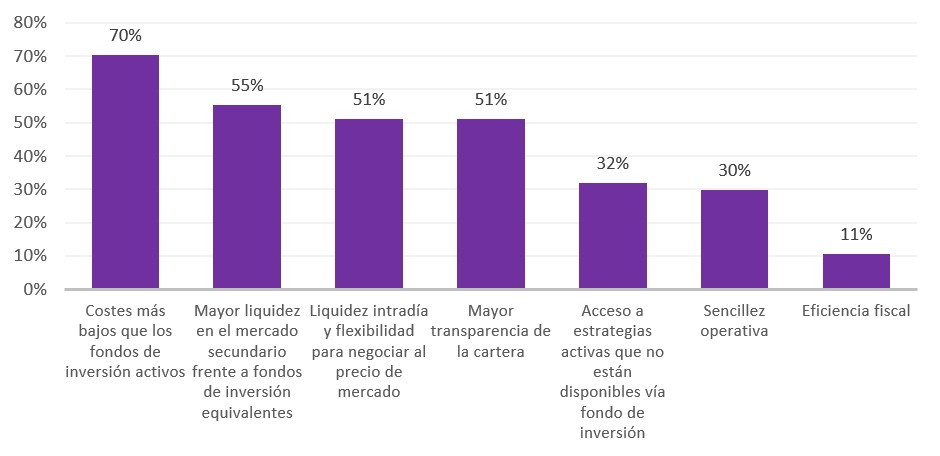
Source: Schroders Global Investor Insights Study 2026. The survey question was: “When considering an active ETF, which of the following advantages are most important to you?”, and respondents were asked to rank their top three reasons.
How do investors use active ETFs?
The survey points out that investors incorporate active ETFs as flexible components within portfolio construction. They allow them to express their investment convictions, access differentiated exposures, and complement their core positions, while maintaining high operational efficiency.
This is structured mainly on two levels. On one hand, investors consider that active ETFs play a relevant role in diversification (68%). On the other hand, they also point to them as a core component in building their investment portfolios (38%).
Tom Stephens, Head of ETFs at Schroders, noted: “The appeal of active ETFs lies in the simplicity of the vehicle and the ease with which they can be integrated, both strategically and tactically. Strategically, they can serve as core equity or fixed income exposure; tactically, they allow positioning in duration, themes, or sectors. And it’s not just a matter of costs: the ability to trade intraday across different platforms facilitates making rapid adjustments, with greater transparency and operational efficiency than many other instruments. This is especially useful when seeking specific goals, such as diversification or risk management.”
Active ETFs for specialized and harder-to-access markets
The survey also shows that demand for active ETFs is not uniform across all investment areas. Investors especially value active management in areas where markets have less coverage, are less efficient, or present greater structural complexity. This is the case for thematic or sector strategies (49%), small- and mid-cap equities (43%), and emerging market equities (40%).
This highlights that investors are looking for active ETFs to combine ease of trading with active management results that make a real difference, especially when index exposure is less precise or when other vehicles are less operational.
Addressing concerns: returns and con fusion with passive ETFs
Despite the strong momentum of active ETFs, the survey shows that some obstacles to adoption remain, which have more to do with the fund manager than with the structure of the vehicle itself. Thus, nearly half of respondents globally (43%) point to uncertainty regarding the performance of this investment solution compared to active mutual funds, a vehicle that remains dominant and has a long tradition in the market, as the main concern. Meanwhile, the second largest concern expressed by investors (40%) is the unclear differentiation between active and passive ETFs.
These elements suggest that the next phase of growth for active ETFs will largely depend on managers’ ability to demonstrate the robustness of their investment process and explain how strategies are implemented and managed within the ETF fund structure, so that investors can understand them and track them over the long term.