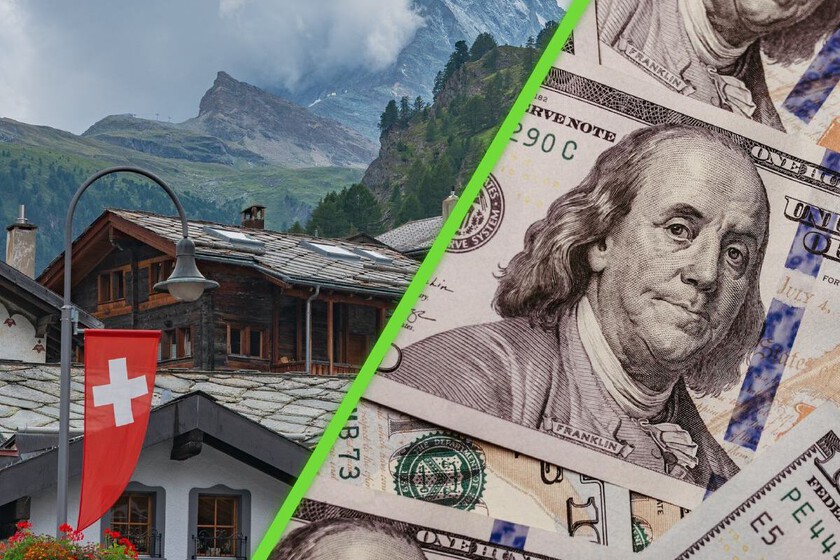
Switzerland is still considered to this day to be synonymous with a wealth haven. Political stability, institutional strength, banking secrecy—at least in its historical form—and a wealth management industry built over generations transformed the country into one of the top destinations for major international fortunes.
However, there are signs of a shift. This does not mean the wealthy are abandoning Switzerland. In fact, the most recent data shows that the country continues to be one of the world’s major wealth management and custody hubs. What is changing is something deeper: high-net-worth families are no longer relying on a single haven and are beginning to build a distributed wealth architecture across multiple jurisdictions.
This transformation is taking place amid rising geopolitical risks, trade tensions, fiscal uncertainty, and the potential for a financial shock to spread rapidly from one market to another.
The International Monetary Fund warned in its April Global Financial Stability Report that risks to global financial stability remain elevated. The war in the Middle East, inflationary pressures, and the risk of renewed tightening of financial conditions combine with vulnerabilities in debt markets, investment funds, and other non-bank financial intermediaries.
The message for high-net-worth individuals differs from the one markets receive: when uncertainty rises, it matters not only what assets you own, but where they are held in custody, under what legislation, and from which jurisdiction they can be administered.
Switzerland Remains a Haven, but It Is No Longer Alone—and Hong Kong Has Overtaken It
The data point that best summarizes this transformation comes from Boston Consulting Group. Global offshore financial wealth reached $15.7 trillion in 2025, an 8.4% increase, driven both by market performance and a higher demand for geographic diversification. However, the business remains highly concentrated: the top ten wealth booking centers captured nearly 90% of new inflows and account for more than 80% of existing global wealth.
What is truly significant is who now holds the top position. Hong Kong narrowly displaced Switzerland as the world’s largest global wealth booking hub. The Asian financial center reached approximately $2.9 trillion, while Switzerland remained at virtually the same level.
This shift, however, should not be interpreted as the end of Swiss dominance. BCG estimates that international wealth in Switzerland grew by 7.6% during 2025 and that the country will continue to benefit from capital flows seeking safety during episodes of geopolitical uncertainty. Over the next five years, the consulting firm projects annual growth close to 6%.
In other words, Switzerland is not losing its status as a safe haven; it is simply ceasing to be the sole major safe haven. That distinction is fundamental.
The new approach to wealth management increasingly resembles an investment portfolio. A family might hold a portion of its financial assets in the United States, use Switzerland for specific private banking and custody needs, establish fiduciary structures in another jurisdiction, maintain a residence in a third country, and use Singapore or Hong Kong to access the Asian market.
It is not necessarily about relocating all assets. It is about preventing any single jurisdiction from concentrating all the risk.
Henley & Partners identified this exact phenomenon in its 2026 Wealth Mobility Report: high-net-worth individuals and their families are building what it calls “sovereign portfolios,” composed of residence rights, citizenship, investments, and businesses distributed across different countries. More than 28% of the applicants the firm served in the first five months of 2026 were already living outside their country of nationality.
The concept is particularly relevant for wealth management: diversification is no longer limited to equities, bonds, real estate, or private assets; it now extends to the legal geography of one’s wealth.
Singapore Gains Ground
One of the primary beneficiaries of this transformation is Singapore. Henley & Partners placed the city-state among the most attractive jurisdictions for international wealth in 2026, while BCG notes that its position as a diversified financial hub allows it to serve as a bridge between Asian and Western markets.
International wealth booked in Singapore grew by 10.3% in 2025, and BCG expects it to maintain a growth rate of around 9% annually over the next five years. The consulting firm also highlights that the city-state has attracted more than 2,000 family offices and over 100 independent wealth management firms.
Singapore’s advantage extends beyond tax considerations. Institutional stability, deep financial markets, connectivity with China and the rest of Asia, an advanced wealth management infrastructure, and a relatively neutral geopolitical stance form part of a proposition that is particularly attractive to Asian families and capital seeking to diversify between East and West.
United States: Financial Safe Haven and Risk Source at the Same Time
The United States occupies a paradoxical position. On one hand, it remains the world’s largest generator of private wealth and concentrates a massive proportion of global financial assets. UBS reported that the United States generated more than 440,000 new millionaires during 2025, representing nearly half of the new millionaires created globally that year.
On the other hand, growing political, fiscal, and trade uncertainty is leading even some wealthy Americans to seek greater international optionality.
Henley & Partners found that applications from US citizens for residence and citizenship programs nearly doubled in 2025 compared to the previous year and remained elevated in 2026. Almost half of those applications were directed toward European programs, and over a quarter went to Latin America and the Caribbean.
This does not imply that the United States is losing its appeal as a financial hub. On the contrary, it means that a jurisdiction can simultaneously be the primary investment destination and a country from which some families wish to secure an alternative exit strategy. The distinction lies between where the capital is held and where a family wants the option to live, operate, or protect a portion of its interests.
The underlying reason is that geopolitical risk is no longer an exclusive variable for governments and large institutional investors. It is also becoming a core variable in wealth planning.
The IMF warns that financial markets have absorbed geopolitical shocks relatively smoothly so far, but it also points out that such stability should not be taken for granted. Vulnerabilities include high debt levels, refinancing risks, interconnections between banks and governments, and the sensitivity of flows to emerging markets amid shifts in global risk perception.
In this environment, wealth management logic evolves. A family no longer asks simply: In which asset should I invest? They now also ask: In which country do I want to hold that asset?
And further: What happens if that country enters a political, financial, fiscal, or geopolitical crisis? The answer often points to greater dispersion.
The Gulf Enters the Equation
The United Arab Emirates represents one of the most compelling cases.
The country has emerged as one of the top destinations for international wealth in recent years, particularly for entrepreneurs, investors, and families from the Middle East, Asia, Europe, and other regions.
Henley & Partners awarded it one of the highest competitiveness scores for wealth mobility in 2026, with 85.3 points, driven by factors such as connectivity, investment access, safety, family inclusion, and long-term residence options.
However, the war in the Middle East is also testing that position. The response observed by Henley is revealing: the surge in inquiries from UAE residents seeking alternative residency or citizenship options does not necessarily signify an exodus. Rather, it reflects a search for contingency plans.
The family remains in Dubai, Abu Dhabi, or another Gulf city, but builds a secondary option in Europe, Asia, or the Americas. That is precisely what defines the new wealth map.
Latin America: The Next Chapter
For major Latin American fortunes, this phenomenon takes on a specific dimension. The region has historically relied on the United States and, to a lesser extent, Europe and Switzerland, as destinations to diversify wealth, access international markets, and mitigate local risks.
Yet the strategy is evolving toward a more complex structure. A Latin American family’s wealth portfolio may encompass a blend of assets and jurisdictions: investments in the United States, international private banking, investment vehicles in Luxembourg, US trust structures, exposure to Asian markets, and potentially a second residence or citizenship.
The goal is not to replace one haven with another, but to build wealth redundancy. This shift is particularly relevant for the wealth management industry, as it forces private banks and family offices to move beyond mere asset allocation and begin delivering a truly international wealth architecture.
The New Competition Is No Longer Switzerland Versus Singapore
The emerging market is not a race to determine which location will become the new single “paradise” for ultra-high-net-worth individuals; it is far more sophisticated.
BCG identifies two major networks taking shape: one centered around Hong Kong and Singapore, closely tied to Asian capital, and another structured around Switzerland, the United States, and the United Kingdom, with a strong presence of European, Latin American, and Middle Eastern wealth.
In parallel, the Gulf—particularly the United Arab Emirates—is striving to serve as a bridge between these major wealth centers. Consequently, competition is no longer fought solely over taxes or financial secrecy.
Factors now in play include political stability, legal certainty, market depth, access to investment opportunities, connectivity, regulation, family office services, residency, succession planning, and the capacity to operate internationally. The result is a far more fragmented map.
And likely a more resilient one as well. For major families living in a world where financial, political, and geopolitical shocks can cross borders with extreme speed, the new wealth haven is no longer a single country: it is the capability of not having to depend entirely on any single one.