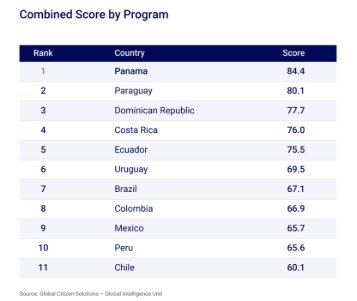
According to an analysis that includes most of the major Latin American economies, Panama leads the combined ranking of investment migration programs developed by Global Citizen Solutions (GCS), a consulting firm specializing in citizenship and residency advisory services. This was explained in a press release, detailing that the Central American country achieved a score of 84.4 points, topping the list in the latest version of Investment Migration Programs in Latin America: A Comparative Analysis.
It was followed by Paraguay (80.1 points) and the Dominican Republic (77.7), with all three ranking ahead of Costa Rica, Ecuador, Uruguay, Brazil, Colombia, Mexico, Peru, and Chile. The briefing evaluates eleven active residency programs in the region based on four criteria: processing speed, tax attractiveness, investment flexibility, and freedom of presence.
Panama is the most consistently competitive across all four evaluated dimensions, while Paraguay offers the best cost-benefit ratio. For its part, Costa Rica sacrifices speed in exchange for flexibility; and Colombia is the fastest on paper, but the least flexible regarding presence requirements. Mexico, the second-largest economy in the region, sits in the middle of the table despite capturing the second-largest share of regional investment; and Chile leads in quality of life, but ranks last as a program.
North America: The Main Source of Demand for Panama
Approvals for Panama’s Qualified Investor program increased by 75% in 2024, from 187 to 327, while those for Real Estate Self-Sufficiency more than doubled, from 63 to 133. The program has approved around 25 qualified investor applications per month, against a target of 150—a sixfold increase—driven by a shift in its applicant base: US citizens have surpassed Colombians as the largest individual group.
Panama leads the combined program ranking, placing first or second across the four evaluated dimensions, boasting the region’s broadest range of qualifying assets—from real estate and securities to bank deposits and forestry—and with no minimum physical presence requirement.
The shift in investor visa demand reflects a broader capital narrative. Foreign Direct Investment into Latin America and the Caribbean reached $194.233 billion in 2025, up 1.7% from the previous year, with Brazil and Mexico jointly absorbing 62% of the flows. Amazon, Microsoft, and Google have collectively committed approximately $23 billion to the region as part of a global artificial intelligence infrastructure expansion in which the four major US tech giants are expected to invest nearly $700 billion in the coming years.
Microsoft alone has committed $2.7 billion for cloud and AI infrastructure in Brazil, $3.3 billion for its data center region in Chile, and $1.3 billion for Mexico through 2027. Cross-border M&A activity follows the same trajectory: transaction value in Mexico grew 86% year-on-year to nearly $32.5 billion in 2025, driven mainly by US and European buyers.
The MSCI Latin America Emerging Markets Index returned 56% in 2025 and still trades at a 43% discount relative to global markets—a gap partly explained by growing demand for AI-linked raw materials supplied by the region. The “Lithium Triangle” formed by Chile, Argentina, and Bolivia holds approximately 50% of the world’s identified lithium reserves, while Chile, Peru, and Mexico supply nearly 40% of global copper, both critical inputs for data center expansion and the energy transition underpinning the AI economy. The collective wealth of Latin America’s high-net-worth individuals (HNWIs) grew 5.1% in 2025, with Brazil (+6.0%) and Mexico (+5.4%) both beating the regional average.
Panama: The Region’s Most Balanced Program
Panama’s advantage stems from an absence of weaknesses rather than a single standout feature. It ranks first or second in all four evaluated dimensions and offers the region’s widest range of qualifying assets: real estate from $300,000, securities from $500,000, bank deposits from $750,000, or forestry investments between $100,000 and $800,000, with no mandatory minimum stay requirement. Approval volumes hit record numbers in 2024. Today, Panama approves about 25 qualified investor applications a month and has set a goal to reach 150, with US citizens having overtaken Colombians as its largest applicant pool.
On the other hand, Paraguay combines a $70,000 threshold with the lowest tax rates in the region—10% corporate and between 8% and 10% personal—and a presence requirement of just one visit every three years. The country granted 29,765 residencies in the first half of 2026, up 81% compared to the same period in 2025, with Brazilian citizens accounting for 76% of those grants. Its new Investor Pass, introduced in April 2026, grants direct permanent residency and adds investment pathways in real estate, financial assets, and tourism to what was previously a single business route.
Colombia, meanwhile, resolves applications in just two to four weeks—faster than any other program evaluated—but with less predictable timelines and more demanding documentation, placing it eighth in the overall standings. It is also the most demanding regarding physical presence, requiring 180 days of stay per year to keep the permit active—a requirement that, according to the report, effectively rules out investors unwilling to physically reside in the country. Colombia is one of only four programs in the region that extends eligibility to the applicant’s parents, in addition to the spouse and dependent children.
Costa Rica ranks fourth overall, sacrificing processing speed (7th out of 11) in exchange for one of the broadest ranges of qualifying investments in the region, including real estate, listed shares, and a rentista income pathway of $2,500 per month. It is one of four countries, alongside Chile, Uruguay, and Panama, that lead the region in quality of life, making it a natural choice for investors planning to actually reside in the country rather than simply maintain a permit.
Chile leads the region as a place to live, but ends up last among the eleven evaluated programs, trailing in tax efficiency, flexibility, and presence options, while ranking 8th out of 11 in speed. Its single qualifying pathway—a business investment sponsored by InvestChile that excludes real estate—reflects a program designed to attract operational businesses rather than internationally mobile capital. The Chilean passport ties with Brazil’s as the strongest of the eleven, offering visa-free or visa-on-arrival access to 177 destinations. Along with Argentina and Bolivia, Chile is part of the “Lithium Triangle,” which holds roughly 50% of the world’s identified lithium reserves, and together with Peru and Mexico supplies around 40% of global copper.
Mexico is the second-largest economy in the region, with a projected GDP of $2.12 trillion for 2026, and captured $43.221 billion in Foreign Direct Investment in 2025—accounting for 22% of the regional total, behind only Brazil. Microsoft has committed approximately $1.3 billion to Mexican infrastructure through 2027, and cross-border M&A activity grew 86% year-on-year to roughly $32.5 billion, driven largely by US and European buyers. However, its residency program, based on proof of economic solvency rather than a formal investment structure, ranks 9th out of 11. It does, however, combine worldwide income taxation with the lack of a strict minimum stay—one of the few such combinations in the region.
Brazil is the largest economy in the region and its main destination for AI infrastructure investment, having captured 40% of regional FDI in 2025. Despite offering entry costs starting at just $30,000, its residency program ranks 7th overall, and its real estate investment option has attracted fewer than 700 applicants in five years—a gap the report attributes to a lack of awareness and external advisory presence rather than program design.
Price Is a Weak Indicator of Program Quality
Among the eleven programs, GCS’s analysis finds that cost bears little relation to performance. Ecuador, with an investment threshold of $48,200, ranks 5th overall, and Paraguay, at $70,000, ranks 2nd. Uruguay, whose $2 million threshold is more than forty times that of Ecuador, ranks 6th.
This momentum is reinforced by pullbacks in other regions: Spain eliminated its golden visa in April 2025, Portugal removed its real estate investment pathway and extended naturalization timelines under a law effective since May 2026, and Greece tripled its investment threshold in prime areas, leading to a 24% drop in foreign property acquisitions under its program. For North American investors, the combination of accelerating capital flows and an expanding menu of residency options positions Latin America as a third hub for investment migration—complementing, rather than competing with, an increasingly restrictive European market.
“Latin America remains highly underrated, with programs offering real potential and passports that grant mobility. They complement Europe’s residency programs and the Caribbean’s citizenship offerings, while competing on cost, speed, naturalization timelines, and access to a broader regional mobility zone,” stated Patricia Casaburi, Founder and CEO of Global Citizen Solutions.