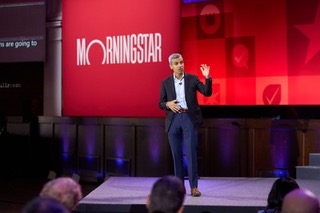
In a global environment shaped by shifting geopolitical dynamics, technological disruption and the continued evolution of private markets, Morningstar Wealth’s conference—led by Morningstar Wealth President Daniel Needham—brought together leading voices from academia, asset management and investment strategy to discuss the forces reshaping portfolio construction in today’s investment landscape.
One of the event’s keynote conversations featured geopolitical analyst Walter Russell Mead of the Hudson Institute and The Wall Street Journal, who argued that today’s international environment should not be viewed as a complete rupture with the past, but rather as the evolution of deeper historical patterns.
Geopolitics: Historical continuity and new strategic tensions
Mead argued that U.S. foreign policy has displayed remarkable historical continuity, shaped by four enduring intellectual traditions—Hamiltonian, Wilsonian, Jeffersonian and Jacksonian—that continue to influence contemporary policymaking. From this perspective, today’s foreign policy debates are not anomalies but expressions of long-standing tensions within American strategic thought.
Regarding the Trump administration, Mead noted that its foreign policy reflects a blend of these traditions, particularly the tension between pragmatic isolationism and a more assertive nationalism, evident in issues such as Iran, immigration and America’s global role.
On China, Mead emphasized that while it represents the West’s principal long-term strategic challenge, the relationship does not necessarily have to culminate in inevitable conflict. In his view, the key will lie in Asia’s economic development and the creation of sustainable regional balances that reduce incentives for direct confrontation.
Technology and artificial intelligence: The new axis of political economy
One of the panel’s central themes was the impact of artificial intelligence and the technology sector on the restructuring of American capitalism. According to Mead, AI will not only transform productivity but also reshape the very structure of economic and political power.
Unlike traditional multinational corporations, many of today’s technology companies depend less on global supply chains and more on digital ecosystems, fundamentally changing their incentives with respect to trade and labor policies.
Mead cautioned that while automation across both the public and private sectors could deliver significant productivity gains, it may also lead to substantial labor displacement. The challenge, he argued, will be ensuring that the benefits of this transformation are broadly shared, preventing the emergence of new structural inequalities.
Artificial intelligence and financial advice: The enduring value of human judgment
In a later session, Morningstar CEO Kunal Kapoor discussed how artificial intelligence is transforming the financial advisory industry. His central message was clear: AI will not replace financial advisors, but it will raise expectations for the value they provide.
Kapoor argued that as automated tools increasingly answer basic questions and democratize access to financial information, advisors will differentiate themselves through judgment, context and personalized advice.
“The challenge is no longer answering questions—it is identifying what truly matters within a client’s financial situation,” was one of the key messages from his presentation.
Private and public markets: A structural convergence
Another major theme was the growing role of private markets in portfolio construction. Kapoor noted that companies are remaining private for longer, concentrating a larger share of value creation outside traditional public markets.
At the same time, instruments such as private credit and semi-liquid investment vehicles have expanded rapidly, offering institutional and sophisticated investors additional diversification opportunities. However, Kapoor stressed that these investments require a deeper assessment of liquidity, costs and transparency.
Active management: The case for long-term discipline
One of the conference’s most anticipated sessions featured Will Danoff, manager of Fidelity Contrafund, in conversation with Morningstar’s Robby Greengold.
Danoff emphasized that successful active management is rooted in rigorous research and the ability to identify sustainable competitive advantages. He credited Fidelity Investments’ extensive research platform with helping him develop a comprehensive understanding of the market.
He highlighted three core investment principles: maintaining a broad investment universe, identifying companies with exceptional leadership—often founder-led businesses—and allowing long-term winners to compound over time rather than reacting excessively to short-term market volatility.
Private credit versus public credit: Competition or complementarity?
Another panel brought together representatives from Blackstone, PIMCO, Cliffwater and Morningstar to discuss the evolution of credit markets in a higher interest rate environment.
The panel’s broad conclusion was that private and public credit should not be viewed as competing asset classes but rather as complementary tools within a diversified asset allocation strategy.
Private credit offers issuers greater flexibility and customized financing solutions, while public credit remains attractive because of its liquidity and efficient price discovery. In this environment, manager selection becomes increasingly important, particularly as the credit cycle matures and financial stress risks increase.
Hospitality, relationships and the human element in wealth management
One of the event’s most distinctive presentations came from entrepreneur and author Will Guidara, who introduced the concept of “unreasonable hospitality” to the world of financial advice.
Best known for his career in fine dining, Guidara argued that the wealth management industry often underestimates its fundamentally relationship-driven nature. In his view, in an increasingly automated world, genuine human connection has become both scarce and exceptionally valuable.
His philosophy rests on three principles: making human connection the primary differentiator, consistently exceeding client expectations and intentionally applying creativity to every client interaction.
An industry undergoing simultaneous transformation
Taken together, the discussions throughout the Morningstar conference reflected an industry experiencing profound structural change. The convergence of geopolitics, technology, private markets and evolving investor expectations is redefining not only how portfolios are constructed but also the role of advisors and investment managers.
Despite the diversity of perspectives across the panels, one overarching message emerged consistently: the future of investing will depend as much on understanding global macroeconomic and geopolitical forces as on integrating technology without losing the human judgment that has long been at the core of sound financial decision-making.