
Global Citizen Solutions (GCS), the international firm specializing in residency and citizenship planning consultancy, has published a new report prepared by its research department, the Global Intelligence Unit (GIU), titled Tax Optimization for Global Citizens, a comparative study of tax positions across 48 jurisdictions for internationally mobile individuals. The report evaluates each jurisdiction based on 11 indicators grouped into three pillars (Tax Burden, Tax Structure, and Investment Migration, with weightings of 42.5%, 42.5%, and 15% respectively), under the premise that how a tax system treats foreign income and departing residents matters just as much as the nominal rate it charges.
The United Arab Emirates leads the overall ranking by combining a 0% personal income tax rate with a 5% consumption tax and no charges at the time of departure. Antigua and Barbuda, Paraguay, Hong Kong, and the Bahamas complete the top five. Malta and Cyprus are the only two European jurisdictions to enter the top ten, doing so through preferential regimes rather than low nominal rates.
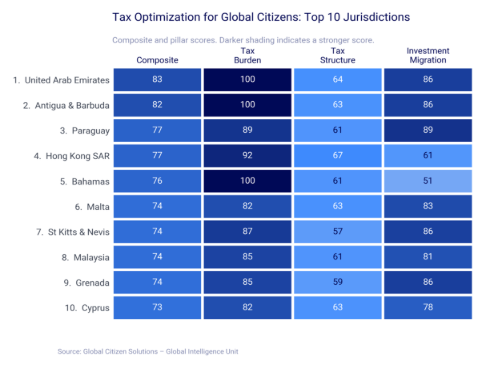
Tax Optimization Chart for Global Citizens. Source: Global Intelligence Unit in its report “Tax Optimization for Global Citizens”
Tax Structure Weighs Heavier Than the Nominal Rate
The central finding of the report is that a jurisdiction’s tax rate and the structure of its tax system are largely independent of one another. Uruguay charges 36%, a rate closer to Western Europe than the Caribbean, yet records the highest Tax Structure score in the entire sample, placing twelfth overall exclusively due to that structure. Hungary, by contrast, charges 15% but ranks 31st because it taxes its tax residents on worldwide income and offers no substantial relief to newcomers.
Two mechanisms explain a high score in Tax Structure: a tax base that never reaches foreign income, as in Uruguay, Panama, and Hong Kong, or that only reaches it upon remittance, as in Malta and Mauritius; and a preferential regime superimposed on a system that otherwise taxes worldwide income, as in Cyprus, Portugal, and Italy.
“The countries that break the dilemma between taxes and quality of life—among them Malta, Cyprus, Uruguay, Costa Rica, Mauritius, Switzerland, and Portugal—do not achieve this by charging zero taxes. They manage it by taxing on a territorial or remittance basis, or through a well-designed preferential regime, leaving room to fund the public services that quality of life depends on. That is the true decision facing anyone who relocates: it is not simply about the lowest tax rate, but how foreign income is treated, whether through automatic exemption, partial relief, or more targeted exceptions, and how much certainty that structure actually offers,” comments Artur Saraiva, Founder and COO of Global Citizen Solutions.
Living Well, Departing Well
The report’s two structural findings point in opposite directions. Jurisdictions charging fewer taxes tend to rank lower in quality of life, meaning that what a resident saves in taxes is weighed against what they sacrifice in daily life. Thirty-one of the 48 jurisdictions in the study impose no exit tax, including all jurisdictions in Latin America and the Caribbean, so a lower cost of living rarely comes accompanied by a lower cost of departure, and a higher cost of living does not guarantee an easier exit either.
Seven jurisdictions break this quality-of-life pattern by combining a tax position in the top half of the table with a spot among the world’s top 50 in quality of life: Malta, Cyprus, Uruguay, Costa Rica, Mauritius, Switzerland, and Portugal. None achieves this by charging zero income tax. Each instead utilizes a territorial, remittance, or preferential regime structure that leaves room to fund the public services upon which quality of life relies. Regarding departure, eleven of the seventeen jurisdictions that do charge upon departure—including Australia, Canada, Denmark, Germany, Norway, Spain, and Switzerland—apply a broad charge with the possibility of deferral, while five, including Portugal, the United Kingdom, and Japan, apply a more limited version. The United States concentrates the highest tax burden in the entire sample, both by rate and by structure, while also imposing the most demanding departure conditions of all analyzed jurisdictions: deferral is only available against collateral acceptable to the U.S. Treasury, only if the expatriate permanently waives treaty protections, and only with interest that accrues until the tax is paid.
Death, Taxes, and Exceptions
Inheritance tax separates higher-burden systems from the index leaders more clearly than any other metric. France charges up to 60%, Japan 55%, and Germany 50%, whereas none of the thirteen leading jurisdictions in the index levy an inheritance tax. The report also highlights the United States as an outlier: since it taxes its citizens on their worldwide income regardless of where they live, relocating alone does not end a U.S. citizen’s tax obligations.
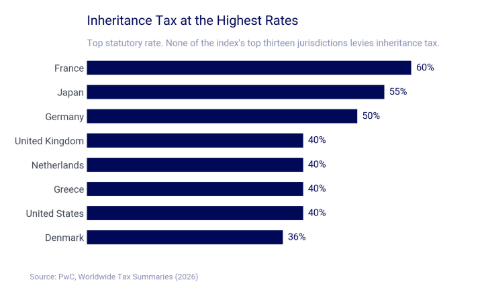
Highest Percentage Inheritance Tax Chart. Source: Global Intelligence Unit in its report “Tax Optimization for Global Citizens”
Net Wealth Tax, a Rarity
Net wealth tax applies in only eight of the 48 jurisdictions in the sample, with rates ranging from 0.1% in Uruguay to 3.5% in Spain. None of the jurisdictions that do not levy personal income tax apply a wealth tax either, meaning the absence of an income tax and the absence of a wealth tax usually go hand in hand rather than offsetting each other.
The report concludes that no single jurisdiction fits every profile. Entrepreneurs approaching a liquidity event are guided by the treatment of capital gains and the cost of departure; retirees, by inheritance, healthcare, and consumption taxes; and remote professionals, almost exclusively, by the tax base applied to foreign-source income. The full report presents specific lists for each of these profiles across the 48 analyzed jurisdictions.