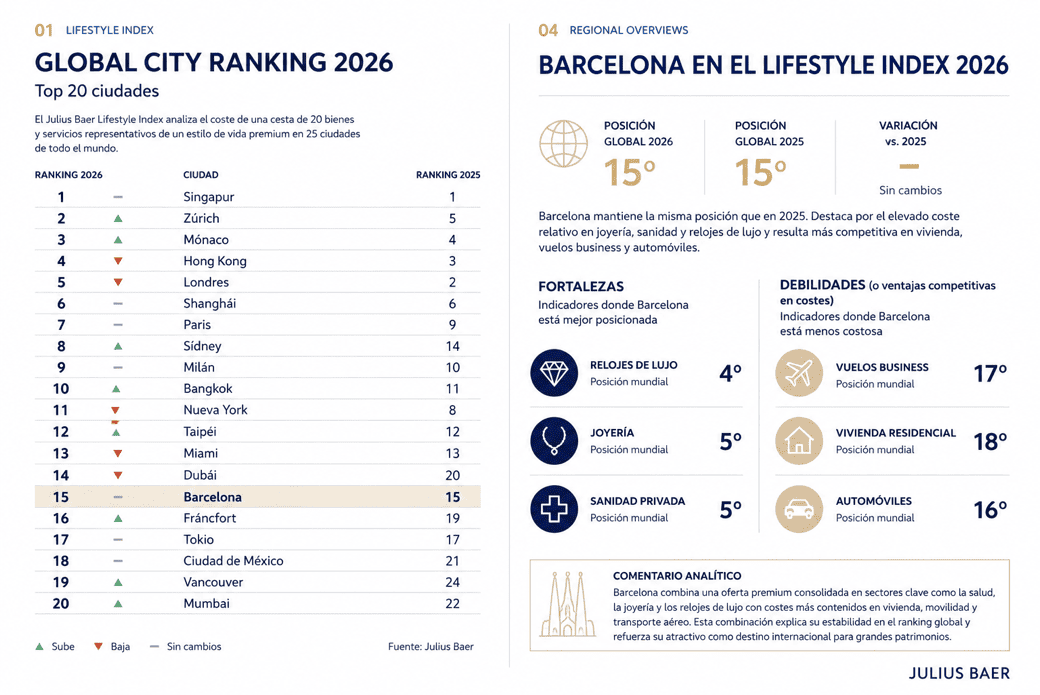
Singapore has reaffirmed its leadership for the fourth consecutive year as the world’s most expensive city for maintaining a premium lifestyle, followed by Zurich and Monaco, according to Julius Baer’s Global Wealth and Lifestyle Report 2026.
Zurich’s rise, which placed it three spots higher, was due to the strengthening of the Swiss franc, backed by the country’s reputation for stability and the currency’s role as a “store of value” in times of uncertainty, according to the wealth manager. Singapore’s long-held leadership is due to high housing and automobile prices, the two categories with the highest weighting in the index, along with the strength of the Singapore dollar, the report added. The index compares prices in U.S. dollars.
As Christian Gattiker, Head of Research at Julius Baer, summarizes: “Currencies are once again taking center stage, but the real key lies in how currencies, assets, and investor decisions interact.” In his view, “what is clear in 2026 is that the world remains a complex place and uncertainty stays at a very high level.” In this context, “stable cities and countries become even more attractive,” emphasizes Julius Baer’s head of research.
The bank’s Lifestyle Index ranks 25 cities by analyzing price inflation for 20 luxury items and services, such as housing, automobiles, business class flights, school tuition, and tasting dinners. The survey interviewed 360 high-net-worth individuals with family bankable assets of $1 million or more between February and March 2026.
For high-net-worth individuals, the cost of maintaining a high standard of living has increased “significantly” over the past 12 months, with an average increase of 10.2% in this year’s index in U.S. dollars, according to the report. The rise in gold prices is reflected in the index, with a 16.4% increase in jewelry and 15.5% in watches.
Barcelona consolidates its stability within international luxury
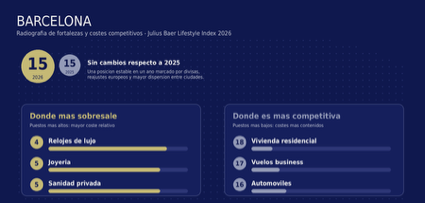
The Catalan capital, the only Spanish city in the ranking, retains 15th position worldwide; exactly the same position it occupied in the 2025 edition. Far from representing a lack of dynamism, this stability reflects the city’s ability to maintain a competitive positioning in a particularly volatile year for major economies.
The analysis prepared by Julius Baer shows a city with a balanced profile. Barcelona excels in categories linked to premium consumption, such as watchmaking, jewelry, and private healthcare, while maintaining relatively more moderate costs in housing, automobiles, and air travel, which helps contain the total cost of a high-net-worth lifestyle.
The report concludes that the concept of wealth is evolving toward a broader, more strategic vision. The ability to preserve purchasing power, access different jurisdictions, maintain a high quality of life, and diversify risks is consolidating as one of the main assets for major international fortunes.
Other relevant positions in the study
Dubai fell to 14th place in the ranking, although Julius Baer indicated that this decline reflects rising costs in other cities rather than increased affordability in the financial hub. The Swiss bank also noted that “much has changed” in the Middle East in the months since the index data collection, which took place before the conflict with Iran. As a result, the outlook for residents and internationally mobile individuals and families “is now less clear,” it stated.
Sydney recorded the biggest climb in this year’s ranking, moving up six spots to eighth place. Julius Baer attributed this partly to the strength of the Australian dollar and the country’s “geographic isolation”; the cost of importing high-end products significantly boosted Sydney’s position on the list, according to the bank.
For the first time in three years, no city in the Americas appeared in the top 10. This is mainly due to the depreciation of the U.S. dollar against other major currencies, despite strong local price increases. Even so, North America recorded significant wealth accumulation over the past year, with an astounding 47% of high-net-worth individuals reporting a significant increase in the value of their assets.
The report concludes that wealth can no longer be measured solely in financial terms: today it also integrates mobility, security, health, resilience, and adaptability—elements that will define the assets of the future.