
Private banking and wealth management clients are optimistic about the developments and implications of AI over the next five years, but at the same time, they are reorienting their portfolios toward more prudent positions in the face of rising geopolitical instability and global uncertainty.
This emerges from the conclusions of the study ‘Investing for Change: Client Strategies and Concerns’, which Deutsche Bank published based on data from a survey of its Private Bank clients conducted between March and May 2026, complemented by another somewhat shorter monthly survey of clients and non-clients. Respondents expect technological advancements within a context of continuous global and social turbulence. Notably, younger respondents (aged 25 to 40) are more pessimistic than older ones regarding issues related to geopolitics or social and environmental cohesion, while this trend reverses when it comes to artificial intelligence.
Specifically, AI, government debt and fiscal pressures, and policy-driven changes in trade patterns are perceived as the main drivers of change by 69.8%, 56.9%, and 50% of respondents, respectively; meanwhile, health security and pharmaceutical advancements ranked as the least influential topics. In fact, 77% are certain that AI will affect most aspects of business and investment. Furthermore, 70.2% believe that higher levels of defense spending will be necessary, and 49.9% are of the opinion that corporate governance must change radically to tackle all of these new global challenges.
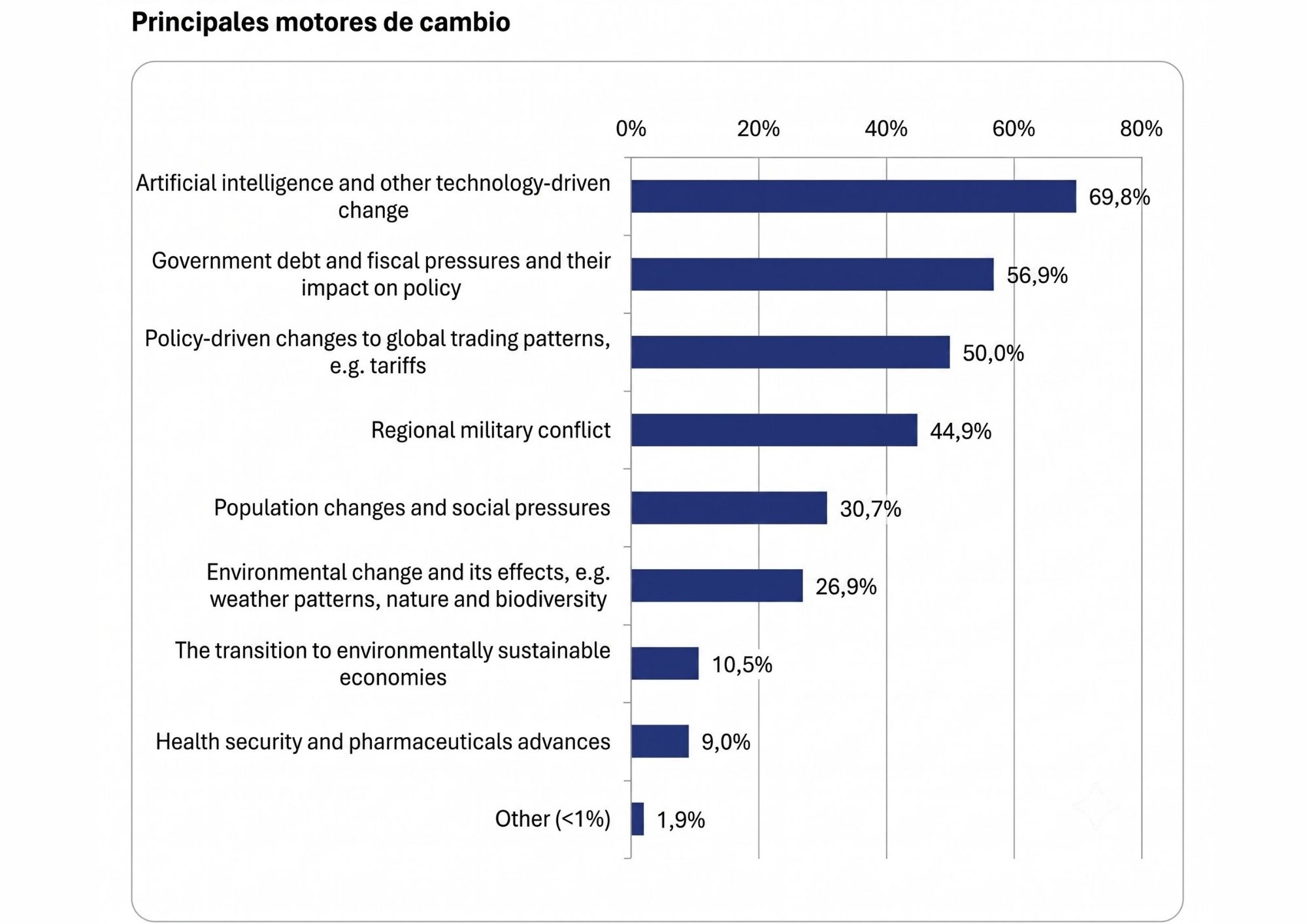
Deutsche Bank Chart. Source: Deutsche Bank Client Survey Investment Portfolio Composition
Given this context, a long-term vision dominates the current objectives of investment portfolios. Specifically, 68.3% of private banking clients state that their goal is the long-term preservation of their wealth, and 65.2% point to consistent long-term returns. Only a minority of respondents (17.8%) affirm that achieving maximum returns is a current objective for their portfolio. Furthermore, only 3.3% have non-financial goals such as environmental or social impact. Caution and selective conviction also prevail in investment plans. For many investors, strategic and tactical approaches will coexist. Around 36.1% plan to review their strategic asset allocation, but 47% will adopt a more tactical approach as opportunities arise. It is also interesting to note that 29.7% will expand and seek new risk management approaches.
Only a minority plan major shifts toward specific themes or assets. For instance, only 9% foresee increasing exposure to technology and AI themes, followed by health/pharma and medicine (7.5%), energy and renewables (4.1%), and defense (3.9%). Regarding ESG matters, 15.1% plan to increase their investment, while 9.5% plan to reduce it. By country, according to Deutsche Bank’s dbInsights survey platform—which targets a broader audience in Germany, France, Italy, the United Kingdom, and the US—AI is consensus-ranked as the top investment theme, followed by renewable energy and biotechnology. In terms of risks, continental Europe is most concerned about geopolitical instability, whereas the US and the UK are more wary of government policy and regulation.