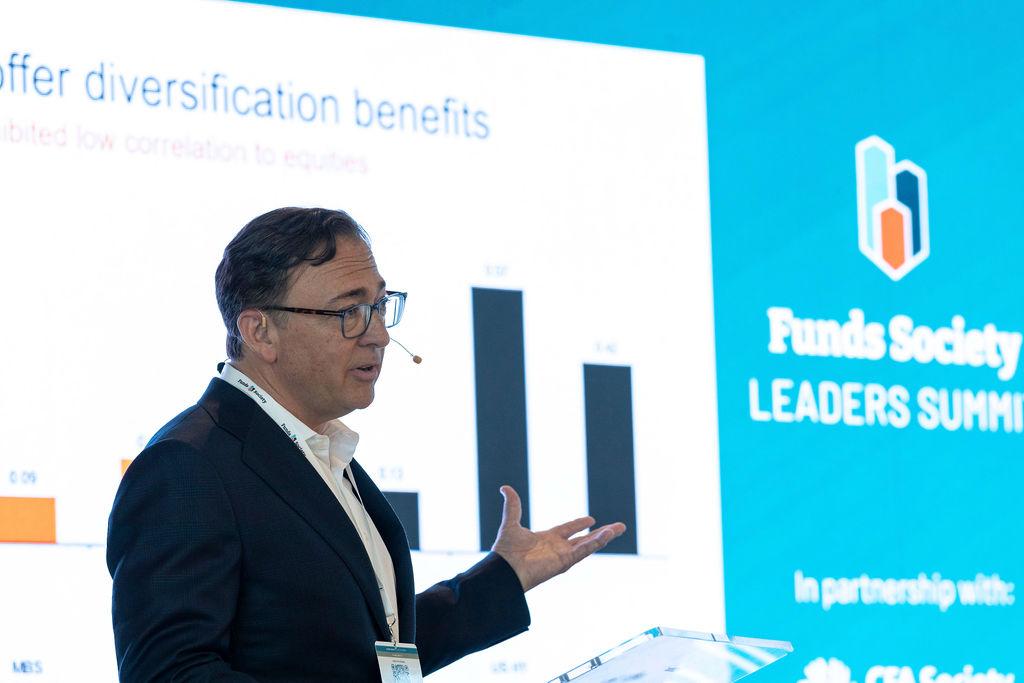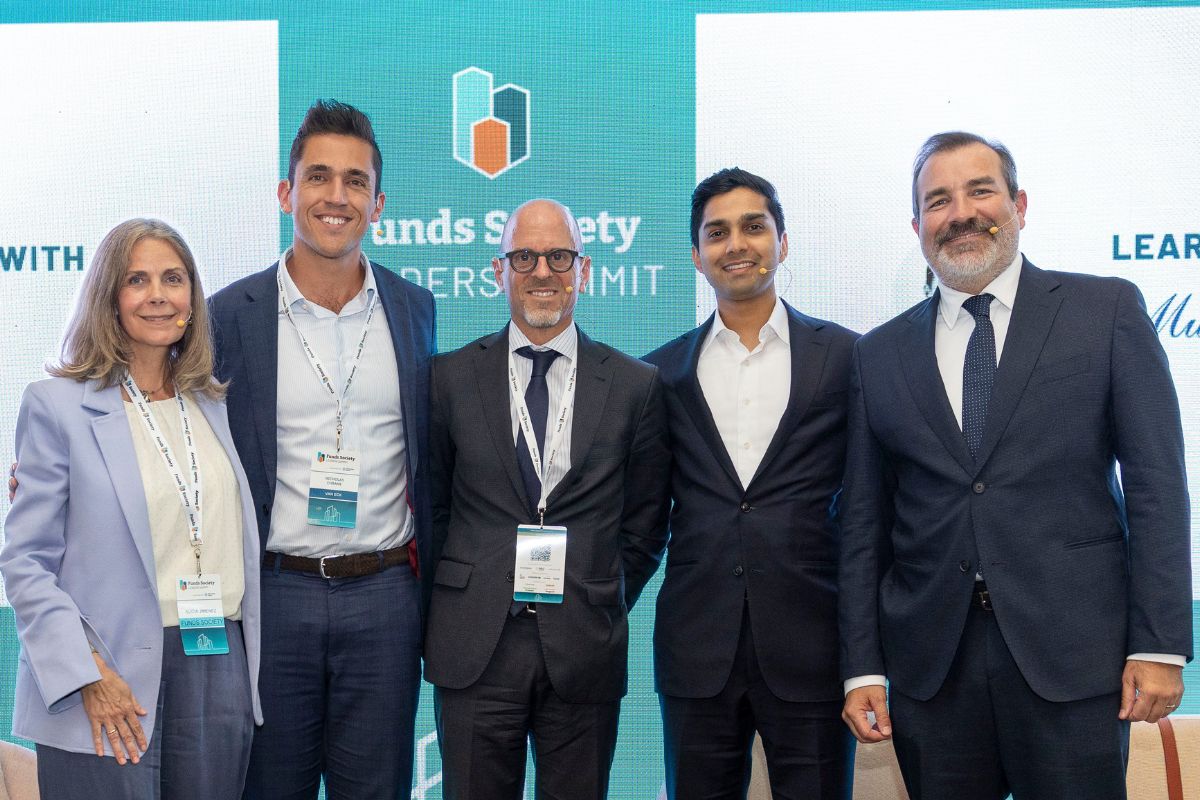
The recently held Funds Society Leaders Summit in Miami featured a panel in which chief investment officers and representatives from various ETF-specialized firms analyzed the state of the markets in general and the technological revolution in particular. The panel, “Alpha, Beta, and the AI Revolution: A Dialogue with Miami CIOs on Risks and Opportunities,” moderated by Alicia Jiménez, CEO of Funds Society, began with the perspective of Fernando De Frutos, CIO at Mora Capital Group, who noted that it is not usually a “good idea to base investment portfolios on geopolitics,” although he admitted that this time “it might be different.”
Here, the Mora Capital expert explains that market volatility “is very low, at the same time that extreme risks are increasing. And that is quite unusual.” Therefore, although “there are very good reasons to be optimistic about equities, we are getting used to sharp corrections and very rapid V-shaped recoveries,” and he insists that he does not believe “we should prepare for the worst-case scenario, but markets have probably become too complacent in considering extreme risks, such as the possible permanent destruction of infrastructure.”
Also regarding the influence of geopolitics on investment strategies, Ahmed Riesgo, Chief Investment Officer of Insigneo, emphasized that “geopolitical risk and conflict will be a constant in the system over the next 10 or 15 years.” For now, he sees the need to hedge positions in oil within portfolios, where “there is a kind of permanent geopolitical risk premium.” Even so, he expects crude oil could stabilize around $80. He also observes factors “behind the scenes of the market that overshadow any type of geopolitical conflict, and it revolves around AI.” The impact of artificial intelligence, according to Riesgo, “is a trend that is driving productivity worldwide” and, although it is somewhat more advanced in the United States, “over time, it will outweigh any impact that a particular crisis might have.”
Karlan Patel, Vice President ETF Investment Strategies at State Street Investment Management, drew on the firm’s index measuring investor risk and sentiment—both retail and institutional—to conclude that the average institution holds around 20% of its portfolio in cash, a percentage that “has remained stagnant over the past five years.” However, that position drops to 5% or 6% in the retail segment. “I would say the average institutional investor now maintains a neutral stance, which gives us some sense that markets have reasons to rise.” But as a counterpoint, Patel does not observe that “a lot of money” is being invested.
For his part, Nicholas Chbane, CIMA, Director RIA South at VanEck, offered his perspective on how to generate returns safely. To begin with, he defined the firm as an expert in “macroeconomic themes,” so its efforts are focused on long-term trends. He starts from the premise that the trend of devaluation will persist due to “continuous money printing, digitization, AI, and improvements in productivity and efficiency.” In this way, he acknowledges that he sees opportunities in AI and related industries, while perceiving risks in traditional fixed income.
Ultimately, for Chbane, real assets “are the area to be in” to hedge that devaluation risk, but also to “take advantage of the opportunity in the development of AI infrastructure, because they include many of these underlying components, whether gold, nuclear energy, natural resources, traditional energy, infrastructure; they have generated annual returns above 20% over the past five years.” Within fixed income, Chbane believes that “creativity is key.” Here, he acknowledges that they have been successful “capturing assets and CLOs over the past two years” and sees appeal in emerging market debt, which combines protection against deflation with higher real yields.
Interest Rates and Fixed Income
Fernando De Frutos, regarding central banks’ monetary policy and its impact on investment decisions, notes that the 60/40 portfolio “is not dead,” as interest rates are much closer to inflation. “We have comfortable returns of 4%–5% with investment grade,” he states, and observes that “carry will continue to help,” so from a portfolio management standpoint, “it is a good asset to be in.”
For his part, Riesgo believes the environment is positive for both fixed income and equities but adds that it will depend on the region. He recommends buying equities from Western countries and fixed income from Eastern economies. “I like the Chinese technology sector, but I prefer U.S.-listed companies,” he notes. Regarding fixed income, the opposite applies: “I prefer Chinese sovereign bonds to U.S. Treasuries,” which does not mean they do not hold U.S. fixed income in their portfolios.
Even so, he believes it makes sense to diversify into markets such as Australia, Canada, and New Zealand, since “their fiscal position is much better.” The reason for his preference for Western equities lies in the fact that innovation is based in the United States. “U.S. companies are better at generating profits than those anywhere else in the world. That’s why U.S. equity markets perform better. And I don’t see that changing. In fact, I almost foresee this trend accelerating over the next two years,” he states.
Regarding interest rates, Riesgo believes that “many people spend a lot of time and attention on this issue, as well as media coverage,” and considers that whether the Federal Reserve cuts rates once or twice, or does not cut them this year, “really won’t make a big difference. For a holder of 10- or 30-year bonds, there could be a minimal difference, but it won’t actually change anything.” He does not expect the monetary authority to enter a cycle of sharp cuts or pronounced hikes over the next six months to a year. Therefore, he sees value in buying Treasuries “if things get really bad” in Iran, but the scenario will not be unfavorable even if his base case unfolds.
From a practical standpoint, Patel believes that in the high-yield segment “it is essential to adopt active management.” For the core portion of fixed income portfolios, bank loans stand out to him, which “are very particular, but require an expert in that area to navigate properly.” As for equities, “it is entirely possible to express tactical strategies” with passive instruments. At this point, he explains that in a 60/40 portfolio, 6% can be allocated to three main sectors with a 2% weighting each. With this decision, “the portfolio’s standard deviation does not change, but now significant exposure to factors in the direction of those sectors is assumed,” including technology and utilities. In general, according to Patel, passive instruments provide all the options needed to express both alpha and beta.
Artificial Intelligence, Longevity, and China
Technology was one of the central themes of the panel. Chbane notes that the economy is moving into the adoption phase of artificial intelligence, which “raises concerns about how certain industries will be affected and who the winners and losers will be.” He acknowledges that “it is very difficult to predict who the winners will be,” making technological diversification and analysis of implementation challenges essential.
In this regard, Chbane identifies two bottlenecks: computing—related, for example, to semiconductors—and electricity. “We manage a semiconductor ETF that is already approaching $50 billion and continues to attract investments because there is a strong need for chips,” he notes. Regarding natural resources, they also represent an opportunity “because the new digital world cannot be built without real-world assets,” such as land, buildings under construction, electricity supply, materials for chips, servers, and data centers. Even “nuclear energy as a diversification factor to meet future energy needs.”
Riesgo pointed out that the market is currently focusing only on a couple of layers related to AI. He mentions longevity as a side effect of this technological advancement. “We are about to witness a boom in longevity, and AI is driving and will continue to drive returns in that area,” he states, citing recent advances in curing pancreatic cancer. “It has not yet been reflected in stock prices, in the healthcare sector, or in investor outlook,” he notes, suggesting that the opportunity and growth potential in longevity are significant.
For the expert, this means that future 60/40 portfolios will have a greater equity component, potentially reaching 65% or even 70%, since “people will live longer and the real risk is running out of money.” Riesgo admitted he fears missing the bullish inflection point, as the power of compounding would be reduced. “What longevity means for us is a higher proportion in equities and real assets than in fixed income.”
To capitalize on technology opportunities in the near term, De Frutos agrees with the other panelists that “AI is the most transformative development we have probably experienced in our lifetime” and that it is necessary to analyze all areas where AI will have an impact, “including a possible blind spot, such as China.” Here, De Frutos notes that China does not resemble the United States in terms of investor protection, but also believes that “we could be in for a surprise.”