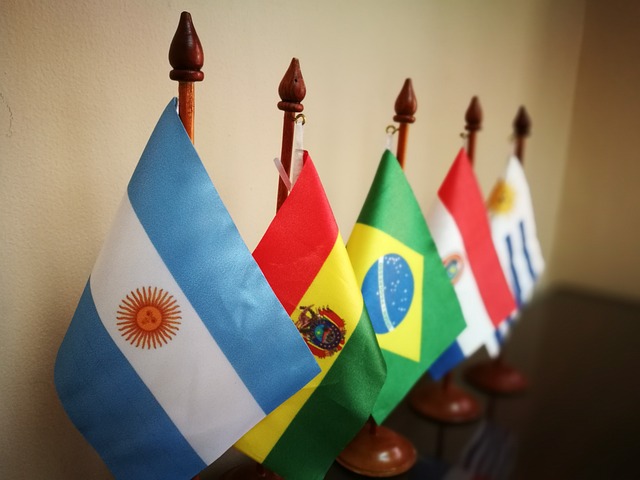
Fifty years ago, Latin American currencies fell into a spiral of collapses that led them to experience the darkest period in their modern history; today, the outlook is different, as the region is perhaps experiencing a standout moment in terms of stability: the “currency pax.” However, storm clouds on the horizon have unsettled their performance amid the global context.
So far in the 21st century, Latin American currencies have followed a clear path: structural depreciation against the dollar, but with very different degrees of stability. Mexico and Chile have managed to preserve relative value over time, Brazil has alternated between cycles of strength and weakness, while Argentina represents an extreme case of monetary destruction. But overall, nothing comparable to the abrupt, widespread devaluations of the last quarter of the 20th century, nor to the experiments with various exchange rate regimes.
According to Deutsche Bank’s currency strategy, the performance of the region’s most important currencies so far this century is as follows: the Mexican peso maintains moderate structural depreciation of between 70% and 90%, nothing comparable to the more than 1,000% seen in the last quarter of the previous century. It has gone through periods of high volatility this century, but without collapse; in fact, it is one of the most stable currencies in emerging markets.
The Brazilian real, meanwhile, has accumulated depreciation of between 170% and 220% this century, also with strong periods of volatility, but still remains attractive due to high interest rates (carry trade). The Chilean peso has depreciated between 60% and 80% during the century, but is also one of the most stable currencies in the region. The Argentine peso is another story, with multiple currency changes and controls; it is an extreme case of chronic inflation, successive devaluations, and total loss of real value. It is one of the worst-performing currencies globally this century.
Given the current global turbulence, will Latin America be able to maintain this stability, or is there a risk of a new period of extreme volatility and pressure on the region’s exchange rates?
Funds Society spoke with Pedro Quintanilla-Dieck, Senior Emerging Markets Strategist at UBS Global Wealth Management (GWM), one of the Swiss bank’s main divisions, about his outlook for the near future regarding the region’s most representative currencies.
Short-Term Weakness, the Hallmark for Latin American Currencies
In general, current analyses point to greater weakness in the region’s most representative currencies given the global context, but so far there are no signs of the kind of exchange rate collapses seen in the last quarter of the previous century.
UBS GWM shares this view: “In our opinion, Latin American currencies have greater protection against global volatility thanks to structural fundamentals. The region stands out for stronger macroeconomic and fiscal frameworks and is relatively insulated from geopolitically conflictive areas. In addition, Latin America produces commodities that are increasingly in demand, such as copper in the energy transition and agricultural products in a context of vulnerable supply chains. In this environment, the Brazilian real stands out for its resilience, supported by high interest rates and strong external accounts thanks to agricultural and energy production,” notes Pedro Quintanilla.
According to the expert, this strength is the result of decades of fiscal discipline in many countries in the region, as well as control of factors such as inflation, and more broadly, structural adjustments that contributed to the exchange rate stability the region is experiencing today.
Below is the analysis provided by the UBS GWM expert on the region’s main currencies and, above all, the institution’s medium-term expectations for each of them.
Chilean Peso: Impacted by the War, but Resilient in the Medium Term
In net terms, the Chilean peso has depreciated slightly against the dollar. Until the end of February, factors such as attractive valuations, high copper prices, and a generally weak dollar supported the Chilean peso. However, since the start of the conflict with Iran at the end of February, the peso has become one of the most depreciated emerging market currencies, due to the sharp increase in oil prices, which negatively affects the country’s terms of trade, given that Chile imports 100% of the oil it consumes.
As the conflict eases and oil prices normalize, the Chilean peso is likely to resume its appreciation trend. In addition, there are idiosyncratic factors that could support the currency, such as accelerated growth driven by the pro-business agenda of Kast’s new government, which includes tax cuts and deregulation. The Chilean peso is currently trading at 915 per dollar, but in this context we expect it could close the year around 870 per dollar, approaching levels seen before the conflict.
Argentine Peso: Structural Reforms Will Continue to Support It
In our view, the accumulation of international reserves and progress in structural reforms continue to reduce country risk and support the transition toward a more flexible exchange rate regime. The central bank has purchased nearly $4 billion so far this year and is expected to exceed $10 billion in 2026. In addition, rising oil prices benefit the peso, as Argentina is a net exporter. We expect the exchange rate to close the year at 1,700 pesos per dollar.
Brazilian Real: The Strongest Currency in the Region
The Brazilian real is the emerging market currency with the greatest appreciation so far this year, advancing 6% against the dollar. This performance has been driven by high commodity prices, historically high interest rates, and a gradual rate-cutting policy. In addition, as a net oil exporter, Brazil has been shielded from depreciation pressures during the Middle East conflict, benefiting from stronger terms of trade and higher fiscal revenues.
We believe these factors will continue to support the real in the short term. As the conflict subsides, Brazil will lose the additional boost from oil but could benefit from a better global environment and a generalized weakening of the dollar. Ahead of the October elections, the real could face slight depreciation. It is currently trading at 5.1 per dollar; we estimate it could approach 5 in the coming months, although it will likely close the year around 5.5 per dollar.
Mexican Peso: USMCA Developments Will Bring Volatility
Our projections point to a gradual appreciation of the peso going forward, with levels of 17.7 by the end of the second quarter of 2026, 17.5 in the third quarter, and 17.2 by year-end and in the first quarter of 2027.
This scenario assumes a moderation of global tensions and greater stability in financial markets. However, we anticipate a non-linear path, with episodes of volatility linked to both external and domestic factors, particularly around the USMCA and monetary policy decisions in Mexico and the United States.
Thus, while most analyses point to weakness in regional currencies in the coming months due to various geopolitical and internal factors—or a combination of both—there currently appears to be no risk of a collapse of the “currency pax” that has characterized this part of the world so far this century, unlike what occurred in the final three decades of the 20th century.