José Corena (MFS): “A Machine Cannot Understand a Relationship Between An Advisor And A Client That May Have Developed Over 30 years”

  |   By  |  0 Comentarios

Photo courtesy

Macro and geopolitical uncertainty, interest rates that have stayed higher for longer and high index concentration are testing investors and their advisors alike. Now artificial intelligence is adding a new source of noise to the advisory relationship – “and clients are really listening to AI”, warns José Corena, Managing Director of the Americas at MFS Investment Management. In an exclusive interview with Funds Society, Corena explains why Latin American investors are unlikely to fall out of love with fixed income, and why liquidity concerns suggest private markets may already have peaked: “We have probably already seen a peak in private credit and private equity.”

Corena also makes the case for active management, highlighting MFS Meridian Funds – Contrarian Capital Fund and the firm’s Blended Research range, which combines fundamental and quantitative research. He also discusses the expansion of MFS’ active ETF line-up and what it takes to get new products onto distribution platforms.

Finally, he reflects on a year of change in MFS’ regional team, which spans Chile, Uruguay, Brazil, Colombia, Miami, New York, Texas and the U.S. West Coast, and explains why having people on the ground remains central to its strategy.

With markets this complex, what are clients really asking for?

Simple: they don’t want to lose money. That sounds straightforward, but markets have become far more complex. Geopolitical fragmentation is reshaping trade and investment decisions, interest rates have stayed higher for longer than expected, and a handful of stocks now dominate the major indices. When so much of the market rests on so few names, owning the index is not quite the safe harbour it seems – and research, selectivity and genuine diversification start to matter a great deal more.

On top of that, AI is adding another layer of noise between advisors, their teams and their clients – and clients are really listening to it.

Latin American investors have long had a love affair with fixed income. Is it still justified?

Very much so. Latin American investors will always have a soft spot for fixed income, and today the asset class is giving them good reason. After years of near-zero rates, bonds are once again offering something investors had almost forgotten about: meaningful income. For clients, that combination of income, diversification and liquidity is hard to ignore.

Some investors have been looking for that income in private credit. But I think we have probably already seen a peak in private credit and private equity. Clients are increasingly asking what they are really being paid to lock up capital for seven or ten years, and in our view the reward for illiquidity has been shrinking. Public credit, by contrast, offers attractive yields and solid fundamentals – and you can get your money back when you need it.

That doesn’t mean fixed income is a market to own blindly. Not every borrower is equally well placed, so research and careful credit selection make a real difference. Each country also has its own dynamics. In Mexico, institutional investors have plenty of local fixed income opportunities, while Chile‘s pension reform could bring greater flexibility in asset allocation. But the common thread across the region is the search for reliable income without giving up liquidity.

MFS is a committed active manager. How are you responding to the shift towards passive?

We are a global active manager with more than 100 years of history, and we are fully committed to public markets. We don’t do alternatives, private credit or private equity. Instead, we focus on what we do best: active management across public equity and fixed income, allocating capital responsibly and always with a long-term lens.

That said, we recognise that investors have choices – between active and passive, and between vehicles, from traditional mutual funds to the growing area of active ETFs. We launched our first active ETFs in the U.S. in December 2024 and now have 13, covering U.S. and international equities as well as fixed income. They have been very well received, with assets of more than $3 billion, and tax-loss harvesting has been an important driver of demand.

Active management is here to stay, even if it increasingly sits alongside low-tracking-error strategies, active ETFs and passive products. The Magnificent Seven have done extraordinarily well, but that doesn’t mean the other 493 companies in the S&P 500 lack potential. Concentration doesn’t last forever. New competitors emerge, and AI is lowering the barriers to entry, which could accelerate that process. As market leadership broadens, active managers are well placed to find the next generation of leading companies.

Which strategies are standing out this year?

Two in particular – and on the surface they couldn’t be more different, which is exactly the point. One goes where other investors fear to tread; the other makes sure we don’t miss what the market has overlooked.

MFS Meridian Funds – Contrarian Capital Fund is built on a simple truth: markets change, but human nature doesn’t. When a company hits trouble – a management misstep, a supply-chain snag, a cyclical slump mistaken for structural decline – fear takes over and investors sell first and ask questions later. That is when perfectly sound businesses end up trading well below what they are worth. Our portfolio managers, Anne-Christine Farstad and Zahid Kassam, lean into that discomfort rather than run from it. As they like to put it, you buy where it hurts.

Buying cheap shares is the easy part; the real skill is telling a temporary setback from a permanent one. We don’t invest in certainty – we invest in probabilities. The lower the price we pay, the less needs to go right, so a margin of safety is non-negotiable. So is a strong balance sheet, which buys a company time to fix what went wrong. When the dust settles and the fundamentals shine through again, that is when we believe the share price can bounce back. The result is a concentrated portfolio, built stock by stock with no regard for benchmark weights. Notably, it has no technology exposure today – and that is no accident. Tech is the market’s favourite trade, and the valuations show it; there is nothing contrarian about paying top prices for what everyone already owns. Even so, since its launch in November 2024, the fund has outperformed its benchmark, the MSCI World Value Index, and passed US$1 billion in assets in less than two years.

Blended Research takes a very different route to the same destination – generating alpha for clients. Every stock gets two independent opinions – one from our fundamental analysts, one from our quantitative models – and we focus on the “intersection” stocks that both rate positively. Quantitative models tend to shine when markets are driven by momentum; fundamental research comes into its own when momentum fades. Together, they give us human judgement and machine discipline across a far broader universe of securities. Long before AI became the talk of every boardroom, we were putting people and models to work side by side: we launched our first Blended Research strategy in 2001, so this is a capability with a 25-year history. Different routes, same conviction – in today’s concentrated markets, the best opportunities are often where the crowd isn’t looking.

Fee-based advisory is growing in U.S. wealth management. Is Latin America following?

In the U.S. offshore business serving non-U.S. clients, advisors increasingly see the benefits of the advisory model. Larger teams are forming because they are building businesses around longevity and generational planning, not individual transactions.

Generational and technological change mean advisors need time to build relationships with clients and their wider families. But transactional business won’t disappear. I expect the two models to coexist – some clients will want an advisory relationship, others won’t – and we can serve both.

The Southern Cone faces a particularly tough transition from brokerage to advisory, and reaching U.S. levels of advisory penetration would be hard given how the independent ecosystem works. Independent brokers rely on trailers, or retrocessions, as their advisory fee, and they don’t have the scale or time to work with 15, 20 or 25 fund houses, so they focus on five or ten. There are advisory elements in their model, but it is not true advisory.

How do you get new products onto those platforms?

We have a dedicated team of relationship managers working across our U.S. domestic, international and global platforms. Platforms have become more selective. Many products were approved 20 or 25 years ago, so firms already have a large line-up to review. The question now is simple: what makes a new product distinctive enough to justify adding it?

On the independent side, platforms such as Insigneo – one of our largest clients in Latin America – matter a great deal, and Insigneo has been relatively open to new products. Launching in the Southern Cone can also help us build scale, which in turn strengthens the case for those products with U.S.-based clients. We have some distinctive strategies coming to market, and we hope they will reach the critical mass needed for approval.

It has been a year of change for your regional team. What does that mean for the clients and advisors you work with?

It has probably been the year of most change for our team, and most of the moves were personal decisions. We are known for our low turnover as a firm, in both the investment department and even in distribution. Sometimes when long-tenured colleagues leave, it is a good reminder that change is constant.

What does not change is the continuity and the priority of having people on the ground. Advisors want a partner who understands their market, picks up the phone when markets get difficult and brings our global research to their clients’ portfolios. We want to be the people advisors call before they talk to their clients, not after.

Finally, what role will AI play in the future of investment and advice?

AI is here to stay. I tell my team that AI will not replace us, because nothing can replicate face-to-face interaction – understanding the person and the relationship.

But if you are not using AI, you will be replaced. Used well, it can make us far more efficient.

The problem is that it adds to the enormous amount of noise we already get every day from social and mainstream media – and different platforms can give different answers. For example, we have seen advisors prepare detailed proposals, only for clients to upload them into an AI tool and ask whether they make sense. The answer can point to a passive solution, even when the whole conversation was about meeting an actively managed investment need.

That doesn’t make those recommendations right or wrong. But a machine cannot understand a relationship between an advisor and a client or family that may have been built over 20, 30 or 40 years. AI can read the document; it cannot understand the context behind the relationship.



Is There Still Room for Alpha in North American Private Equity?

  |   By  |  0 Comentarios

North American Private Equity Panel at the Picton Latam Summit 2026

In a context in which private equity has failed to reach the performance of public equities, returning below the S&P 500 and the MSCI ACWI over one, three, and five years, the question regarding the value of the illiquidity premium is once again on the table. The fact is there is a question hanging in the air: Is there still room to generate alpha in the asset class? Especially in North America, where the United States remains the largest and deepest market for private capital.

This is the question that brought together a panel of specialists from major specialized asset managers, convened by the Latin American distribution firm Picton, at the latest edition of its Latam Summit. Before an audience of GPs and LPs from various corners of the region, investment professionals outlined a landscape in which everyone is competing for the most attractive assets and dispersion is forcing investors to be more selective.

“There is performance, but you have to look at where to be,” said Nigel Beslee, Managing Director at Goldman Sachs. There is a major positioning challenge for investors, with the task of allocating conscientiously across different asset classes, against a backdrop of high uncertainty, significant market movements, and a technology narrative that is dictating the pace of trading desks globally.

“Nobody is aiming for median returns in PE,” the executive emphasized, as everyone is hunting for the highest returns.

“Rather than themes like sector or strategy, it is company-specific factors that drive alpha,” recalled Luca Salvato, Partner at Ares. In addition, there is the factor of certain “existential risks,” such as the AI revolution, which are difficult to quantify in a historical context given their nature as an unprecedented technology.

Against this backdrop, the professional emphasized market timing. “The timing in which a manager decides to sell the asset can generate a lot of alpha,” he assured.

The Technological Revolution

While private capital and public equity have different dynamics and characteristics, the professionals on the panel warned that private equity faces the challenge of beating a public equity market that has periodically been reaching new highs in recent years. This is mainly thanks to the effect of the stocks known as the Magnificent Seven—Alphabet, Amazon, Apple, Meta Platforms, Microsoft, Nvidia, and Tesla—which group together the firms considered captains of the AI boom.

Between that and an ecosystem where investment cycles are increasingly longer, investors must find ways to access growth vectors at reasonable prices. “There is a massive trend of private for longer, especially in high-growth tech companies,” said Michael Zappert, Partner at TPG, so LPs must carefully evaluate how to access this category.

In that regard, those in the PE industry see an interesting source in the application of this technology within their portfolio companies. This, Zappert noted, can generate significant value, as “AI is going to change every aspect of work.”

Since it is currently difficult to access the major tech firms leading on this front, the professional does see more opportunities in this wave of application.

Beslee agreed with the reading, highlighting that it is “difficult” not to see AI as one of the largest market factors; while Salvato added that, although this technology will not necessarily be a major generator of alpha in the asset class, it will undoubtedly boost the companies they invest in.

Increasing Diversity of Structures

In addition to creativity in capturing AI tailwinds, the current context forces GPs to be more creative with the structuring of investment vehicles as well. “It’s about being thoughtful about the spaces where you can do something different,” in the words of Zappert; while Salvato emphasized that one cannot deny the importance of managers in asset management, given the increased sophistication of the environment in North America.

All panelists commented on their experiences applying this greater flexibility, as is the case with Leonard Green. David Kass, Partner at the firm, recounted that at the company they have had to remain flexible with the structuring of vehicles when the assets are good and fit with the firm’s investment philosophy.

Different avenues can even be pursued to invest in a diversified manner within the asset class. In the case of Goldman Sachs, they highlighted the GP Stakes strategy, which invests in stakes of specialized asset managers.

The Importance of Liquidity

In any case, professionals agree that liquidity will continue to be one of the key variables going forward in the world of private capital. “There is massive pressure for liquidity,” said Zappert, especially with the strong influx of capital that the asset class recorded in 2021. The prevailing trend in portfolios, he stressed, is toward having a higher level of liquidity, not less.

For that reason, a space that has opened up strongly is that of secondary funds and continuation vehicles, which have created new liquidity spaces for PE managers. The industry is focusing on DPI (Distributed to Paid-In Capital, the ratio of distributions to invested capital), commented Kass, so distributions generate their own pressure on portfolio management. “At some point, you have to generate liquidity,” he said.

Looking ahead, Salvato added, continuation vehicles “are here to stay” and “are becoming an important part of the ecosystem.” However, he warned, this space also features a high level of dispersion in results.

Latam Financial Services Appoints Martín Herbon as Managing Partner

  |   By  |  0 Comentarios

Photo courtesyMartín Herbon, Managing Partner at Latam Financial Services

After nearly three years on the Latin American distribution team at M&G Investments, veteran executive Martín Herbon is setting off in a new direction. The executive was recruited by Latam Financial Services, a firm that distributes the UK asset manager’s vehicles—among others—in the region.

The company informed Funds Society of the addition, highlighting that Herbon is “one of the top mutual fund distribution executives” in Latin America. His hiring, they explain, comes as the distribution firm expands its business in the region.

Herbon has more than 20 years of experience in the investment industry. He currently serves as Head of Global Financial Institutions at M&G Investments in London, forming part of the senior leadership team for the distribution business across Latin America, EMEA, and Asia-Pacific.

Previously, he held the same role at Natixis Investment Managers, a firm where between 2014 and 2021 he was Country Head for the Southern Cone, building an extensive network of relationships with private banks, family offices, independent advisors, pension funds, and sovereign institutions in the region.

Prior to that, he held leadership positions in portfolio management, investment strategy, and high-net-worth client advisory at RBC Wealth Management, Merrill Lynch, and Union Capital Group.

Latam Financial Services represents the asset managers M&G Investments, Nuveen, and Virtus Investment Partners, with a focus on the US Offshore and Latin American markets. Its strategy is developed from two hubs: its Miami office and its Montevideo office.

What Are Semi-Liquid Funds?

  |   By  |  0 Comentarios

Pixabay CC0 Public Domain

For years, investing in private markets implied accepting a demanding commitment: locking up capital for eight, ten, or more years, with no real possibility of early exit. Semi-liquid funds emerged to soften that restriction and bring these asset classes closer to a broader investor audience.

It is a middle ground between two worlds. A semi-liquid fund is a vehicle that invests in non-publicly traded assets, such as unlisted companies, private loans, infrastructure, or real estate, but offers the investor a certain capacity to enter and exit on a periodic basis. It is thus situated between traditional funds with daily liquidity and classic closed-end private equity funds.

The key difference lies in frequency. While a conventional equity fund allows participations to be redeemed on any business day, a semi-liquid fund typically opens liquidity windows on a monthly, quarterly, or even semi-annual basis.

How Liquidity Is Managed

The underlying assets cannot be sold overnight without sacrificing value. For this reason, these funds incorporate protection mechanisms for the benefit of all unitholders. The most common are:

  • Advance notice: Investors must communicate their intention to exit weeks or months in advance.
  • Redemption caps: Many funds set a limit per period, for example, a percentage of total assets. If requests exceed this limit, they are met on a proportional basis.
  • Initial lock-up periods: A minimum holding period is common before requesting an exit.
  • Liquidity reserves: Part of the portfolio is kept in more liquid assets to meet ordinary redemptions.

These mechanisms are not a flaw, but part of the design. They acknowledge that the illiquidity of the asset is inherent to the strategy.

What the Investor Looks For

The main appeal is the illiquidity premium: the additional return that, in theory, is obtained by holding assets that cannot be sold quickly. Added to this are diversification—since private markets have dynamics different from public ones—and access to opportunities not available on the stock exchange.

Furthermore, the format lowers barriers. Many semi-liquid vehicles allow lower minimum investments than traditional closed-end funds and avoid staggered capital calls, where investors must contribute funds as the manager requests them.

Risks and Points of Attention

Liquidity is “semi,” not total. In stress scenarios, when many unitholders want to exit at the same time, limits can be activated and delay payment. It is crucial, therefore, not to consider these investments as capital for immediate use.

Attention should also be paid to valuation. As these are unlisted assets, their price is calculated through models and periodic appraisals, rather than daily market quotes, which can artificially smooth apparent volatility. And, as with any alternative strategy, fees tend to be higher than in traditional management.

A Tool, Not a Universal Solution

Semi-liquid funds expand options for those seeking to diversify beyond equities and fixed income. Their usefulness depends on the investor’s time horizon, liquidity needs, and understanding of the exit terms. Reading the prospectus in detail, understanding the redemption rules, and allocating only a prudent portion of the portfolio are basic practices before investing.

International Firms See Room for Further Rallies in Brazilian Equities Following First Round

  |   By  |  0 Comentarios

Wikimedia CommonsPresidential Candidates of Brazil: Flávio Bolsonaro (left) and Luiz Inácio "Lula" Da Silva (right)

The strong rally in Brazilian equities following the first round of the presidential election reinforced international firms’ positive view on the country’s stocks. In analyses distributed after the vote, a range of international investment houses point to fundamentals supporting a continuation of the movement, backed by expectations of greater fiscal discipline, lower interest rates, and a resurgence of investor interest in companies linked to the domestic economy. The realization of this scenario, however, will depend on the next government’s proposals and its ability to execute them.

The Ibovespa advanced 7.70% on Monday, October 5, closing the first post-election session at 206,911.89 points. The reaction occurred after Flávio Bolsonaro finished the first round ahead of Luiz Inácio “Lula” da Silva, contradicting the president’s lead shown in some polls. The movement was accompanied by a drop in future interest rates and an appreciation of the real.

Foreign flows also gathered strength: international investors made net contributions of 10.06 billion reais into Brazilian equities during that session, the largest daily balance in the series tracked by Bloomberg since 2008.

UBS Sees Upside Potential Exceeding 30%

In the report published prior to the market open on Monday, UBS moved to adopt a “deeper and more lasting” fiscal adjustment as its base-case scenario. For the team, the higher probability of a change in government, combined with the composition of the new Congress, increases the chances of a credible fiscal anchor featuring spending control, a revision of indexation mechanisms, and a reliable trajectory of primary surpluses.

“We believe that domestic-linked equities, local interest rates, and the Brazilian real—in that order—should benefit substantially from a higher probability of this fiscal scenario,” states the report, signed by Alejo Czerwonko, Luciano Telo, Solange Srour, Ronaldo Patah, and Debora Nogueira.

According to UBS’s evaluation, the Brazilian market was trading at 8.7 times forward earnings, below its ten-year historical average of 9.7 times. If the fiscal scenario is confirmed, this multiple could approach 11.8 times.

“Combined with lower real interest rates influencing earnings expectations, this could translate into an upside potential exceeding 30% for the index over the coming months,” the team writes.

The estimate was formulated prior to the post-election session jump and therefore does not represent a projection of an additional 30% gain on top of post-rally prices.

Banks, retail, real estate developers, utilities, education, healthcare, and small caps are among the segments most sensitive to this shift. UBS also identifies room for a rotation out of oil stocks and into companies tied to domestic activity.

“If past election cycles serve as a benchmark, equity re-ratings would likely extend throughout the entire first year of the new administration, far beyond the initial post-election rally, as reform proposals advance through Congress and markets gain confidence in policy execution,” the report states.

Julius Baer Maintains Overweight Position

Julius Baer maintained its overweight recommendation on Brazilian equities. According to Nenad Dinic from the equity strategy area, the election outcome began resolving the risk-reward asymmetry identified prior to the vote in favor of the bullish thesis.

“We maintain our overweight position. The asymmetric risk-reward profile we identified before the first round is beginning to resolve in favor of our bullish thesis, with a Bolsonaro victory likely favoring faster fiscal consolidation, lower long-term interest rates, and an accelerated monetary easing cycle,” he states.

The combination of high real interest rates and low multiples offers, according to the firm, significant room for an equity re-rating.

“With real interest rates currently around 10% and local equities trading at 8.7 times forward earnings, the re-rating potential is substantial,” Dinic writes.

The strategist emphasizes, however, that electoral uncertainty should persist until the second round on October 25. Debates and initial details on fiscal proposals will remain at the center of investor attention.

Franklin Templeton Reaffirms Positive Outlook

Franklin Templeton also reaffirmed its favorable view on Brazilian equities. Larry Hatheway, Head of Research at the Franklin Templeton Institute, links this perspective to attractive valuations, earnings growth, and the possibility of falling inflation and bond yields.

“Attractive valuations for Brazilian equities and earnings growth, together with a backdrop of likely declines in inflation and bond yields, reaffirm our positive outlook on Brazilian equities,” he states.

This reading forms part of a broader conviction within the institution that investors should diversify their equity holdings beyond the United States, including emerging markets.

In local-currency Brazilian debt, Hatheway maintains a favorable assessment but adopts greater caution following asset appreciation.

“Most of the returns we anticipated between now and year-end have already materialized. Therefore, while we remain positive, we are now slightly more cautious regarding future returns,” he explains.

Aubrey Highlights Domestic Investor Capital

For Rob Brewis, Director and Manager at Aubrey Capital Management, the composition of Congress will be important for enabling deeper fiscal reforms.

“A deeper fiscal reform would need its support, and we would expect the Senate taking office next year to be more open to it than the current one,” he states.

Beyond foreign flows, Brewis highlights a potential domestic driver for the stock market. With high real interest rates, local investors had little incentive to shift resources from fixed income into equities. A shift in this landscape could expand demand for the asset class.

“The story for Brazilian equities is domestic. Local savers hold most of their money in fixed-income securities, and with real interest rates so elevated, there has been little reason to change,” he says.

“The test is knowing whether there will be fiscal discipline. If there is, and interest rates come down, we believe even a modest migration out of fixed income could, over time, represent a significant boost for equities,” he adds.

Vontobel Sees Revaluation Beyond the Stock Market

Thierry Larose, Portfolio Manager and Analyst at Vontobel, identifies a relief movement reaching across different markets. In comments sent following the initial reaction to the results, he highlighted the real’s appreciation of over 4% against the dollar, a drop of more than 100 basis points in DI futures yields compared to Friday’s close, and a tightening of credit spreads between 20 and 25 basis points.

“Investor confidence is boosted by expectations that the new government will quickly present a strong economic team, ambitious fiscal adjustment targets, and a constitutional amendment proposal shortly after the election,” he states.

The assessment continues Vontobel’s pre-election reading, which had already identified a favorable risk-reward ratio in fixed-rate government bonds.

“In our assessment, yields could compress considerably more under a Bolsonaro victory scenario than they might rise under a Lula re-election. In our view, this creates a very attractive asymmetric risk-return profile,” the firm noted.

Janus Henderson: The Market Will Demand Execution

Despite the favorable reaction, Janus Henderson emphasizes that the election results must still translate into concrete economic measures.

Thomas Haugaard, Portfolio Manager on the hard-currency emerging market debt team, considers that the first round increased the likelihood of a more market-friendly orientation. However, detailed fiscal proposals remain limited.

“Neither campaign has yet provided sufficient clarity regarding the pace, composition, or policy implementation of the adjustment,” he states.

For Haugaard, fiscal credibility remains the primary medium-term variable. A disciplined program could reduce the sovereign risk premium, improve debt dynamics, and encourage capital inflows.

“The market will ultimately demand policy execution, not merely campaign signals,” he underscores.

Aberdeen Demands Credible Proposals

Viktor Szabó, Investment Director of Fixed Income at Aberdeen Investments, also places the fiscal issue at the core of the analysis. While he considers that the new congressional composition could facilitate coalition building under an eventual Bolsonaro presidency, he emphasizes that the contest remains open.

“For markets, however, the central question remains Brazil’s fiscal outlook—its long-standing Achilles’ heel,” he states.

“Bolsonaro now needs to demonstrate that market expectations regarding stronger primary balances and fiscal reform are backed by credible proposals, rather than campaign rhetoric,” he adds.

In Szabó’s assessment, commitments made during the second-round campaign will carry more weight for markets than initial political momentum.

“The promises and commitments both candidates make over the next three weeks will matter more than the political momentum dominating the headlines,” he states.

Ebury Warns About the Duration of the “Honeymoon”

In the currency market, Diego Barnuevo, Senior Market Analyst at Ebury, sees room for a positive reaction from Brazilian assets driven by expectations of fiscal consolidation.

“The first-round surprise should initially translate into a positive reaction for Brazilian assets, including the real, supported by expectations of a more aggressive fiscal consolidation and a more sustainable growth model under an eventual Bolsonaro presidency,” he states.

The fintech considers, however, that the burden of mandatory spending limits the ability to execute significant expenditure cuts. If Bolsonaro wins, investor focus should shift toward government composition and the fulfillment of fiscal commitments.

“Fiscal announcements have so far been notably vague. Any disappointment on this front could quickly shorten the real’s honeymoon period,” Barnuevo warns.

Among international firms, expectations of fiscal adjustment and lower interest rates underpin the favorable outlook for Brazilian assets. The continuation of this movement will depend, however, on translating electoral expectations into an economic agenda capable of securing political support and producing results.

U.S. Inflation in September and Implications for the Fed

  |   By  |  0 Comentarios

Pixabay CC0 Public Domain

Inflation concerns continue to be the heaviest factor explaining short-term equity movements. The consensus among economists anticipated a strong U.S. inflation reading for September, which ultimately surprised on the downside: headline CPI reached +0.6%, in line with the year-over-year rate moving from 3.4% to 3.7%, while core CPI came in at +0.3% versus the +0.2% expected, shifting from 2.4% to 2.6% year-over-year. Its impact was amplified by the proximity of the Federal Reserve meeting scheduled for the 28th.

However, we believe the release was not strong enough to justify another rate hike in October. Beyond the impact of rising energy costs and the effect of AI investments on the prices of PCs, software, and mobile phones, the only aspect to monitor is the uptick in Owners’ Equivalent Rent (OER), which rose compared to the previous month.

The market’s immediate reaction to the data was to push expectations of a 25-basis-point rate hike in federal funds higher: probabilities spiked above 70%, only to quickly retreat to 12.7%, the lowest level since June. The September retail sales data (which deteriorated relative to August), the moderation in import prices shown in the Philadelphia Fed survey, and comments from Mary Daly (San Francisco Fed) and Michelle Bowman—who do not foresee a rate hike this month—exerted downward pressure on that probability, aiding the Treasury bond market. Regarding the U.S. Treasury bond, we do not believe that developments in the neocloud sector, discussed in the next section, were the main driver behind the yield compression. Investment in AI will continue to contribute positively to GDP in the coming months.

AI: Neocloud Strain and Ongoing Adoption

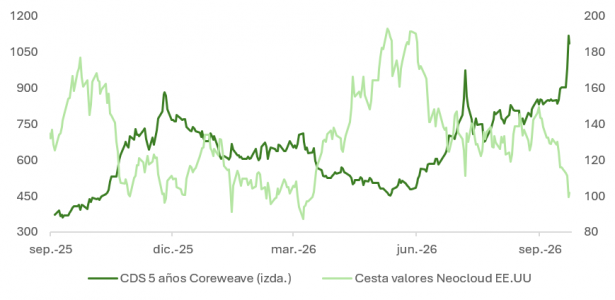
Inflation and its initial effect on the Treasury yield (which exceeded 5.32% on Wednesday before stabilizing near 5.08% on Friday) was also the catalyst for the sharp drop in share prices among neocloud companies. CoreWeave alarmed investors at the worst possible time by communicating that it would like to achieve an investment-grade credit rating to finance its growth on an “unlimited” basis. Its debt fell below 80 (against a par value of 100), having traded at par just a few months ago, while its CDS priced in a more than 50% probability of default over the next five years.

We consider this an isolated case affecting a subsegment of technology companies with higher financial leverage and greater sensitivity to rate hikes, rather than a red flag for the broader set of companies linked to the AI theme.

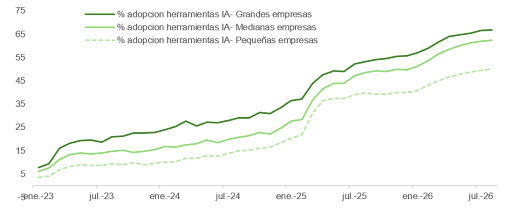
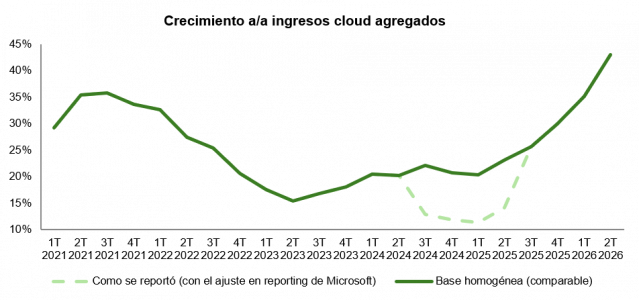
For now, the adoption of paid AI services among both large and small enterprises continues to advance, rising from 8% in large firms and less than 4% in small ones at the start of 2023 to 67% of large, 62% of mid-sized, and 50% of small businesses today—all within just three and a half years. Moreover, investments are being monetized: aggregate cloud revenues among major compute providers grew 43% year-over-year in the second quarter, based on nearly $370 billion over the last twelve months.

Geopolitics and the “Incompetence Premium” in U.S. Debt

In the short term, the evolution of inflation readings will be determined primarily by geopolitical factors. In this regard, uncertainty has heightened recently: Iran, through its Revolutionary Guard, has intensified threats against vessels that might “illegally” attempt to trade or load oil in the strait. Similarly, the Wall Street Journal reported comments from Iranian authorities regarding the deployment of troops to carry out retaliatory actions against U.S. allies in the Gulf.

As we have been explaining, one of the Iranians’ objectives is to keep the price of crude oil near $100 per barrel to minimize Trump’s chances of retaining control of the Senate as much as possible. However, the escalation in hostilities places Iran in a difficult situation to manage: overreaching in its pressure could hand Trump the justification he needs to strike with greater force once control of both houses is lost on November 3.

A poorly explained war, an imprecise central bank, and Treasury buybacks too small to move the needle have exasperated fixed-income buyers. Some strategists are already referring to an “incompetence premium” impacting the pricing of U.S. sovereign debt.

Woodford, Warsh, and the Abandonment of Forward Guidance

This is why the coincidence surrounding Kevin Warsh’s abandonment of forward guidance—which likely affected the structure of the yield curve—and the Nobel Prize in Economics awarded to Michael Woodford, arguably the academic who put the most effort into establishing a theoretical foundation for that concept, remains curious. The award arrived last Monday, October 12, four months after Warsh dropped the concept in the FOMC statement on June 17. That said, the contradiction is smaller than it appears at first glance.

In Interest and Prices (2003), Woodford argued that monetary policy operates primarily through expectations of the future rate trajectory rather than the rate applied today. At Jackson Hole (2012), he extended that concept to zero-lower-bound (ZIRP) environments. His recommendation was to communicate guidance state-contingent on the economy rather than tied to a calendar date. The Fed implemented this in December 2012 by incorporating unemployment and inflation thresholds into the FOMC statement.

His subsequent work with García-Schmidt (2019) on economic agents planning over finite horizons significantly tempers the impact of long-term projections. Thus, within his own body of work, we find reasons to believe that guidance was less potent than the models suggested.

In reality, the disagreement with Warsh lies in substance, not form. For Woodford, what must be communicated is the central bank’s reaction function to incoming data, not the path of interest rates. Warsh states that guidance has “outlasted its usefulness” and offers instead a “framework” or “roadmap,” provided it is not termed forward guidance. This closely aligns with abandoning the rate trajectory while retaining the reaction function—which is precisely what Wall Street requested.

Furthermore, an important nuance exists: Woodford advocated guidance as a tool specifically when rates are at zero. With federal funds at 3.75–4%, its marginal utility is significantly lower. Therefore, in my view, extrapolating what occurred post-COVID (in 2021, the issue lay in committing to a rate path in an unprecedented environment amid runaway inflation) with Powell’s “transitory inflation” commentary and the resulting loss of credibility would be a mistake.

What occurred then does not prove that communicating the Fed’s reaction function to the market is useless. The risk lies in leaving the market to guess it, which inherently increases uncertainty, noise, and volatility in the fixed-income market.

In summary, the Fed’s reaction function is the rule, explicit or implicit, that translates the state of the economy into a rate decision. Communicating it means telling the market how the Fed decides, without promising what it will do.

Communicating the reaction function establishes the rule: the market continues to react to data, but in the direction and magnitude intended by the Fed—exactly what Woodford advocated. The question with Warsh is whether, in removing guidance, he will also cease to communicate the rule.

Historic Record in Assets Under Management: BlackRock Crosses the $15.5 Trillion Threshold

  |   By  |  0 Comentarios

Photo courtesyLarry Fink, CEO and Chairman of BlackRock.

In its third-quarter results presentation, BlackRock announced that it has crossed the $15.5 trillion threshold in assets under management (AUM), driven by $869 billion in net inflows over the last twelve months, representing organic growth in base fees of 10%. “These results demonstrate the value of our integrated platform, as clients increasingly choose us as a partner in investment, financing, and technology. That client trust is translating into greater earnings power, with shareholders benefiting from a more than 35% year-over-year increase in adjusted earnings per share, an adjusted operating margin of 47.8%, and annualized organic base fee growth of 11% in the third quarter,” highlighted Larry Fink, CEO and Chairman of BlackRock.

This momentum is reflected in the $205 billion in net inflows recorded during the third quarter and an 11% annualized organic base fee growth, reflecting broad-based strength across iShares ETFs, systematic active equities, private markets, and cash. In this regard, Fink added: “Clients entrusted us with $205 billion in net inflows this quarter, and $869 billion over the past year. Our results reflect BlackRock’s scale, with 12% growth in technology ACV (Annual Contract Value) and net inflows across all asset classes, client types, regions, and in both active and index management.”

Solid investment performance drove $66 billion in active net inflows led by fixed income and systematic franchises, while iShares generated $135 billion in net inflows. “BlackRock brings together issuer relationships built over decades, financing expertise, investment performance, and the technology and data that connect everything. That combination is differentiating us in every region,” commented the CEO, highlighting the securing of mandates at the forefront of capital markets, raising $68 billion in private markets over the past year, and the first deployment of its AI Infrastructure Partnership. “We are entering our seasonally strongest fourth quarter with accelerating momentum and a broad pipeline. Demand for capital is growing across the global economy, and BlackRock is increasingly at the center of how that capital is deployed and managed,” Fink concluded.

Business Lines

On a financial level, investment advisory, administration fees, and securities lending revenue increased by $990 million compared to the third quarter of 2025, driven by organic base fee growth and the impact of market beta on average AUM. Compared to the second quarter of 2026, the increase was $310 million, also supported by the effect of one additional day in the quarter. Within this category, securities lending revenue reached $253 million (compared to $203 million in the third quarter of 2025 and $239 million in the second quarter of 2026), reflecting higher spreads and higher average balances of securities on loan.

On the other hand, performance fees grew by $114 million compared to the third quarter of 2025, primarily due to higher revenues from liquid alternative products related to a single hedge fund, partially offset by lower revenues in private markets. Compared to the second quarter of 2026, these fees increased by $325 million, driven by liquid alternative and private market products.

The firm’s technology business continued its expansion with 14% growth in technology services and subscription revenue year-over-year. In figures, this represented an increase of $73 million compared to the third quarter of 2025 and $22 million compared to the second quarter of 2026, reflecting sustained demand for Aladdin and multi-product solutions, with ACV increasing 12% year-over-year.

Finally, distribution fees experienced an increase of $59 million compared to the third quarter of 2025, an increase directly driven by the company’s higher average assets under management (AUM).

Vanguard Anticipates High-Growth Macroeconomic Environment Similar to the 1990s Driven by AI Development

  |   By  |  0 Comentarios

Canva

Not one, nor two, but three: three have been the shocks that markets have been experiencing this year. A shock produced by AI, the energy price shock on account of the conflict between Iran and the United States, and, more recently, the sharp correction seen in sovereign debt. Josefina Rodríguez, an economist with Vanguard’s Investment Strategy Group team, recently shared at a media breakfast in Madrid how her firm’s macro vision is articulated around these three shocks. A clue: the central scenario her team’s experts are working with is more optimistic than the consensus, particularly regarding AI.

Artificial Intelligence Shock

Consensus estimates capex spending by major hyperscalers at around 1.3 trillion euros for 2026, a figure that rises to 1.7 trillion looking toward 2027… six times higher than the numbers these companies were handling a year before the pandemic, in 2019. Rodríguez noted that market expectations are high, but added that if these companies actually manage to capitalize on their investments, it will have a direct impact on the real economy and, in turn, drive private investment, particularly in the U.S.

The expert added that Vanguard’s view is that “the investment cycle will be higher and longer than the historical average, and with greater demand.” According to the firm’s calculations, private investment in the U.S. could reach 10%. Considering that investment accounts for 20% of total U.S. GDP, she anticipates that the country will grow next year at a rate of 3%, compared to the 2% anticipated by the consensus.

This optimistic view on AI will obviously be reflected in equities. The economist recalled that the current environment features high valuations backed by solid earnings, “which offer breathing room to face today’s high rates,” and indicated that the consensus forecast for next year is for corporate earnings to grow once again at a double-digit rate.

However, the expert clarified that the trajectory of the AI investment cycle will not be linear. Vanguard’s baseline scenario foresees continued gains at a rate similar to the current one over the next 12 to 18 months, followed by an inevitable market correction triggered by one of these catalysts, or a combination of several:

  • Lack of monetization
  • Commoditization of competition, with high levels of uncertainty driven by the launch of new models
  • Physical bottlenecks
  • Potentially stricter regulation

Energy Shock

The expert described the recent surge in gas prices and Brent crude climbing back above $100 as “a second wave,” referring to the initial peak recorded following the outbreak of hostilities between the United States and Iran. The difference is that this time it has been accompanied by a decoupling between refining margins and crude prices, which is also impacting final consumer prices. Furthermore, she highlighted that the spike in natural gas prices has left Europe in a vulnerable position as it entered this autumn with inventories at very low levels.

How is this energy price escalation impacting inflation? Rodríguez asked to frame the data within the context that major central banks have failed to maintain inflation at their 2% target on a sustained basis over the past five years. For her, the issue is that now the base effect of rising prices is also being channeled via goods-related inflation (transportation, for example), which carries a larger weight in the CPI calculation. Thus, Vanguard forecasts that both the ECB and the Bank of England (BoE) will raise interest rates twice each over the next six months.

The expert also detailed another important consideration when approaching inflation under these macro conditions: the possibility that the neutral interest rate could be higher than in the past. Two main factors would press against financial conditions and justify a higher neutral rate: elevated government deficits and an increase in capital demand from both governments and corporations.

Specifically, the thesis Vanguard is working with is that this neutral rate should sit above 4% in the U.S., compared to the Federal Reserve’s estimate that it should lie between 3% and 3.5%. “This could explain why the Fed has not been able to get inflation back down to its target,” commented Rodríguez.

Bond Shock

The third component of the equation is the recent correction in bonds, with the yield curve under particular pressure at the long end. Here, the economist detailed that Vanguard is working with three baseline scenarios, with its central scenario being the most optimistic of the three: a macro environment similar to that experienced in the 1990s during the expansion of telecommunications, with interest rates near 4% and inflation at 2%. This environment would be marked by AI’s ability to meaningfully boost productivity, driving growth and reducing government deficits. Additionally, the firm considers that part of AI’s transformative power could also impact longevity and healthy habits, translating into a reduction in healthcare expenditures.

The second scenario to which the firm assigns a higher probability is similar to the 1980s: AI is not transformative enough to drive productivity demand with a positive impact, leaving interest rates at 5% and inflation between 2% and 3%. It would also be a scenario marked by higher fiscal pressures.

The final scenario, assigned the lowest probability, would resemble the 1970s: a period of fiscal dominance where the Fed’s margin for maneuver would be narrow, as it could not raise interest rates sufficiently due to fiscal risks. In this scenario, rates would sit at 4% with inflation above 3%, pushing nominal rates above 7%.

Which Assets Could Perform Best?

The final part of the presentation revolved around Vanguard’s estimates regarding performance across different asset classes over the coming decade. The firm expressed a preference for fixed income assets, calculating based on its central scenario that annual returns for both equities and fixed income will hover around 5% per year over the next ten years, making fixed income the alternative offering the best risk-adjusted return.

The Boom of Generation Z and the Search for Privacy Transform the Global Art Market in 2026

  |   By  |  0 Comentarios

Photo courtesyArt Basel & UBS: "Detail of a work" by Tracey Emin, presented by White Cube at Art Basel Hong Kong 2026

The global report on art collecting produced by Art Basel and UBS points out that Generation Z has consolidated itself as the most dynamic spending engine in the art market, recording an average fine art investment of $347,460 in 2025. According to the entity, this annual study—which analyzes the behavioral patterns of 3,100 High-Net-Worth Individuals (HNWIs) across ten key markets—shows a clear evolution toward more informed purchasing decisions, the adoption of AI in searching for works, and a marked inclination toward preserving the privacy of collections.

The firm explains that entering the art world remains deeply tied to family influence, a pathway that motivated the start of 28% of global collectors and up to 40% among Gen Z youth. Furthermore, 72% of the total sample states that they received works via inheritance or legacy, recording a high retention rate among younger generations.

In global wealth allocation, collectors dedicate an average of 15% of their financial portfolios to art, a figure that rises to 23% in the Ultra-High-Net-Worth Individual segment (UHNWIs, with wealth exceeding $50 million). By discipline, painting remains in the lead, concentrating 31% of total expenditure in fine art, followed by sculpture (15%), works on paper (10%), and digital art (9%).

The New Profile of Generation Z and Asset Diversity

The study reveals differential behavior among younger collectors. In 2025, average fine art expenditure by Generation Z reached $347,460, more than doubling the average of previous generations.

Likewise, this segment led purchases in the tier above $1 million per work and showed the highest diversification toward adjacent luxury and collectible categories, such as jewelry and gems, watches, designer accessories, and collectible sneakers.

Buying Caution, Digitalization, and Artificial Intelligence

Despite strong spending, the market displays more risk-averse behavior. Following the peak recorded in 2024, the proportion of investors who acquired works by newly discovered artists dropped to 45%, reflecting a clear preference for names with a commercial track record and proven trajectory.

In the analysis and decision-making phase, digitalization is taking hold irreversibly. 58% of respondents turn to digital sources for advice, and 22% actively use Artificial Intelligence applications and tools for market monitoring, a figure noticeably higher than the 4% recorded in 2024. Investors highlight AI’s positive impact on artist discovery (67%), valuation and price analysis (64%), and authenticity verification (65%).

Commercial Multichannel Strategy and the Rise of Direct Artist Channels

Regarding acquisition channels, gallery owners and dealers consolidate their position as the industry’s central hub, channeling purchases for 87% of high-net-worth individuals over the past year. However, a consolidation of multichannel strategies is observed:

  • Gallery sales and fairs: 62% purchased in person at galleries, and a similar percentage transacted within the framework of art fairs.
  • Direct sales from artists: Experienced a notable advance to 69%, through studio visits (48%), direct commissions (40%), and transactions via social media such as Instagram (38%).
  • Auction houses and online channels: Auctions recorded the participation of 50% of collectors, while virtual marketplaces and third-party platforms captured 59% of buyers.

Privacy Management and Market Outlook

One of the report’s most intriguing contributions is the gap between digital exposure and personal privacy. In contrast to traditional patterns of conspicuous consumption, only 10% of buyers seek public recognition as collectors, while 64% prefer to keep ownership of their collections reserved for their family or inner circle. This discretion is especially pronounced among Generation Z, where 39% limit physical visits to their homes and 36% restrict access to their digital content.

Looking ahead to coming months, industry prospects are favorable. 57% of respondents anticipate that the fine art market will continue to grow for the remainder of the year, and 60% foresee positive evolution over a ten-year horizon, placing price transparency and online data security as their primary areas of focus and concern.

How Do the World’s Largest Institutional Investors Invest in Crypto?

  |   By  |  0 Comentarios

Canva

Large institutional investors have demonstrated strong resilience in their adoption of digital assets, as Bitwise asserts in its latest report, “Inaugural Report on How the World’s Largest Institutions Are Investing in Crypto Today,” noting that none reduced their exposure during the recent 50% market decline, and several even took advantage of the dip to buy more.

The report reveals that all of these investors hold Bitcoin as their core and longest-held position, increasingly treating it as an asset paired with gold within allocations that mostly range between 1% and 2% of their portfolios. Likewise, although they maintain secondary positions in Ethereum and Solana with shorter horizons and explicit exit conditions, the report emphasizes that price is not a reason to sell for any of them; they would only liquidate their investments in the event of a failure in their initial thesis, adverse regulatory changes, or an industry credibility crisis.

These institutions rarely disclose their crypto asset positions, whether for competitive or reputational reasons. This study aims to break that silence by asking managers directly which assets they hold, in what amounts, for what reasons, and under what circumstances they would sell.

The findings suggest that adoption is occurring faster and more permanently than the general public perceives, supporting Bitwise’s forecast that a majority of institutional investors will hold crypto assets in their portfolios within five years.

“Institutional investors are adopting crypto assets as a major component of their portfolios. Adoption is happening faster and more consistently than the general public may realize,” notes Matt Hougan, Chief Investment Officer at Bitwise. He adds: “Markets fell by roughly 50% between Q4 2025 and Q2 2026, yet not a single institution we interviewed reduced its allocation during the sell-off, while several bought more. When asked what would trigger an exit, none mentioned price. That directly contradicts the common assumption that institutions are weak-handed investors during pullbacks.”

According to Ryan Rasmussen, Head of Research at Bitwise, what stands out from these conversations is the consistency reached across industry criteria. “Institutions with different mandates, governance structures, and constraints have arrived at a strikingly similar framework for approaching crypto assets in their portfolios,” he states. “Bitcoin serves as the anchor, often alongside gold, while Ethereum and Solana are earning their place. This pattern holds true across the world’s largest institutions, from sovereign wealth funds to university endowments, pensions, and foundations,” he concludes.