As the global recession and financial crisis move further back in the rearview mirror, companies have been more proactive about using their balance sheets in ways that enhance shareholder value. But we think they can do a lot more.
As the market tumbled and liquidity dried up post-2008, companies became very conservative in weathering the storm, hunkering down and building up massive cash reserves on their balance sheets. By mid-2013, US companies were sitting on cash that was equivalent to about 11% of their total assets (see Display), a more than three-decade high, earning almost nothing. What’s more, a long decline in interest rates has made borrowing much cheaper.
When corporations don’t put their healthy balance sheets to work in productive ways, shareholders get restless.
Thankfully, that trend has changed. With borrowing costs still very low and business conditions stable to improved, management teams have been more receptive to using debt to buy back shares, increase dividends and make acquisitions.
Each of these actions can boost shareholder value. Share buybacks shrink the total number of shares outstanding, providing a shot in the arm for earnings per share by helping them grow more rapidly in the years ahead, all things being equal. Dividend payments provide attractive income to investors, and acquisitions—if done thoughtfully—can create new avenues for business growth.
But there’s more to do. It’s getting somewhat harder to find companies that seem content to ignore low interest rates and high cash balances, but we still see some firms doing exactly that—even good companies that already represent attractive investments.
They can do better for their shareholders.
Let’s use QUALCOMM as an example. The telecom giant is a well-run business, but the company management’s strategy for returning capital to shareholders has been pretty underwhelming. The firm sits quietly in San Diego with a net cash balance equivalent to about $18 per share, and $6 of that isn’t held offshore—making it more accessible. Without borrowing a cent or repatriating any offshore cash, QUALCOMM could buy back 9% of its shares outstanding. By issuing relatively cheap debt, it could leave more cash on hand and accomplish the same goal.
We believe that buying back shares would benefit both the stock and shareholder value. The company did report $1.5 billion in share repurchases for the second quarter. But since these purchases were used to offset the exercise of company stock options, the average number of shares outstanding actually rose compared with the same quarter in 2012 and, for that matter, the first quarter of 2013.
So, from the perspective of outside shareholders, no shares were repurchased. Even as Qualcomm’s corporate earnings have exploded in recent years, its stock price has languished. In fact, it’s trading at a discount to the S&P 500 Index in terms of P/E ratio—despite strong growth forecasts relative to the S&P 500.
Apple took a different route—but only after a lot of convincing. It was a longtime holdout from buybacks, offering similar justifications to those we’ve heard from Qualcomm and other companies. These include the need for sufficient cash reserves to make operational investments and acquisitions in a rapidly evolving industry. We acknowledge the need for some liquidity, but it’s telling to us that Apple eventually relented and borrowed against its cash reserve to buy back a substantial number of shares.
Other companies still resist share repurchasing, even when their stocks are undervalued and they have more than enough cash on hand to shrink bloated share bases. Qualcomm’s management has raised its dividend in recent years, a modest positive. But it doesn’t shrink the share base—and it certainly doesn’t help the company take advantage of its stock’s low P/E ratio.
In our view, truly shrinking a company’s share base by buying back outstanding shares is likely to lead to higher earnings per share later on. And since corporate cash is earning less than the dividend yield on the stock, it could actually save money. Whether a company uses cash, relatively cheap debt issuance or a combination of both to increase shareholder value, we think investors would welcome the news.
Kurt Feuerman is Chief Investment Officer of Select US Equity Portfolios at AllianceBernstein.
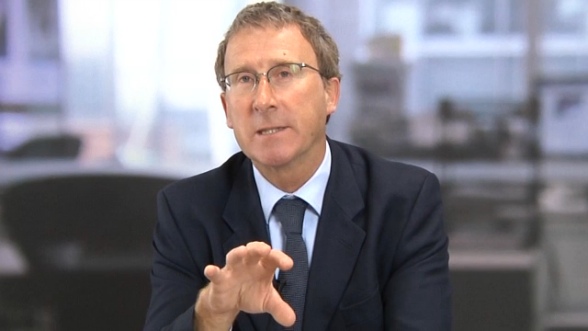
Nouriel Roubini, chairman of Roubini Global Economics and professor at NYU Stern Business School, was the economist who anticipated the collapse of the United States housing market and the worldwide recession, which started in 2008. In an interview in Bloomberg TV, posted in YouTube, Roubini pictures an “anemic recovery” for the US economy which will result in a very slow process of tapering by the FED, “regardless of who chairs the FED, as it is a committee that will act slowly in any decision”. Roubini expects the FED to take three years to normalize the interest rate situation and highlights that even if global growth will be better on 2014, in will still be “still just below trend”.
Talking about Europe, Roubini also describes the economic situation as “anemic and pathetic”, stressing that in Southern Europe, countries like Greece and Spain are near “depression” and that the Eurozone will not be able to reduce at all the high levels of unemployment . China will not help either, as it “will surprise on the downside” growing below 7% next year.
Nouriel Roubini speaks on Bloomberg Television’s “Bloomberg Surveillance.”
Mexico continues along the path to reform with President Enrique Pena Nieto recently presenting the government’s fiscal proposals. Labour, education, telecom, financial and energy bills are already at various stages of the legislative process. According to the Mexican finance ministry, the combination of these reforms will put the economy on a path towards potential annual GDP (gross domestic product) growth of above 5%.
The fiscal reforms are not the sweeping overhaul of the tax code that many had hoped for and that are needed to reduce the government’s reliance on oil revenues. However, more bold changes such as the imposition of a value-added tax (VAT) in order to improve collection from the informal side of the economy would prove both unpopular and could run the risk of creating a fiscal headwind at a time when the economy is in a fragile position. Additional reforms will be required in the long term, but in order to ensure that the impressive momentum behind the cross-party “Pacto por Mexico” accord is maintained and that the energy bill is approved, the government is erring on the side of caution with this latest bill.
The impact on Mexican corporations of these changes is onerous in the short term but presents big opportunities in the long term. Productivity improvements will improve the cost structure of labour-intensive industries, more formal employment will drive domestic consumption, and there will be energy savings and investment opportunities from the proposed opening up of the energy sector and other infrastructure plans. The reforms are no free lunch though as they will also spur competition in some sectors, meaning that only the most nimble companies will be able to capitalise.
Opinion column by Nicholas Cowley, Investment Manager, Global Emerging Markets at Henderson Global Investors
Dexia announced today the signature of a share purchase agreement with New York Life Investments for the sale of Dexia Asset Management, after having entered into exclusive negotiations on 19 September 2013. The scope of the transaction includes 100% of Dexia’s shares in Dexia Asset Management and will be realized for a firm price of EUR 380 million.
Dexia has been forced by European authorities to sell its asset management arm as a condition for its bailout after the 2008 financial crisis.
Dexia Asset Management, a major player in asset management, with centers in Brussels, Paris, Luxembourg and Sydney, has built a significant presence in Europe and across international markets over the last 20 years. Dexia Asset Management has EUR 74 bn in assets under management (approximately $100 billion) , as of 31 July 2013; it provides investment solutions, to a diversified client base across 25 countries. Renowned for its specialist skills in fundamental and quantitative strategies, it has also earned a solid reputation in tailored asset allocation solutions. It is recognized as a front-runner in SRI (sustainable and responsible investments) and in regulated Alternative Investments.
A wholly owned subsidiary of New York Life Insurance Company, New York Life Investments is a leading investment management firm, with $388 billion in assets under management, as of 31 July 2013 –of which $173 billion are third party assets-. During the initial auction process, New York Life Investments was one of the final contenders. New York Life Investments constitutes a solid financial and operational partner, able to support Dexia Asset Management’s commercial development. Moreover, Dexia is confident in its capacities to achieve a successful completion of the transaction.
Dexia will release the impacts of the sale on its financial situation and its regulatory ratios when the transaction is closed. According to New York Life Investments, the transaction, which remains subject to the approval of regulatory authorities, is expected to close on or about December 31, 2013. The addition of Dexia Asset Management is expected to bring New York Life Investments’ total assets under management to more than $480 billion, and will likely propel its rankings into the top 25 global institutional money managers.
John Kim, chairman and chief executive officer, New York Life Investments, added: “The acquisition of Dexia Asset Management will provide our clients with access to the company’s highly-rated funds, strong European platform, and established Australian equities business. It builds upon the strong momentum we’ve achieved in our third-party global asset management business and positions us for further growth in key markets around the world.”
Photo: Averette. Wharton Equity se hace con uno de los terrenos sin desarrollar más grandes de downtown Miami
Wharton Equity Partners has taken title to one of the largest remaining undeveloped parcels of land in the Miami CBD, a full city block comprised of approximately 2.2 acres. The property was acquired through a deed in lieu of foreclosure on a note that Wharton Equity purchased from IberiaBank earlier in 2013. The note was acquired with an institutional partner in an “all cash” transaction that closed in under 30 days from contract signing. The partnership has begun evaluating options for the property including development, joint venture and/or sale.
Known as the “Burdines Site,” the property was approved for a 2.2 million square foot mixed-use project designed by internationally-acclaimed architect/design firm, Pei Partners (IM Pei) and Miami based firm, Oppenheim Architecture+Design. The prior approval included residential, hotel, retail and office components as part of the project. The property enjoys a superb location and favorable zoning, and when developed, will provide unmatched views of Biscayne Bay, the Brickell Avenue corridor and the Miami River.
Among its attributes, the property is adjacent to the on- and off-ramp of Interstate 95 and has a Metromover station located on site. Additionally, the property is centrally-located and within walking distance of downtown Miami’s major dining, entertainment and retail destinations. Adjacent to the property is the 47 story Miami Tower, famous for its ever-changing colorful exterior lighting scheme, an icon that defines the heart of downtown Miami.
The property is within a few blocks of a number of high-profile projects that are under construction in the re-surging downtown Miami market. Among them, one block away, is Met 3, a mixed-use project consisting of a new Whole Foods Market at street level with 462 high end residential units, and Brickell CityCentre, a nearly four million square foot mixed-use project located in Mary Brickell Village, one of the largest developments Miami has seen to date.
The purchase represents Wharton Equity’s continued commitment to the Florida/Miami market where it is in various stages of acquisition of other development sites, as well as large income producing properties. “We are a great believer in the long term prospects of South Florida, and in particular Miami, and expect to acquire other major assets in the market in the coming months,” states Peter C. Lewis, Chairman of Wharton Equity Partners.
Photo: Frank Schulenburg. Global Investors Bullish on Latin America’s Private Equity Markets
Investors believe the overall risk/return equation for Latin American private equity (PE) is improving, though conditions in Brazil are more challenging, according to the annual Coller Capital/LAVCALatin American Private Equity Survey. According to LPs, the risk-return equation is improving in Mexico, Peru and Colombia – more than half of LPs say these countries will provide very attractive markets for investment in the next two years.
This upbeat assessment is reflected in investors’ return expectations: more than half (56%) of domestic and international investors expect net annual returns of 16% or higher from Latin American PE overall. Almost three quarters of LPs expect their private equity commitments in Mexico, Peru and Colombia to deliver annual net returns of 16%+, and half of LPs expect this level of return from Brazil and Chile.
In consequence, over a third (35%) of existing investors expect to accelerate their new fund commitments to Latin American PE. Mexico-focused funds in particular are set to boom. Just 15% of investors with Latin American PE exposure currently have commitments to Mexico-specific PE funds; within three years 39% of LPs expect to have Mexico-focused commitments.
While Latin America’s overall growth story remains highly attractive to private equity investors – even compared with other emerging markets – LPs believe challenges have grown since last year, particularly in terms of the region’s political climate, dealflow and entry valuations.
“These findings are a strong endorsement of the private equity opportunities in Latin America. Despite economic challenges in individual markets, the region retains its attractiveness to both domestic and international LPs, and this is reflected in very strong return expectations. The newer PE markets of Mexico, Peru and Colombia are seen as particularly exciting.” According to Erwin Roex, from Coller Capital
LAVCA President Cate Ambrose said: “The survey results demonstrate that LP views on the region continue to evolve. Over time, investors are reaching a more sophisticated understanding of the opportunity that Latin America presents. The findings point to confidence in the mid- to long-term expectations for PE markets across the region.”
Promising industry sectors for Latin American PE investment
There is a marked difference in how domestically-based and international investors see the attractiveness of individual industry sectors in Latin America. Far more Latin American LPs see good PE opportunities in manufacturing/logistics and real estate, while international LPs find the oil and gas sector particularly attractive. Domestic and international LPs agree that the consumer goods and retail sectors will be very attractive for PE investment over the next three years.
Peter Horrell, Chief Executive, Wealth & Investment Management . Peter Horrell asume como CEO de Barclays Wealth & Investment Management
Peter Horrell has been appointed Chief Executive of Barclays’ wealth & investment management (W&IM) business.
Peter was named interim CEO of the business in April (effective from 1 May 2013), when he was charged by Barclays CEO Antony Jenkins with exploring ways of working more closely with the corporate and retail banks as a platform for future growth.
Over the last five months, Peter has built up a talented leadership team and developed a clear vision for the W&IM business, which offers wealth management and private banking services to clients and intermediaries globally. Peter will report to Antony Jenkins.
Barclays this week announced a thorough revision of its wealth management division, which will comprise exiting 100 markets and 5 of its 17 booking centers to focus in high net worth individuals and in those markets where Barclays has a meaningful competitive advantage.
Foto: Tim Stevenson, manager Henderson Horizon Pan European Equity Fund. Alemania vota por Merkel, ¿qué pasará ahora?
What do the results of the German election mean for Europe and European equities? “Merkel has won a terrific victory for the Christian Democratic Union/Christian Social Union (CDU/SCU), securing an historic third term in power”, highlights Tim Stevenson, manager of the Henderson Horizon Pan European Equity Fund, adding that her previous coalition partners, the Free Democrats (FDP), failed to reach the 5% threshold level and have now dropped out of parliament.
In this video interview, Tim Stevenson, provides an overview of the German election and gives his thoughts on the broader implications for Europe.
The key question now, as Stevenson highlights is, what happens next? It is almost certain that Merkel will have to form a coalition with the Social Democratic Party (SPD). The last time this happened, in 2005, the SPD ended up losing votes in the following election, so we do anticipate a little bit of uncertainty over the discussions. Henderson expects to see a marginal shift to the left by the CDU in order to accommodate the SPD, but given that we are talking about a very narrow difference in policies, “this is likely to be more about taxation rates in Germany and spending plans”.
Ultimately, Henderson expects to see very little change. “Luckily, we have seen that European economies are beginning to recover, which means that the focus should shift away from politics to the reality of what can be done to keep the recovering going and getting unemployment down”.
The implications for the portfolio managed by Tim Stevenson, are pretty minimal. “We are in a period of low growth, but at least we are now talking about growth. While this is good news, it is low growth”. As such, Henderson will continue to favor those companies that have the ability to grow better than the market can, “in what we think is going to stay a pretty uncertain environment for some time to come”.
You may access Tim Stevenson’s video interview through this link.
Photo: Tuxyso. Azimut launches the first UCITS IV-compliant hybrid bonds fund
Azimut has launched what is believed to be the first UCITS IV-compliant hybrid bonds funds in Europe. The fund – AZ Fund Hybrid Bonds – will invest 100 per cent of its assets in hybrid bonds and has an investment time horizon of four and a half years, reported investmenteurope.net.
The fund will offer diversification to investors in terms of issuer, sector, and geographic reach to produce a portfolio with an optimal risk/return profile. Stefano Mach, manager of the new fund, was quoted as saying: “Hybrid bonds are a funding source which is in between equities and traditional bonds in terms of investing costs,” adding that several issuers prefer to get funding through these financial instruments not only because it improves credit structure but also because “it does not dilute the value for shareholders and it accounts for only 50 per cent as debt”.
AZ Fund Hybrid Bonds is aimed at HNWI and has a minimum entry fee of €25,000.
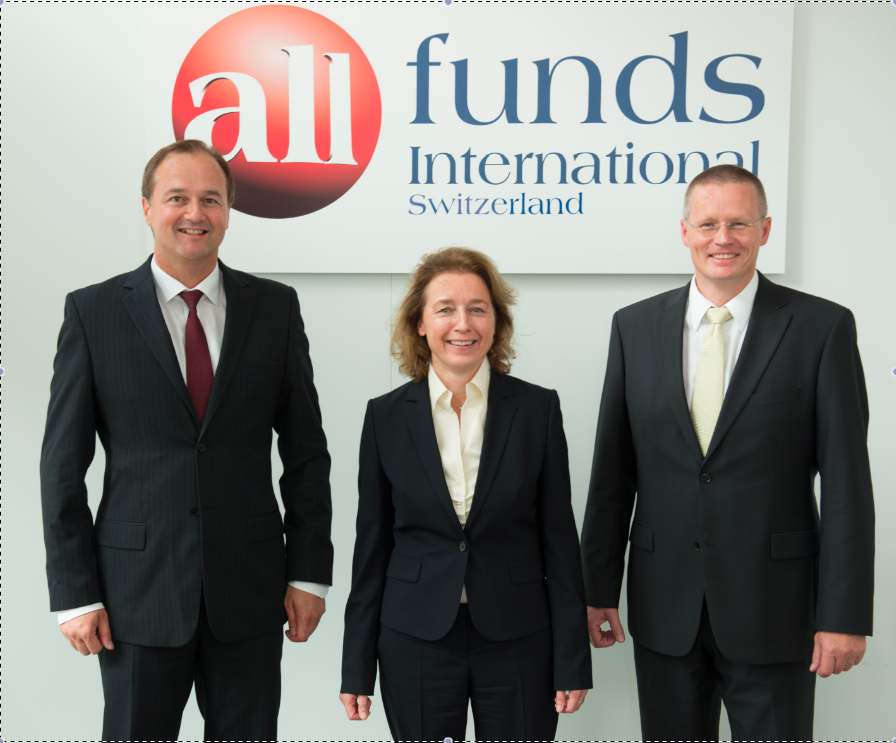
El equipo de Allfunds Suiza. . Allfunds aterriza en el mercado suizo con la apertura de una oficina en Zurich
Allfunds Group has chosen Zurich for the establishment of its office in Switzerland, as a part of its long-term plans for expansion in the Swiss market through the incorporation of a wholly owned affiliate, Allfunds International Switzerland Ltd.
The Swiss Financial Market Supervisory Authority, FINMA, granted Allfunds International Switzerland Ltd the distributor license in late May of this year. The office in Zurich is led by Stig Harby, Allfunds’ Swiss Country Head, who joined Allfunds three years ago and has extensive experience in the financial industry globally and in Switzerland from his previous roles with UBS, Credit Suisse and State Street. Along with him, the office is supported by two senior members recently hired, Matthias Ritz who previously has been responsible for building the product platform of a leading Swiss fund platform, and Barbara Anger who previously led the fund provider management team at a leading Swiss universal bank.
Allfunds Group currently leads the fund distribution business in Europe with more than €100bn of assets under intermediation and has a very strong footprint across the continent. Allfunds has implemented abusiness model able to offer B2B fund solutions, bringing operational efficiency to the fund market, providing fund information and fund research support to leading financial institutions. According to Juan Alcaraz, Allfunds’ CEO: “Being close to our clients is part of our DNA and our commitment to the Swiss Market is now stronger thanks to the opening of our Swiss office. After completing the first milestone with the endorsement of the distribution license, we are now ready to provide our valuable institutional services to local financial institutions. For us, being local is key serving such an important market”.
He also added: “There is clearly room to expand our business here. So far, we have seen great acceptance for our services across Swiss institutional clients given our ability to meet their needs”.
According to Borja Largo, Director of Relationships with Fund Groups: “Fund Groups have specially welcomed our arrival given their need for a better platform solution that is more transparent, diligent and efficient. They believe we are the best partner to boost their business and are actively promoting our services”.