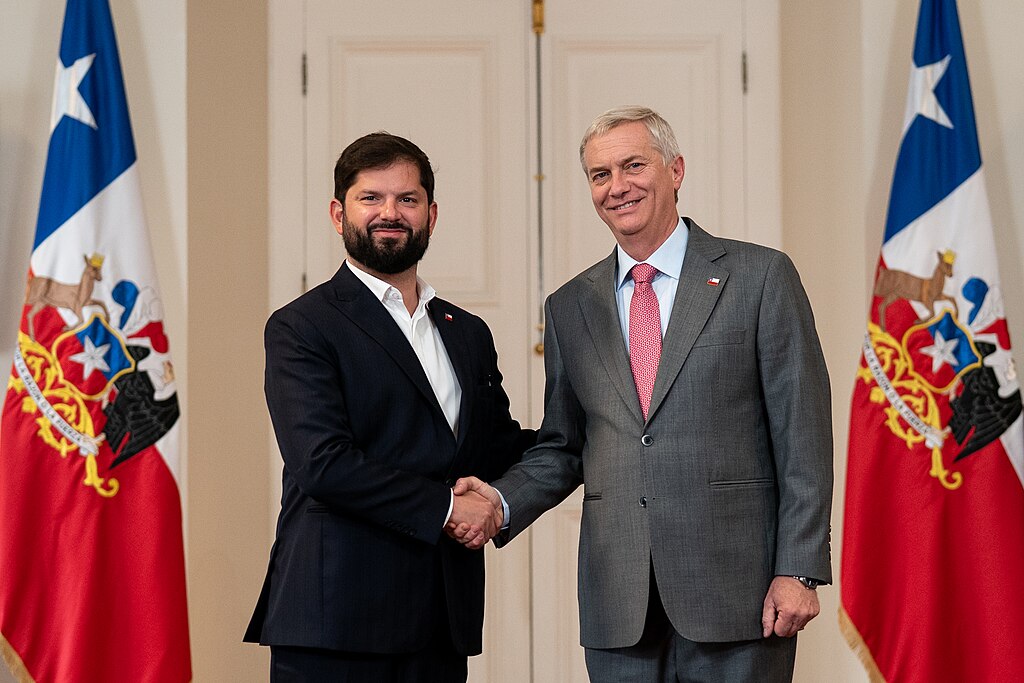
A New Political Cycle Consolidates in Chile
Or at least that is the impression the financial industry has of the results of the Andean country’s presidential election, which concluded on Sunday, December 14, with the ultra-conservative candidate José Antonio Kast crowned as the next head of state. Now, with assets calm—after months of pricing in a shift in political direction—the market is assessing the challenges and scope of Kast’s future presidency and what effects it could have on the economy.
It was no secret that Kast was the investors’ candidate. Facing the continuity candidacy of Jeannette Jara—former Minister of Labor under Gabriel Boric’s government and a member of the Communist Party—the leader of the Republican Party secured a decisive victory. With over seven million votes, he obtained 58% of the vote, marking a wide margin over Jara.
Although the general view is that this result is positive for Chilean assets, local markets did not experience major movements the day after the presidential election. While the stock exchange opened with a moderate rise, gains were erased throughout the day, and the S&P IPSA benchmark index ended the session down 0.94%. The Chilean peso, meanwhile, strengthened slightly, with the exchange rate climbing about 0.6%, to 915.7 pesos per dollar.
What happened? Market participants agree that prices had already priced in Kast’s victory. The expectation of a government with a pro-market agenda has been one of the drivers of the rally the Chilean stock market has seen this year. The IPSA has risen more than 50% so far in 2025 and closed the final trading session before the runoff election at the unprecedented level of 10,400 points. Meanwhile, the Chilean peso went from 993 pesos per dollar—exceeding 1,000 pesos in early January—at the end of 2024, to 915 pesos at the close of trading on Monday. The view among traders: with the election in the rearview mirror, many took the opportunity to realize gains.
Economic Optimism
Kast’s presidency will begin with the handover of power on March 11 of next year. From then on, the market hopes he will push forward pro-growth policies. Among his promises are the reduction of the corporate tax rate from the current 27% to 23%, an aggressive $6 billion fiscal spending cut plan for the first 18 months of his term, and a reduction in bureaucracy.
According to Principal, the combination of improved confidence and more favorable financial conditions creates space for a “moderately optimistic outlook” for 2026 in Chile. “GDP is projected to grow 2.1%, driven by a recovery in real income and solid mining investment, while non-mining investment remains moderate amid regulatory uncertainty and high labor costs,” the firm stated in a recent report.
Given the wide margin of the president-elect’s victory, notes Mauricio Guzmán, Head of Investment Strategy at SURA Investments, the political landscape becomes clearer. “The market’s focus will shift toward the ability of the eventual administration to implement and deliver on its main campaign promises,” he predicts.
Outside the economic sphere, the priorities outlined during the presidential campaign include crime and organized crime, prison system modernization, and stricter immigration policies.
Kast’s Main Challenges
Looking ahead, the issue of governance—with a Congress in which the ability to negotiate will be key—is top of mind for the financial industry. The issue is that, to paraphrase the musical hit Hamilton: winning is easy, governing is harder.
“His main challenge will be governing with a deeply divided Congress, where his party does not hold a clear majority and will need to negotiate with the center-right faction and use blocking strategies to pass key reforms,” said Eirini Tsekeridou, fixed income analyst at Julius Baer.
Principal agrees with this assessment. “Overall, Chile enters 2026 with greater confidence and a clearer policy direction, but the outlook will largely depend on execution,” the firm’s report warned.
In this sense, they believe that the future Kast administration’s ability to manage fiscal consolidation and simplify regulation “will define whether the rebound in confidence translates into sustained increases in investment and improved medium-term economic performance.”
Even so, considering the rally that equities have experienced and the possible implications of a Kast presidency, there are doubts about how much more fuel local assets have to keep rising.
What’s Ahead for Chilean Assets
At Julius Baer, they remain optimistic, maintaining a buying bias for local equities. “The equity risk premium remains well above levels seen during the last stable regime (2010–2018), offering an attractive compensation, and Chilean stocks have limited exposure to global trade tensions and solid earnings momentum,” said Tsekeridou.
As for Chilean bonds, the European investment bank also maintains a “hold” recommendation due to “slower fiscal consolidation,” according to the analyst. And regarding the currency, the expectation is that the peso will continue to strengthen.
Guzmán, from SURA Investments, is less optimistic. “Given that José Antonio Kast’s victory was widely expected, we anticipate market gains within a narrower range, considering that the baseline scenario was largely priced in,” he said. In that sense, the Colombian-headquartered firm holds a “neutral stance” on the local stock market, “given the significant revaluation the index has shown during the year.”
In fixed income, the firm recommends investing in medium-term instruments, between 3 and 5 years, “which would allow investors to capture a relevant premium compared to short-term rates,” according to Guzmán.
Regarding the exchange rate, while they do not foresee major movements in the short term, they have a “constructive” view of the Chilean peso. SURA’s forecast is that the Chilean currency will gradually appreciate, adjusting to its economic fundamentals and offering a “relevant premium” to investors. “This view is based on reduced political uncertainty, greater interest from non-resident investors, and a favorable macroeconomic environment, which includes strong terms of trade and a globally weaker dollar,” the professional stated.