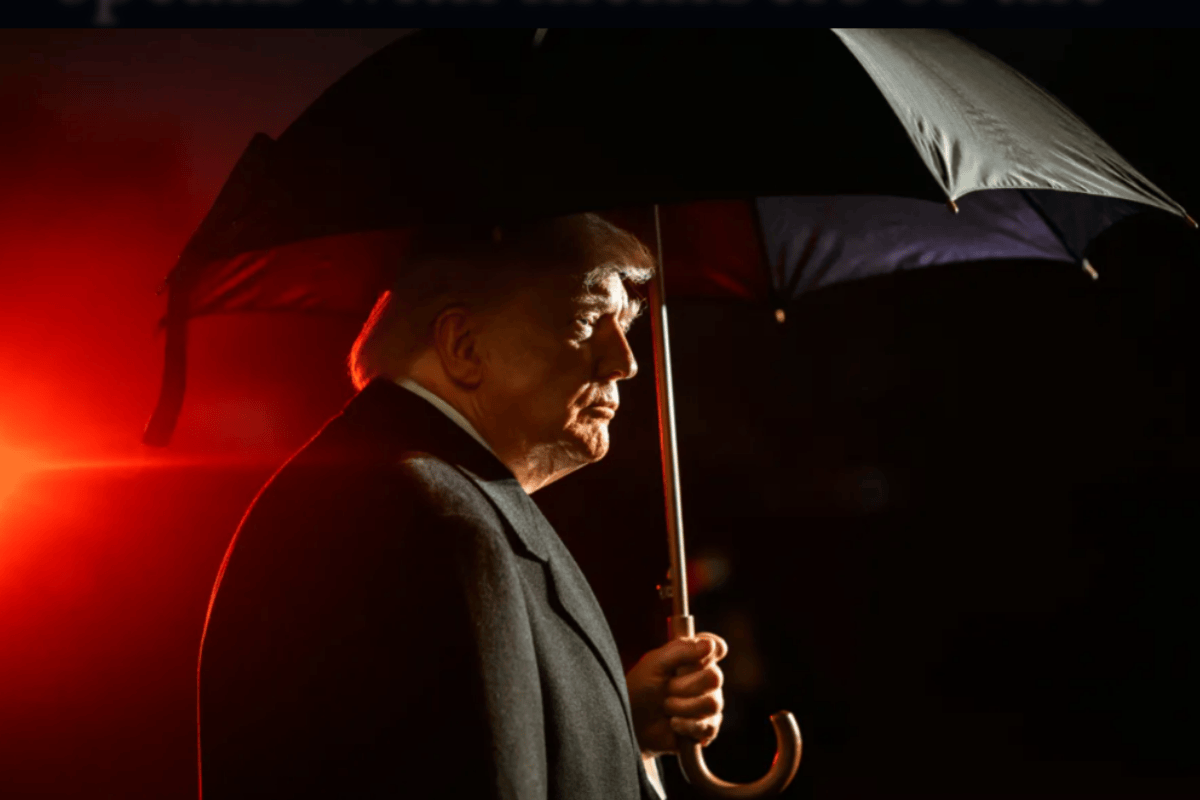
It has been 365 days since Donald Trump was sworn in as President of the United States, and aside from the cold, little about that January 20, 2025, resembles today. One year ago, international asset managers saw his term as a clear opportunity for U.S. equities, driven by his campaign promises, and expected reduced uncertainty, since “Trump’s character and style were already known.” However, the past twelve months have brought surprises and, above all, significant changes in geopolitics and trade policy.
While global economic prospects have modestly improved, uncertainty remains. Experts highlight that as of January 20, 2026, the focus lies on asset valuations, rising debt, geoeconomic realignment, and the rapid deployment of artificial intelligence, all of which are creating both opportunities and risks. In fact, according to the latest edition of the Chief Economists’ Outlook from the World Economic Forum, while 53% of chief economists expect global economic conditions to weaken over the next year, this marks a notable improvement from the 72% who held that view in September 2025.
“This survey of chief economists reveals three defining trends for 2026: the sharp rise in AI investment and its implications for the global economy; debt levels approaching critical thresholds amid unprecedented changes in fiscal and monetary policies; and shifts in trade alignment. Governments and businesses will need to navigate short-term uncertainty with agility, while continuing to build resilience and invest in long-term growth fundamentals,” says Saadia Zahidi, Managing Director at the World Economic Forum.
AI and Other Asset Valuations
Following a year of exceptional performance, the debate over whether we are in an AI bubble has taken center stage among asset managers. According to MFS IM, the question is misguided: focusing on whether AI euphoria is excessive distracts from the broader and more critical issue of misallocated capital and the physical limits that constrain growth.
Indeed, equity gains concentrated around AI have split chief economists’ opinions. While 52% expect U.S. AI-linked stocks to decline over the next year, 40% foresee further gains. Should valuations drop sharply, 74% believe the effects would ripple through the global economy. The outlook for cryptocurrencies is even gloomier: 62% anticipate further declines following recent market turbulence, and 54% believe gold has already peaked after its recent rallies.
Regarding AI’s potential returns, expectations vary widely by region and sector. Roughly four out of five chief economists expect productivity gains within two years in the United States and China. The IT sector is projected to adopt AI the fastest, with nearly three-quarters anticipating imminent productivity improvements. Financial services, supply chains, healthcare, engineering, and retail follow as “fast-adoption sectors,” with expected gains within one to two years. By company size, firms with 1,000 or more employees are expected to benefit first: 77% of economists foresee significant productivity gains for these companies within two years.
The employment outlook related to AI is also expected to evolve. Two-thirds anticipate moderate job losses over the next two years, though long-term views diverge significantly: 57% expect a net job loss in ten years, while 32% foresee net gains as new occupations emerge.
Debt and Tough Decisions
Rising debt and public deficits mark another contrast with last year. Managing these elevated levels has become a central challenge for economic policymakers, especially amid growing spending pressures. Global debt levels have hit historic highs, with debt-to-GDP ratios exceeding 100% in many major economies. In the United States, the deficit remains unusually high for a period of full employment. Higher debt servicing costs are putting upward pressure on long-term bond yields, while political instability in countries such as France, the United Kingdom, and Japan is adding to the uncertainty, notes Paul Diggle, chief economist at Aberdeen Investments.
An overwhelming majority of chief economists (97%) expect defense spending to increase in advanced economies, and 74% expect the same in emerging markets. Spending on digital and energy infrastructure is also expected to rise. In most other sectors, spending is projected to remain stable, though a majority of economists foresee declines in environmental protection spending in both advanced (59%) and emerging (61%) economies.
Opinions are split on the likelihood of sovereign debt crises in advanced economies, while nearly half (47%) see them as likely in emerging markets over the next year. A strong majority expect governments to rely on higher inflation to ease the debt burden—67% in advanced economies and 61% in emerging ones.
Tax increases are also considered likely: 62% expect them in advanced economies, and 53% in emerging markets. Over the next five years, 53% of economists expect emerging markets to resort to debt restructuring or default as a management strategy, compared to only 6% in advanced economies.
A Consequence of the New Geopolitics
Announcements from the Trump administration on trade and geopolitical matters have reshaped the global landscape, if not dismantled the traditional international framework altogether. As a result, global trade and investment are adjusting to a new competitive reality.
According to chief economists’ forecasts, tariffs on imports between the United States and China are expected to remain generally stable, though competition may intensify in other areas. Notably, 91% expect U.S. restrictions on technology exports to China to remain or increase; 84% anticipate the same for China’s restrictions on critical minerals.
In this new context, 94% expect an increase in bilateral trade agreements, and 69% foresee a rise in regional trade deals. “Eighty-nine percent expect Chinese exports to non-U.S. markets to continue growing, while economists are divided on the future volume of global trade. Meanwhile, nearly half expect international investment flows to keep rising, and 57% anticipate an increase in foreign direct investment (FDI) into the United States, compared to just 9% who expect greater inflows into China,” the report notes.
Beyond China, attention is now turning to Greenland. “By making the imposition of new tariffs conditional on Europe’s acceptance of his plan to acquire Greenland, Donald Trump is taking another step in using trade as a tool of geopolitical pressure. Beyond the theatrics of the statement lies a doctrine now widely accepted: alliances are no longer stable frameworks, but renegotiable power relationships. This political strategy comes with a potentially significant economic cost, between 0.2% and 0.5% in growth depending on the severity of the tariff threat,” says Michaël Nizard, Head of Multi-Assets & Overlay at Edmond de Rothschild AM.