
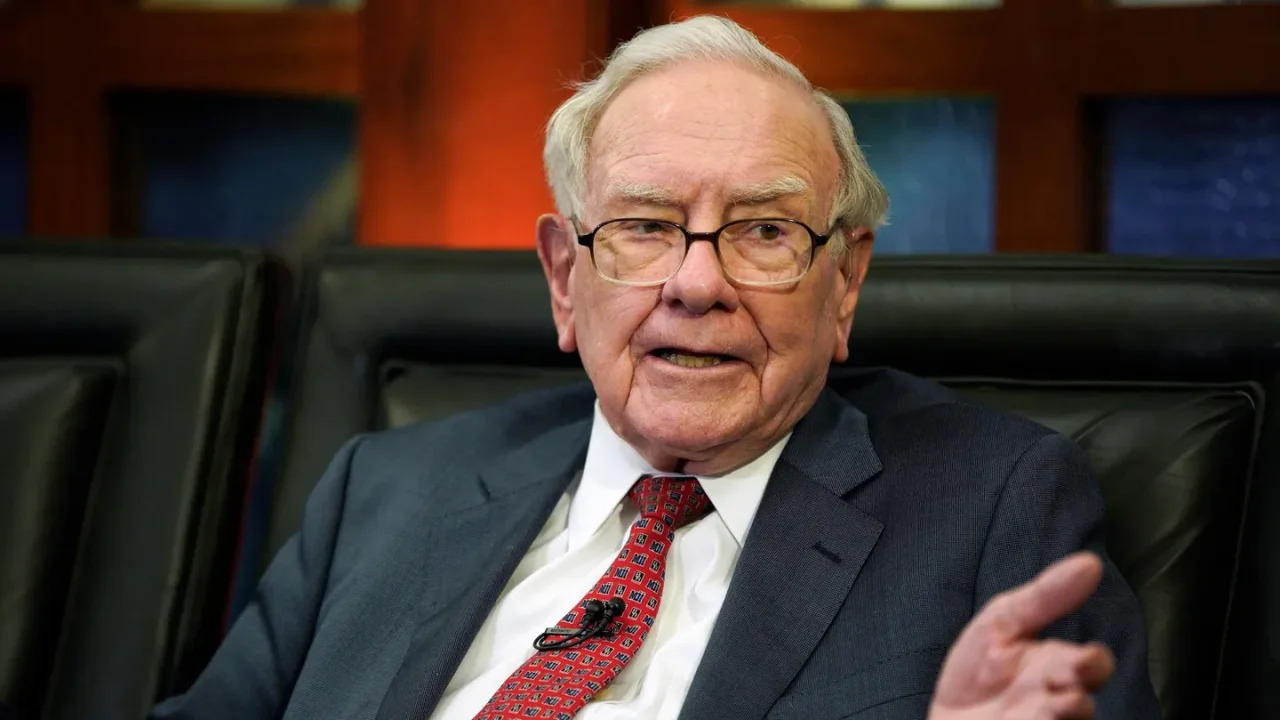
The legendary Warren Buffett recently turned 96 and, in accordance with the succession roadmap designed many years prior, has fully relinquished the reins of Berkshire Hathaway by assuming the duties of Chairman Emeritus. However, he did not miss the opportunity to leave one more lesson as part of his intangible—yet equally valuable—legacy.
Without a trace of defeat, Warren Buffett acknowledged the only opponent no investor can defeat. “Father Time always wins,” he wrote to Berkshire Hathaway shareholders as he explained his decision to become Chairman Emeritus. But in his case, he added something more: “he has been generous to me.”
The phrase summarizes far more than just a change in corporate title. In the letter accompanying Berkshire Hathaway’s announcement, Buffett does not write as someone abandoning a company after six decades, but as someone observing the passage from one generation to another, evaluating which part of his work should survive when he is no longer at the helm.
Since 1965, Buffett has been the central figure of Berkshire. Now he leaves the chairmanship of the Board, and Howard G. Buffett, his son, will assume that responsibility, while Greg Abel will continue at the operational helm as Chief Executive Officer. Warren Buffett will remain as a member of the Board.
The transition, therefore, does not represent a rupture. In fact, Buffett himself presents it as the logical conclusion of a process that had been in preparation for years. The novelty of his message lies elsewhere: in how he explains what he considers truly important to preserve at Berkshire.
And his answer is surprising because it is not a stock, an acquisition, a cash reserve, or any other financial asset—it is something he considers far more valuable: culture.
The True Asset Is Off the Balance Sheet
Buffett writes that Greg Abel manages the company, while Howard Buffett will bear the responsibility of protecting its culture and values. He immediately establishes an unusual hierarchy in business parlance: both elements possess, he says, a value superior to that of any asset recorded on Berkshire’s balance sheet.
The statement is especially meaningful coming from the man who built Berkshire into one of the largest business conglomerates in the world and who for decades was considered one of the primary benchmarks of long-term investing.
At the moment of handing over control, Buffett does not speak of maintaining a specific level of profitability, keeping a particular portfolio, or reaching a certain market capitalization; he speaks of preserving a way of doing business.
It is precisely there that one of the keys to his legacy emerges: Berkshire was not built solely around the investments that Buffett and Charlie Munger selected. It was also built around a philosophy—thinking in terms of decades, avoiding impulsive decisions, maintaining a unique relationship with shareholders, and granting managers of acquired companies a considerable degree of autonomy.
That is why succession does not simply consist of finding someone who can sit in Buffett’s chair; it consists of proving whether an organization can maintain its principles when the person who embodied them for more than six decades is no longer in command.
An Insurance Policy for Shareholders
Buffett leaves in his letter one of his customary metaphors to explain his son’s role: Howard Buffett, he says, should be viewed as “an insurance policy” owned by the shareholders—one that everyone hopes never to have to use. Coming from Buffett, this is telling.
Furthermore, Greg Abel is at the operational helm. Howard does not step in to manage Berkshire’s day-to-day operations, but rather to act as a custodian of what does not appear on the financial statements: culture and values. This division of responsibilities demonstrates the extent to which the succession was designed as an institutional process rather than merely replacing an individual.
Buffett points out that Howard has served as a director of Berkshire for 33 years—a period even longer than the time he himself had to learn before taking control of the company at age 34. In this sense, the message is clear: succession does not begin the day Buffett steps down from a role; in reality, it began decades earlier.
Time as an Enemy and as an Ally
There is an irony in all of this that says much about Warren Buffett: for decades, the investor turned time into one of Berkshire’s primary advantages. While much of the financial market moves to the rhythm of quarterly earnings, Buffett and Munger built their reputation on patience and the ability to think long term.
In his letter, Buffett recalls precisely that from the beginning they sought shareholders who thought “in terms of decades rather than quarters.” Now, however, time appears from a different perspective. Buffett has just turned 96, and after more than 60 years leading Berkshire, he acknowledges that the time has come to complete the transition.
Yet he does not present it as a tragedy or a crisis—quite the contrary. He says he still has “the best job in the world” and has never felt better about what lies ahead. This is likely one of the most interesting aspects of the letter: Buffett does not describe his departure as the end of an era to be mourned, but as a natural consequence of the very same principle he recommended to his shareholders for decades: thinking long term.
Time ultimately wins, but preparation can determine what happens next. Buffett is not leaving Berkshire; rather, Berkshire no longer needs him to run it. There is another important distinction: Buffett is not departing Berkshire entirely, as he continues as a director and shareholder. In his letter, he expresses his desire to remain a shareholder alongside the rest of the owners.
That changes the meaning of the transition. The man who for decades made the fundamental decisions will no longer occupy the position from which they are made, but he will continue to observe the company’s evolution from within and participate in it as an owner.
This aligns seamlessly with the relationship he always sought to build with shareholders: sitting on the same side of the table. That is why, rather than a farewell, the letter carries the tone of passing the baton. Buffett seems to be saying that Berkshire no longer needs him to serve as its operational core because key decisions can be made by others and because, at least in his view, the principles he considers essential are deeply rooted.
Greg Abel is proof of that trust. Buffett asserts that his expectations for him were very high from the start, and that Abel has exceeded them. He also states that Abel has been making the truly important decisions for some time, and that he has never had reason to doubt any of them.
The statement carries special weight: succession does not begin now simply because Abel has officially received power; it formalizes a dynamic that was already largely in place.
From Charlie Munger to Howard Buffett
The letter also has a generational dimension: throughout much of Berkshire’s modern history, Buffett and Charlie Munger were inseparable from the company’s identity. Munger passed away in November 2023, just days shy of his 100th birthday. Now Buffett steps back further, doing so by leaving behind an organization where continuity no longer depends on two historic figures at the helm.
That may represent one of Berkshire’s greatest challenges in the coming years: demonstrating that what worked extraordinarily well under Buffett and Munger can continue to work when both belong to the company’s history. Buffett appears confident that it will, not because he believes a replacement for himself exists, but because he believes the organization he built can prove more enduring than the man who built it.
Perhaps that is why the final section of his letter is more significant than the corporate announcement itself. Buffett thanks the shareholders for the trust they placed in him and calls serving as their chairman “the privilege of a lifetime.” He then returns to the concept of time: “Father Time always wins,” he writes.
Immediately, however, he refrains from framing the phrase as a tragedy, writing instead that time was generous to him because it allowed him to see Berkshire reach a point where he feels more confident than ever about its future. That is perhaps the true message and final lesson of his last letter as Chairman.
A company’s success consists not merely of how much capital it can accumulate while its founder is at the helm, but whether it can preserve what made it unique once the founder is no longer there. Buffett appears to have reached that conclusion after more than six decades.
The man who turned patience into an investment strategy ultimately faces his own ultimate long-term test: handing over control and trusting that time—which inevitably ends all individual leadership—will not also bring an end to the philosophy he built.

 By Funds Society