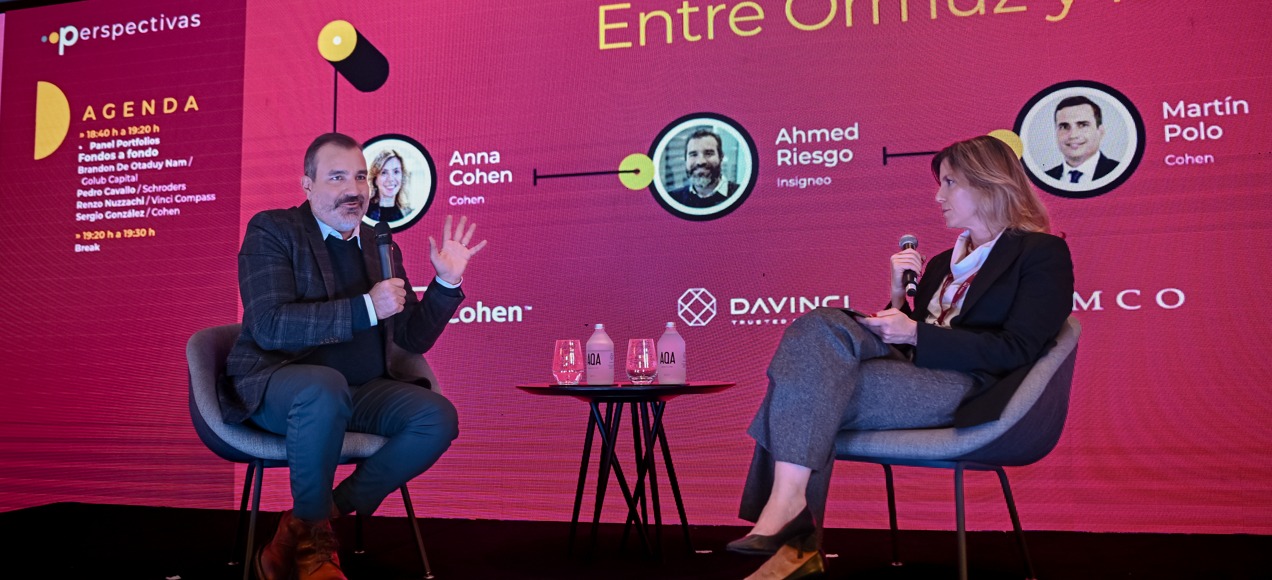
Republicans are projected to lose control of the Senate in the U.S. midterm elections on November 3, 2026. This was anticipated by Ahmed Riesgo, Chief Investment Officer (CIO) of Insigneo, during the webinar “Brazil and the U.S.: Two Decisions, One Market,” organized by Grupo Cohen and moderated by its President and CEO, Anna Cohen. Riesgo attributed this scenario to Donald Trump’s unpopularity, the inflationary impact of tariffs, and public opposition to the war with Iran. For the executive, the surprise would not be an administration defeat, but rather Republicans managing to retain the upper house.
According to Riesgo, Republican states that seemed safe six months ago—Iowa and Texas, among others—are now open contests. Riesgo highlighted the case of Texas, where Democrat James Talarico could defeat Ken Paxton. “Texas voting Democratic blue has very few precedents in history,” Cohen noted. Riesgo clarified that the phenomenon does not reflect an ideological shift, but rather direct punishment of the president for rising prices. “You see it in the polls. They are going to crucify him over the war, and they are crucifying him,” he stated.
The Argentine analyst underscored the convergence of factors impacting the electorate: “You have a trifecta of negative impacts: the pump and consumption, the rate hike and borrowing costs, and the entire social issue, which in the United States continues along polarized trends.” Riesgo agreed: the political thermometer of the average American is the price of gasoline, and when it rises, the government pays the price at the ballot box.
The War with Iran
Riesgo highlighted the weak support for the intervention in Iran. A Pew Research Center survey conducted March 16–22, 2026, found that 59% of U.S. adults considered the initial decision to use military force a mistake, while 38% considered it correct. However, the executive cautioned that it would be premature to judge its long-term consequences. “There are signs that it could have positive long-term benefits, both for the United States and for the region, which are not visible today,” he added.
According to Riesgo, the combination of the military conflict and trade tariffs puts upward pressure on energy and input costs, and their eventual pass-through to consumers would deepen discontent among lower-income households. Cohen noted that higher-net-worth Americans are partially shielded: “Consumption has not fallen. Savings probably have; they are not over-leveraging, but there is some form of friction regarding inflation.”
The Insigneo CIO also commended the Trump administration’s push for artificial intelligence. In his estimate, the new technology lifts the economy’s potential growth from a baseline of 1.8% to nearly 3%. This is an estimate by the executive, not observed data or an official consensus. “It doesn’t sound like much, from two to three, but a shift in the trend level of growth for an economy the size of the United States is, as Trump says, ‘huge,'” he illustrated.
The strategist drew a parallel with Robert Solow’s 1987 paradox regarding the difficulty of seeing the impact of computers in productivity statistics. In Riesgo’s view, corporate margin expansion reflects AI benefits that those metrics do not yet capture. “Where did it come from? Did it come from Americans suddenly wanting to work harder? No, it’s the opposite. Every day Americans want to work less,” he quipped.
Cohen summarized the tension with a direct question: “What happens if there is a scare with upcoming earnings reports? Where does the S&P end up?” Riesgo replied that while some companies—particularly those exclusively exposed to frontier AI models—need extraordinary growth to justify their valuations, the vast majority of sectors are still pricing in very few benefits from the new technology.
Riesgo Projects the 10-Year Bond at 4.80% by Year-End 2026
Faced with a futures curve projecting policy rate increases in December 2026 and in March and September 2027, Riesgo deemed that monetary tightening excessive. The specialist stressed that the Federal Reserve is unlikely to follow that path and recommended positioning in duration: “One of the easiest trades to make money on in my career has been betting that the central bank is not going to do what it is telling you it will do,” he argued. Along those lines, he set his year-end target for the 10-year Treasury at 4.8%, 16 basis points below the 4.96% recorded by the benchmark note following trading on October 22.
During its quarterly client presentation in the final week of September, when the 10-year Treasury was yielding around 5.3%, Insigneo recommended adding duration to portfolios. Although Riesgo pointed out that bond yields are competitive against equities—standing around 5% in both cases, with lower volatility in government debt—he ruled out exiting equities: “You can’t be out,” Cohen agreed, given a cycle underpinned by corporate margin expansion.
Toward the end of the discussion, Riesgo suggested that the relationship between the United States and Latin America could gain strategic weight in the coming years. In his analysis, reduced Washington involvement in the Middle East would open room for greater focus on the hemisphere, citing signs such as U.S. investments in rare earths in Brazil and Treasury Department backing for Argentina. For the executive, this dynamic transcends the Donald Trump administration and reflects a broader shift in America’s international posture: “Absolute power has never been greater, but its relative weight has indeed declined,” he maintained.
Regarding relations with China, Riesgo compared the situation to a new Cold War characterized by cycles of détente and tension, but without a full rupture. “Both sides need each other far more than they realize. They want an economic divorce, but they have too many children and too much shared property together,” he illustrated.