From a former avenue of mansions in Miami to rural land transformed into corporate centers in Texas, these districts concentrate banks, wealth managers, and investment firms that manage billions of dollars. The Wall Street of Latin American offshore is not a single street: it is a network of districts where regional wealth finds infrastructure, specialists, and connections to global markets.
On the Latin American financial map, there are streets that function as more than just corporate addresses. They are meeting points for high-net-worth individuals, international banks, investment managers, tax advisors, lawyers, and firms specializing in preserving and transferring wealth.
From their offices, investment strategies are designed, wealth structures are organized, and the financial needs of entrepreneurs, families, and major investors in the region are served.
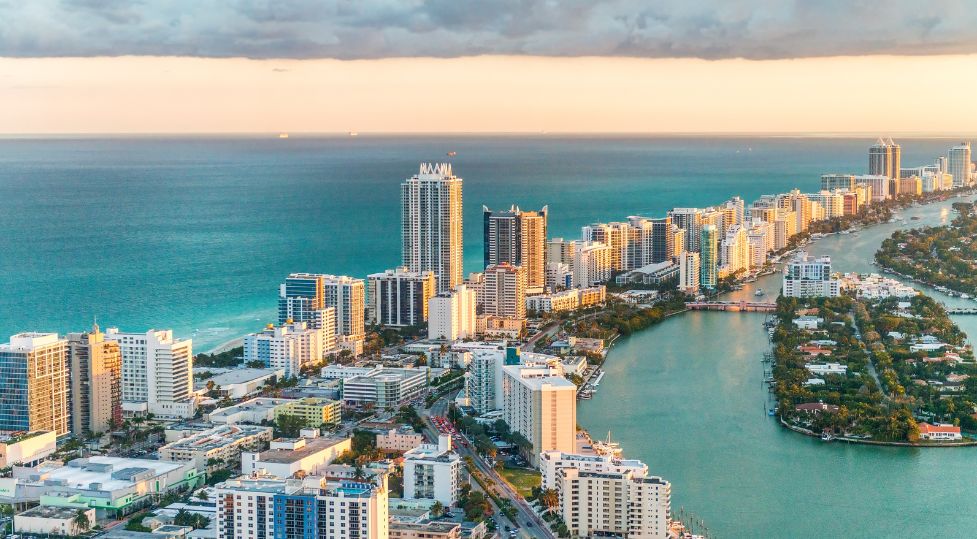
Brickell Avenue, in Miami, is probably the most representative example of this geography of money, but it is not the only one. In Houston, Post Oak Boulevard brings together private banking offices and wealth managers; in Dallas, the Crescent Court complex houses major wealth management firms. They are enclaves with distinct characteristics, but they illustrate how US financial infrastructure allows serving capital that crosses borders.
Calling them the Wall Street of Latin American offshore is useful to understand their importance by comparing them to that iconic New York street, although in reality they are not stock exchanges in a strict sense, nor does all the wealth they manage belong to Latin Americans. Their relevance lies in the concentration of institutions, specialists, and services that allow managing international fortunes from the United States.
Brickell Avenue: The Heart of the Latin American Business
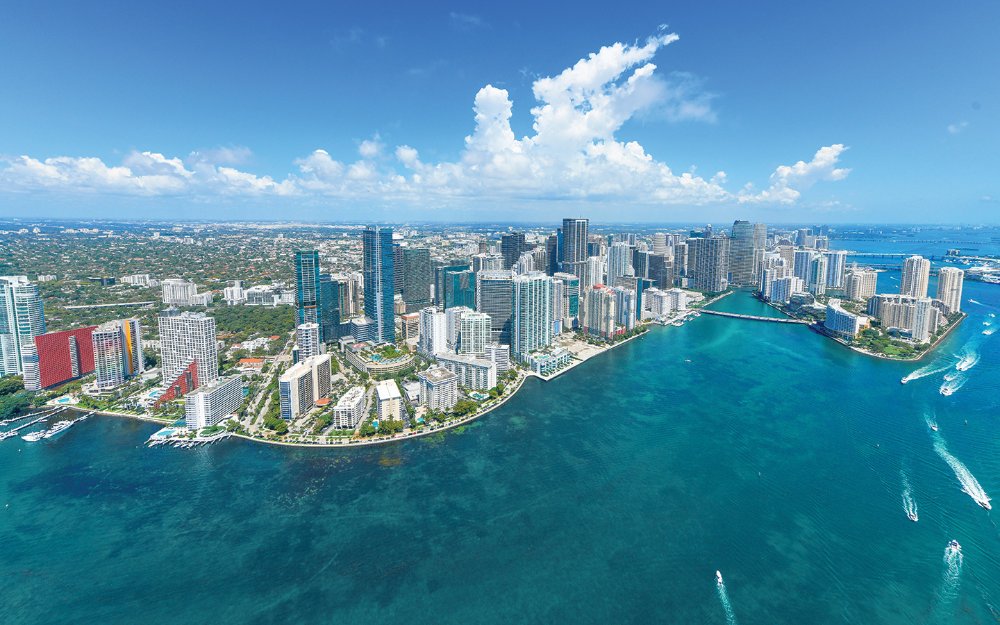
If there is an address that allows visualizing the connection between Latin American wealth and the US financial system, it is Brickell Avenue. The Brickell district, in downtown Miami, combines corporate buildings, bank offices, and firms specializing in investments, with an advantage that another US financial center can hardly replicate: its historical relationship with Latin America.
But what was or what existed before on that street? In the early 20th century, Brickell Avenue had little to do with the skyscraper landscape that today identifies Miami’s financial district. It was a residential area, with large houses and mansions built by some of the most prominent families of the young city. Its prestige was such that the corridor came to be known as Millionaire’s Row, the avenue of the millionaires.
The presence of international institutions is not merely symbolic. J.P. Morgan Private Bank, for example, maintains offices at 1450 Brickell Avenue, where it offers private banking, investment, and wealth advisory services. Morgan Stanley, for its part, announced in 2016 the opening of an office at 1111 on the same avenue, specifically dedicated to wealth management for clients residing in Latin America.
The presence of these players responds to a business logic: major wealth requires more than just managing a portfolio of stocks and bonds. They demand access to global markets, credit, estate planning, fiduciary structures, geographic diversification, and coordination of tax and corporate matters with specialists in different jurisdictions.
In that ecosystem, Brickell’s offices function as access points to much larger financial platforms. A client’s wealth can be distributed among different asset classes, custodians, and jurisdictions, while the relationship with the banker and much of the advisory services are concentrated in Miami.
The importance of the city also transcends a single avenue. Downtown Miami and Brickell are part of an office market in which international financial firms compete for strategic locations. According to Colliers, in the fourth quarter of 2025, the Brickell, Downtown Miami, and Coral Gables submarkets each recorded more than 400,000 square feet of Class A office leasing during the year. The data does not correspond exclusively to financial institutions, but it confirms the scale of the corporate market in which they operate. (Colliers, Miami-Dade Office Market Report, January 2026).
Brickell, furthermore, does not exhaust the business map. Coral Gables and other areas of Miami-Dade host bank offices, wealth managers, and professional service providers. For this reason, rather than reducing the industry to a single street, it is convenient to understand it as a financial corridor whose most recognizable core is Brickell.
Houston: Post Oak Boulevard and the Management of Major Fortunes
Texas offers another piece of this geography, although with a different specialization. Houston combines an economy historically linked to energy with an extensive private banking, financial advisory, and wealth management industry. That structure is relevant for entrepreneurs, investors, and families with interests in Mexico and other Latin American markets, especially when their businesses are linked to energy, infrastructure, and cross-border trade.
One of the most visible points is Post Oak Boulevard, in the Uptown and Galleria area. Offices of institutions offering investment, private banking, and wealth management services are located there.
The history of Post Oak Boulevard shows an even more radical urban transformation. In the 1940s and 1950s, the Uptown area, west of downtown Houston, was surrounded by open land, agricultural areas, and new residential developments. Post Oak was then a two-lane road that ran through prairies and fields, flanked by drainage ditches.
The turn began with post-war commercial development. In 1951, the Sakowitz department store bet on the area; later, other establishments and commercial projects arrived. The decisive moment was the opening of The Galleria, in 1970, promoted by developer Gerald Hines on land that still retained part of its rural character.
Today, an indicator of the dimension of the business appears in Morgan Stanley Wealth Management. The firm reported that its Houston Post Oak market, made up of three offices, had 145 financial advisors, 75 support employees, and four private bankers, in addition to a management and specialized team. Together, that operation supervised $56 billion in client assets and generated annual revenue of $355 million, according to data reported as of October 15, 2025.
The figure requires a precision: it corresponds to Morgan Stanley’s Houston Post Oak market, not to all assets managed by institutions located on the avenue, nor exclusively to Latin American clients. However, it offers a concrete measure of the scale that a wealth advisory platform can reach in this district. (Morgan Stanley Wealth Management, Houston Market Institutional Information).
The corridor also brings together other participants. Texas Capital Private Bank has offices at 1330 Post Oak Boulevard, where it offers wealth advisory, investment management, credit solutions, fiduciary services, and private banking. BBVA, for its part, announced in September 2025 the opening of an office at 1980 on the same avenue to strengthen its corporate and investment banking activities in the United States, expand Global Wealth Advisory services, and reinforce its service to Mexican clients.
BBVA’s presence is particularly significant due to the financial relationship between Mexico and Texas. The entity presented the new office as part of its US expansion strategy, with specialized capabilities in energy and clean technologies, in addition to corporate and wealth services. (BBVA, September 2025).
Post Oak Boulevard represents, therefore, a node in which business wealth, banking services, and wealth management converge. Its link with Latin America is different from Miami’s: less focused on the historical specialization of an international hub for regional fortunes and more connected to the economic activity, business, and financial needs that link Texas with Mexico and other markets.
Dallas: Crescent Court and the Business of Preserving Wealth
In Dallas, the wealth map has one of its most recognizable points at Crescent Court, in the Uptown area. The complex houses offices of major institutions offering investment management and services for high-net-worth families and individuals.
In the early 1980s, several plots of land north of downtown Dallas were occupied by former car dealerships. Developer Caroline Hunt and Rosewood Corporation acquired those properties to build a mixed-use complex that would contribute to transforming the Uptown area.
The project, known as The Crescent, opened in 1986. Its estimated investment was $400 million, an extraordinary figure for a real estate development at that time. The complex incorporated three office towers, a hotel, and retail spaces, in addition to a five-level underground parking garage with capacity for approximately 4,100 vehicles.
Currently, UBS maintains a wealth management office at 100 Crescent Court, while J.P. Morgan Wealth Management has a presence in the same complex. Both institutions offer services ranging from investment advisory to financial planning and strategies to preserve and transfer wealth.
Dallas’s importance does not depend solely on the international entities located in this complex. The city is part of a Texas economy with major companies, business owners, and families with accumulated wealth in sectors such as energy, real estate, technology, and services. That base fuels the demand for wealth management, estate planning, credit, and investment diversification.
For Latin American capital, Dallas constitutes an alternative within the US network of financial services, although it should not be automatically equated with Miami as a specialized center for international Latin American clients. The existence of offices of major banks confirms the depth of its wealth market, but it does not allow attributing a specific volume of Latin American assets to them without additional data.
A Network of Institutions, Not a Single Street
The addresses above show that the Latin American offshore business in the United States is not concentrated in a single building or a single city. It operates through a network of offices, banking platforms, and specialized providers whose function is to connect clients with global financial markets, products, and services.
Miami stands out for its international specialization and its links with Latin America. Houston combines wealth management with a business base closely related to energy and trade. Dallas, for its part, offers an extensive private banking and wealth advisory infrastructure for major fortunes.
The difference matters because the term offshore does not necessarily describe an opaque structure or an operation intended to evade tax obligations. In this context, it generally refers to the management of assets outside the owner’s country of residence. It is an activity that can include international investments, custody, estate planning, and global banking services, always within applicable legal frameworks.
For this reason, the power of these districts is not measured solely by the number of banks that have their offices on the same avenue. It also resides in the ability to bring together in a relatively small space those who design strategies, manage relationships with clients, connect investments with global markets, and coordinate legal, tax, and fiduciary services.
For Latin American families seeking to diversify their assets outside their countries of origin, these hubs offer access to a financial infrastructure that is difficult to replicate in a single place. For institutions, they represent markets in which proximity to the client, specialization, and the ability to coordinate multiple services can become competitive advantages.
The image of a Latin American Wall Street distributed among Brickell, Post Oak, and Crescent Court helps to understand this reality, provided it is recognized that these are centers with different functions and that the money managed by each firm does not necessarily equal Latin American wealth.
Ultimately, the power of these streets lies in their ability to connect the wealth of Latin America with the international financial system. Behind the facades of their buildings, there are not just offices: there are investment, advisory, and wealth management platforms that form part of the infrastructure with which the region’s major capital moves beyond its borders.