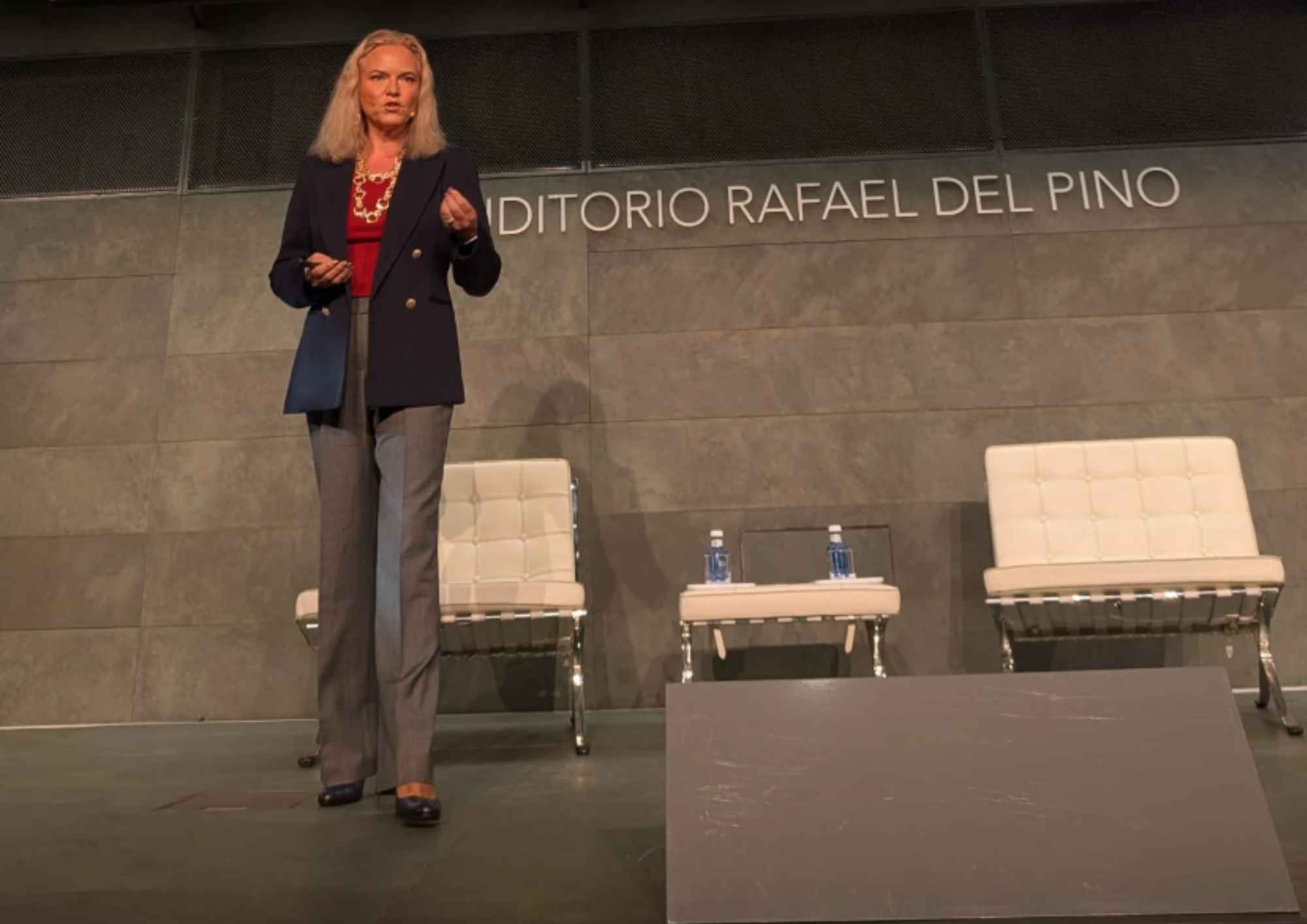
“If you have risk in your portfolio, now is the time to buy hedges.” This advice comes from Pilar Gómez Bravo, Co-CIO of Fixed Income at MFS Investment Management, speaking at the MFS Iberia Summit 2026. Her presentation centered around four key axes: the impact of scarcity on fixed income, geopolitical risk, the Fed’s pivot under Kevin Warsh’s new mandate, and the circularity of AI investments. The expert analyzed how these factors are changing how risk is quantified in fixed income and explained how she and her team are approaching it, maintaining an overweight position in credit. “We are entering a world where we will see more volatility across credit, equities, and rates,” she warned.
Why Scarcity Matters
The analysis first focused on the upward trend in commodities, with an accumulation of crowded trades across various segments—not only in oil and energy costs in Europe, but also in agricultural raw materials. “The only area where we are not seeing large spikes is in metals,” Gómez Bravo clarified. She interprets commodity behavior as “an indicator of supply shocks” and believes these inflationary trends “will continue, at least in the short term, unless we see a drastic reduction in the cost of oil or end the wars, particularly in the Middle East as well as in Russia and Europe.”
Goods scarcity stemming from geopolitical developments and strong demand for AI infrastructure occupied a major portion of the presentation. “Artificial intelligence infrastructure is absorbing all the funding, crowding out other necessary types of investments.” For Gómez Bravo, this scarcity conflicts with the premise that had guided the AI boom: productivity gains leading to a disinflationary impact. “The problem is that we face an acute period where this scarcity of goods—whether chips, conductors, or the required labor—is generating higher cost inflation, and we are not yet seeing the productivity surge. Central banks cannot ignore the fact that, at least for the next few years, we will see this pressure on corporate costs as companies pay up for scarce materials,” she reflected.
This capital scarcity is reflected in the surge of AI-linked fixed income issuances. As an example, Gómez Bravo noted that in the third quarter alone, SoftBank issued $55 million in CCC-rated high-yield bonds to finance a data center, placed at a 9% coupon with $13 million in oversubscription—a sign that investors are demanding higher yields given the volume of debt companies are issuing. “We see that many issues in the credit market are being absorbed, but at the expense of wider spreads. If we previously thought this environment might continue to drive spreads tighter, we now believe these issuances will cause us to hit the floor. Therefore, ‘buy the dip’ no longer makes as much sense as before, because you will be hit with further supply without the technical tailwinds to keep narrowing spreads,” she summarized.
This does not mean carry has lost its appeal. Gómez Bravo considers a defensive carry position still attractive. For her, the “canary in the coal mine” is CCC-rated debt, where spreads have widened, though she views the move not as “alarming,” but as something to monitor closely.
Gómez Bravo also highlighted the rise in off-balance-sheet financing and noted that “circularity is becoming increasingly complex.” This involves not just hyperscalers with strong cash positions, but also secondary AI-related businesses, such as neocloud providers with weaker financial standing, which are entering lease agreements with hyperscalers to backstop their debt and build necessary infrastructure. “I am not saying this is inherently bad, as client financing has always existed, but for those of us in this business for many years, it starts raising red flags,” she added.
What Credit Is Telling Us
The expert and her team are monitoring signals in the fixed income market to identify areas where risk must be reassessed. “Credit will be the leading market risk indicator,” she stated, pointing to the non-alarming yet noticeable uptick in CDS across segments like semiconductors.
Given widespread low volatility, including in currencies, Gómez Bravo affirmed that “now is the time to buy hedges” as a cost-effective way to protect against anticipated risk spikes. “The moment financial conditions begin to tighten, companies may have to go back to shareholders for the capital required to invest in that infrastructure,” she stated regarding AI infrastructure businesses.
The heavy volume of issuances from AI-linked companies is also driving up funding costs for other issuers, including the U.S. government. Pointing to macroeconomic data and capital expenditures in particular, she noted that “outside of AI, we are not seeing significant momentum in other sectors,” concluding: “All allocation risk boils down to AI vs. non-AI.” The impact on the U.S. economy is significant, as AI capex and the wealth effect from equity rallies directly affect purchasing power, particularly for baby boomers.
She noted emerging signs of stress alongside widening CCC spreads, referencing Fitch expectations of a 6% default rate in private credit.
How the U.S. Treasury Is Operating
Gómez Bravo stated that the U.S. Treasury is following a formula previously deployed under Janet Yellen: reducing long-term issuance in favor of short-term Treasury Bills. “What Kevin Warsh is attempting to do is adjust the composition of the Fed’s balance sheet before beginning to shrink it.”
A second tactic involves incentivizing demand for stablecoins as a means to introduce “another buyer of Treasuries.” In her view, the deregulation promised for Trump’s second term responds to the need to “find more buyers for its debt” in a market where foreign buyers are retreating due to elevated national debt loads, polarization, and fragmentation. Gómez Bravo asserted that “the U.S. has run out of savings.” While AI infrastructure financing draws substantial capital, she observes a supply-demand mismatch pushing costs higher. “That is why we do not foresee a major market catalyst driving a sudden collapse in U.S. real rates,” she concluded.
MFS Macro Outlook
Finally, Gómez Bravo summarized MFS’s fixed income outlook and positioning. The firm does not anticipate a near-term recession, as corporate and household fundamentals remain resilient across the U.S., Europe, and emerging markets.
She also expects central banks to re-synchronize on rate hikes following energy and Middle East pressures. However, she believes much of this movement is already priced in: “Opportunities exist to position across curves and countries, but it is difficult to hold high conviction on a long duration position.”
Nor does the firm expect fiscal discipline from governments. “We maintain that government debt financing will depend on which part of the curve they choose to fund, and what policies they deploy, as deficits remain a persistent source of volatility.” In this regard, Gómez Bravo sees “significant fragility” in the U.S., pointing to a K-shaped economy, 7% mortgage rates, and credit card debt reaching 30%. “We see a clear divide between the haves and have-nots,” she summarized, noting that the cost of capital continues to rise, impacting both corporations and consumers. “It is difficult to envision avoiding an economic slowdown unless AI infrastructure investments continue at this pace.”
MFS considers the U.S. yield curve to have flattened significantly and rules out another rate hike in December. The firm currently maintains a neutral stance on the front end of the curve, holding selective long-end exposure through derivatives.