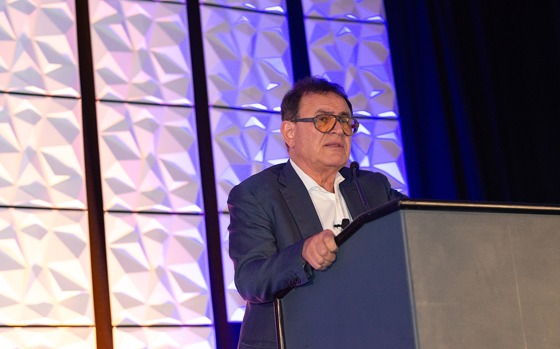
During the “2026 Bolton Advisor Conference,” held in Miami, renowned economist Nouriel Roubini outlined an optimistic view of the future of the U.S. economy. Throughout his presentation, first, and later during his conversation with the firm’s Managing Director and Chief Legal Officer, John Cataldo, he highlighted the growth potential and resilience of the U.S. economy in the coming years.
The CEO of Roubini Macro Associates, a New York-based consulting firm that provides strategic macroeconomic analysis, began his presentation with a perspective on the current global regime shift, warning about the transition “from relative political stability to relative instability, or even chaos.”
“We are now in a period in which supply shocks, especially negative ones, have become significant: covid, supply chain problems, protectionism, restrictions on migration, and geopolitical conflicts, all fragmenting and deglobalizing the world economy, generating stagflation risks,” he analyzed.
Roubini warned about the shift of the global economy toward more regulated markets and the risks of lower growth and higher inflation: “This entire set of concerns indicates that our economic regime is moving away from free markets toward regulated markets, and toward a situation where growth could be lower and inflation gradually higher, what people call stagflation,” he stated.
However, when analyzing the future of the United States, he affirmed: “American exceptionalism has not ended, the U.S. stock market is not in a bubble, our debts are not unsustainable or exorbitant. The dollar is going to remain and fluctuate, but it is not going to collapse.”
For the speaker, the key to U.S. leadership lies in its capacity for innovation and technological adaptation. “Technology, historically, is a positive supply shock that increases potential growth, productivity, and reduces the cost of producing goods and services. Artificial intelligence is just the latest manifestation of that positive shock,” he explained. In his view, the current technological revolution “is more important than the invention of fire, the introduction of agriculture, the printing press, the steam engine, or electrification.”
The economist, who also serves as Professor Emeritus of Economics at the New York University (NYU) Stern School of Business, projected that this innovation cycle will allow the United States to grow faster than other developed economies. “If the United States grows faster than Europe, eventually the dollar will be stronger, not weaker,” he stated. Roubini emphasized that the acceleration of potential growth, thanks to technology and digitalization, will be the best remedy for the country’s fiscal challenges. “Having a larger deficit and growing public debt is a problem. But if U.S. potential growth accelerates, the debt-to-GDP ratio will tend to stabilize or decline,” he argued.
Along these lines, Roubini also downplayed fears about the dollar: “The honest truth is that there is no alternative. The U.S. dollar will continue to be the world’s leading reserve currency because we remain the place to invest, among others, not the only one, but the main one.”
Referring to the financial market, he rejected the idea of a long-term bubble in U.S. assets: “If one takes a medium-term view, returns for the best private technology companies, for the Nasdaq and the S&P, will be as high as in the last twenty years, and probably much higher. We are not in a bubble. This is something secular.”
By contrast, Roubini was skeptical about the supposed cryptocurrency revolution: “Calling these things currencies is incorrect. Perhaps they are crypto assets, but they are not currencies, because anyone who knows basic monetary theory understands that for something to be money or currency it must be a unit of account. Things are priced in dollars, euros, yen; nothing is priced in Bitcoin… it has to be a stable store of value, and it is too volatile.”
Regarding Latin America, he was direct: “Latin America, like most emerging markets, is a mixed picture. One must ask which country has macroeconomic stability, because without stability there is no foundation for growth. Latin America has oscillated between booms and crises, and between right- and left-wing populism. I would say things are changing in part because many of these countries learned that loose fiscal and monetary policy is a recipe for disaster.”
In the case of Argentina, he specified: “The program (of President Javier Milei) may be radical, but the type of economic adjustment that was needed required shock therapy, and that is what is being done. It will take time and involve pain, but eventually it will produce results.”
He also addressed the rivalry between the United States and China, arguing that strategic competition will persist, but that the U.S. capacity for innovation and adaptation will be a decisive factor in maintaining global leadership: “Even before Trump, there was already a kind of cold war between the U.S. and China in economic, political, military, and security matters. That competition will continue. China is an emerging power.”
Closing his presentation, Roubini emphasized that American exceptionalism remains in force, supported by institutional strength, innovation capacity, the strength of the dollar, and the resilience of the financial system. According to his assessment, the United States is positioned to experience a cycle of accelerated growth and sustain its leadership in an increasingly fragmented and challenging world.