
Tensions between the United States, Israel, and Iran are once again placing geopolitics at the center of financial markets. For asset managers, the challenge is not only to react to volatility, but to design portfolios capable of withstanding energy shocks, unexpected inflation, and recurring episodes of global uncertainty.
For years, institutional investors operated under an implicit assumption: geopolitics could trigger episodes of volatility but rarely altered the long-term functioning of global markets. That paradigm is now changing.
The conflict in the Middle East serves as a reminder that geopolitical risks can directly affect energy markets, inflation dynamics, and the behavior of financial assets.
The critical point lies in the Strait of Hormuz, the world’s most important energy corridor, through which approximately 20% of global oil consumption flows. Any disruption in this strategic route could trigger sharp movements in energy prices, inflationary pressures, and greater volatility across financial markets.
For asset managers, the key question is clear: how to construct portfolios capable of withstanding and adapting to a more volatile geopolitical environment.
This geopolitical context arrives at a time when the asset management industry was already undergoing structural changes.
The world’s largest asset managers currently oversee nearly $140 trillion in assets, intensifying competition to generate alpha, innovate in product offerings, and expand distribution channels.
At the same time, several analyses point to clear trends shaping the industry:
- accelerated growth of private markets
- fee pressure in traditional products
- greater use of technology and artificial intelligence in portfolio management
- increasing demand for alternative strategies
In this environment, reports such as Northern Trust’s Global Investment Outlook 2026 warn that markets may face greater dispersion among assets, more persistent inflation, and recurring episodes of volatility—factors that reinforce the importance of active management.
Another important transformation is the growing convergence between public and private markets. Increasingly, traditional asset managers are incorporating private market strategies, while alternative firms are seeking structures that allow them to broaden their investor base.
The result is a new asset management model in which public and private markets begin to integrate within a single investment architecture.
Portfolio resilience in the new geopolitical era
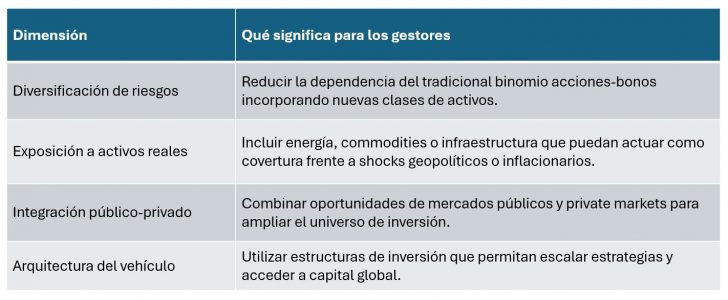
In this new environment, portfolio resilience no longer depends solely on diversification between equities and bonds. It increasingly relies on a combination of structural factors and the architecture of the investment vehicle itself.
How markets typically react to geopolitical shocks
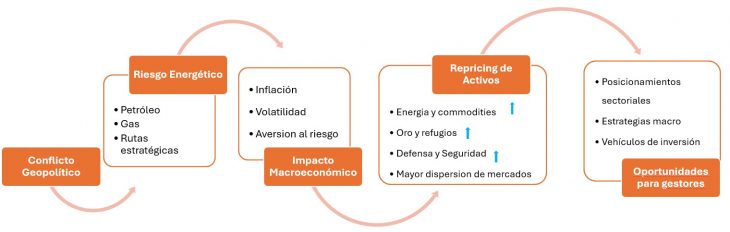
Although geopolitical conflicts often trigger initial episodes of volatility, they can also create temporary dislocations across financial markets. Historically, such events tend to affect asset classes and economic sectors in different ways.
In the case of tensions in the Middle East, markets usually react through four primary channels:
- Energy and commodities: risk to strategic routes such as the Strait of Hormuz can push oil and natural gas prices higher.
- Safe-haven assets: during periods of heightened risk aversion, assets such as gold, the U.S. dollar, and U.S. Treasury bonds often attract stronger inflows.
- Defense and security: geopolitical conflicts are often accompanied by increased defense and national security spending.
- Market volatility: rising uncertainty tends to increase volatility and dispersion across asset classes.
From strategy to investment vehicle
In this context, the structure of the investment vehicle becomes almost as important as the underlying strategy itself.
Asset securitization allows investment strategies or portfolios to be transformed into more efficient and scalable vehicles, offering several advantages for asset managers:
- facilitating access to international capital
- consolidating institutional track records
- improving transparency and distribution
- providing flexibility in the selection of underlying assets and enhancing diversification
- connecting private market opportunities with the liquidity of public markets
These solutions are gaining traction precisely because they address one of the industry’s biggest challenges today: how to expand access to new investment strategies in an increasingly competitive environment.
Geopolitical crises generate uncertainty, but they also tend to create new investment opportunities.
In this environment, institutional asset managers are paying greater attention to risk diversification, exposure to real-economy assets, and the use of more flexible investment structures.
In a world where geopolitics once again plays a decisive role in financial markets, firms that successfully combine structural innovation, genuine diversification, and global access to capital will be better positioned to transform volatility into a competitive advantage.
In line with this evolution in the industry, solutions such as those offered by FlexFunds enable asset managers and investment firms to transform strategies into efficient and scalable investment vehicles, facilitating access to international markets and distribution to a global investor base. For more information, please contact our experts at info@flexfunds.com