Brown Brothers & Harriman (BBH) has released its latest survey of managers on the global ETF industry. This 13th edition of the survey comes at a “turbulent moment,” according to the report, marked by “geopolitical tensions; a turbulent news cycle and a complex regulatory environment.” In short, “uncertainty abounds,” but “the ETF space is an area where optimism prevails,” according to the survey results.
The responses from the 325 ETF managers surveyed, 100 from the United States, 125 from Europe and another 100 from Greater China, suggest that demand for ETFs continues to grow even in a mature market, due in part to “the adoption of ETFs by new markets and channels.” In the short term, as the study reveals, global investors plan to adopt a balanced approach to secure income while also seeking protection against potential declines and volatility.
Almost all investors surveyed (96%) expect to increase their exposure to ETFs over the next 12 months, a percentage that has remained stable since February 2025. The appeal remains global, as investors in the United States are the most likely to increase their positions in exchange-traded funds (98%), followed by those in Greater China (95%) and Europe (94%).
However, a more detailed analysis of regional differences indicates varying levels of maturity in the ETF market. In the United States, the percentage of investors planning to significantly increase their exposure to exchange-traded funds this year was almost cut in half compared with 2025. Europe and Greater China also recorded small declines in plans to significantly increase ETF exposure. However, widespread increases were observed among those planning to slightly increase allocations (by less than 10%). No investor indicated plans to reduce exposure.
Points of Interest
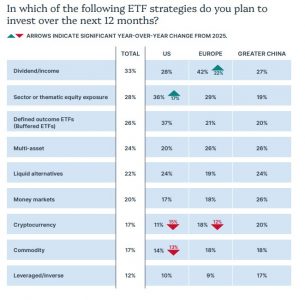
In particular, over the next 12 months investors plan to invest in dividend/income strategies (33%), sector or thematic equity exposure (28%) and defined outcome ETFs (26%). As caution remains the priority, 20% also plan to acquire money market exchange-traded funds, which offer safety and liquidity with modest yields.
To a lesser extent, commodities are also on the menu. Despite the surge in precious metals in 2025, only 17% plan to increase their exposure to commodities, “a view that may be supported by the sector’s volatility in early 2026,” according to the study.
Preferences vary by region. In the United States, investors’ preferred option is defined outcome ETFs (37%), which also rank highly (54%) among the exchange-traded funds they are most likely to use to manage volatility over the next 12 months. However, dividend/income ETFs are the top priority in Europe (42%) and Greater China (27%).
Protection Against Downside Risk
Market volatility is a major concern in 2026 as investors face rising geopolitical tensions.
Globally, the preferred option for managing volatility over the next 12 months is low-volatility equities and defensive ETFs covering sectors such as utilities and consumer staples (57%).