
iShares, Amundi, Vanguard, Invesco, and Xtrackers outpaced their rival ETF issuers in 2025 thanks to strong asset-gathering momentum and new launch activity, according to the new ranking published by ETF Stream. The study, titled ETF Issuer Power Rankings 2025, concluded that the trio of U.S. asset managers recorded significant relative progress compared with their competitors in the European listed ETF market.
The report reached this conclusion based on its own methodology, which evaluates five metrics over a 12-month period: flows (absolute and relative in 2025); trading (cumulative volume and volume relative to the number of ETPs); revenues (absolute fee income and revenue relative to the number of ETPs); activity (number of ETP and strategy launches); and presence (absolute flows by product class).
According to the report, the world’s largest asset manager, BlackRock, tops this issuer ranking for the first time after not only surpassing its own results from previous years, but also recording in 2025 more net inflows and higher trading volume in its European ETF business than its next four competitors combined.
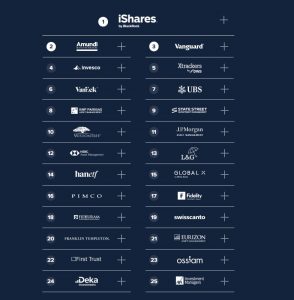
To highlight some of the figures that explain its leadership, iShares recorded net inflows of $92.8 billion in equities and $36.1 billion in fixed income, comfortably more than double those of its closest competitor and around 40% higher than the amounts it posted in each category last year. “Its leadership extended across most segments, with particularly wide gaps in ESG, emerging markets and commodities, where it added $26 billion, $12.1 billion and $7.7 billion in net new assets, respectively,” the report notes.
It also left virtually no front uncovered, with 36 new launches spanning from active core building blocks to collateralized loan obligations (CLOs) and corporate crossovers, quantum computing and AI themes, new ways of weighting U.S. and global equities, and its long-anticipated entry into cryptoasset exchange-traded products (ETPs).
The New York-based manager’s cumulative trading volume in 2025, at $1.84 trillion, marked a notable increase from $1.47 trillion the previous year and was more than three times that of the next most liquid issuer. “It remains to be seen whether its 2026 initiatives in more active launches and more targeted exposures can maintain the same growth pace on an already colossal scale,” the report states.
From second to fifth place
Following iShares’ lead is the European firm Amundi. Europe’s largest asset manager climbed the ranking again after adopting an offensive strategy in low-cost core products and in its retail offering, while also outlining a plan to establish a meaningful presence in the European active ETF and white-label segments. “The launch of its low-fee core range and the expansion of its well-established synthetic replication platform supported $33.9 billion in equity ETF inflows, alongside demand for its well-positioned country-sector strategies, including its European banks product. The firm also recorded $16.9 billion in fixed income strategies, led by strong investment in exposures such as short-duration euro corporate debt,” the report states.
Looking ahead to this year, a shift in focus will see the firm join players such as State Street and DWS in supporting third parties entering the market by offering capital markets support, alongside plans to develop its own in-house active ETF range and a more granular fixed income offering.
Notably, after Amundi, third and fourth place in the ranking are once again occupied by U.S. firms: Vanguard and Invesco. According to the report, Vanguard, founded by Jack Bogle, reached the podium for the first time after ending a three-year drought without launching European ETFs, undertaking ambitious retail distribution initiatives and cutting fees on its core offerings. The Pennsylvania-based manager recorded significant net inflows, attracting $31.7 billion in new money during 2025—the third-highest figure among all issuers—despite ending the year with a limited range of just 40 products.
For its part, Invesco broke into the top five after posting the second-largest inflows in the smart beta and commodities segments, which, together with market performance, drove 44.6% growth in assets under management in its European ETP business.
Rounding out the top five is another European firm: Xtrackers by DWS. “The firm showed strong traction, with the fourth-largest inflows and the third-highest cumulative trading volume, reaching $472.3 billion. However, outflows in certain segments meant that its solid $31 billion in net new assets were less impressive in relative terms compared with the $39 billion in inflows that its European Xtrackers business had gathered the previous year,” the report notes. Like Amundi, the German manager benefited from partnerships with third parties. Specifically, it launched an ETF of ETFs in collaboration with Zurich Insurance and two active equity ETFs based on AI together with DJE Kapital.
Industry trends of the year
“While core indexed exposures continue to account for the bulk of scale in European ETFs, the past year has been characterized by issuers racing to lead the market in active ETF launches, retail distribution and third-party ETF-as-a-service offerings,” explains Jamie Gordon, editor of ETF Stream.
According to the report, other leading ETF providers in Europe made notable strides in asset gathering and strategic initiatives, ranging from new partnerships with neobrokers to capitalize on the growing weight of retail investors to launching full ranges of active ETFs for the first time. “Many even began to ‘rent out’ their capabilities to allow new managers to enter the format for the first time,” they add.
It also notes that competition in the nascent European active ETF segment is intensifying, with new entrants gradually eroding the dominance of market leader J.P. Morgan Asset Management. Nordea and Robeco, which narrowly missed inclusion in this year’s ranking, both ranked among the top 25 issuers by net new asset inflows in their new ETF businesses.
Looking ahead, future-oriented themes experienced a revival driven by defense after two years of net outflows, enabling specialists such as VanEck, WisdomTree and Global X to improve their position compared with last year’s ranking.
In light of these findings, Pawel Janus, co-founder and head of analytics at ETFbook, believes that European ETFs continue to show strong structural growth, reflected not only in rising assets under management but also in accelerating product innovation and an increasingly broad issuer landscape. “The market’s competitive dynamics are evolving rapidly, especially with the expansion of active ETFs and increasingly specialized strategies. In this environment, scale alone is no longer enough. Issuers must differentiate themselves through innovation, distribution strength and operational excellence,” Janus concludes.