There is broad consensus that global economic growth will remain stable in 2026, although political uncertainty, particularly regarding the U.S., as well as geopolitical conflicts, will persist. In this context, the rating agency EthiFinance Ratings expects sovereign ratings to remain stable, especially due to continued access to markets, orderly debt management, and a monetary policy environment in the process of normalization. However, the agency warns that rating differences are becoming increasingly pronounced, driven by disparities in potential growth, political and institutional instability, and uneven fiscal trajectories.
These outlooks and reflections are relevant because, as Antonio Madera, Chief Economist at EthiFinance, notes, a rating is “that big elephant that is hard to move, but when it moves, it makes noise.” In his experience, specialized investors assign ratings the role they are meant to have, that of assessing solvency in a way that should remain stable throughout cycles and not be sensitive to them. “Unlike what happened during the sovereign debt crisis, when an acute solvency problem exacerbated by a financial crisis was signaled, in this case the perception is one of greater acceptance of ratings around the assigned levels,” he warns.
Divergences in Europe
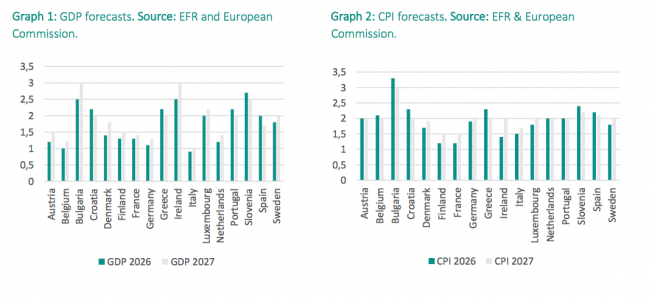
In Europe, by country, the EthiFinance Ratings Sovereign Credit Map places Germany, the Netherlands, and the Nordic countries among those with the highest level of confidence in policy execution and fiscal preservation; while Portugal and Greece show that fiscal adjustments and structural reforms can reshape a sovereign profile; and France, Italy, and Spain face “challenging” fiscal positions, with high public debt and persistent fiscal deficits, although with differences among them.
According to his analysis, Portugal is a clear example of a country capable of moving from intervention to a balanced public finance position, a path that Greece also appears to be following, “although still with very worrying levels of public debt,” he adds.
Doubts About the U.S.?
Regarding the U.S., Madera acknowledges that Moody’s downgrade last year is not, in itself, a reason to question the country’s ability to meet its obligations in full and on time, in terms of default probability, the difference between AAA and AA is minimal, as it remains an extremely safe issuer. “Rather, it underscores that its current fiscal position, debt burden, external deficit, and institutional quality are no longer fully aligned with the level of excellence required of a AAA-rated country,” he notes.
Madera is confident that, just as he does not foresee an upgrade to the U.S. rating, he also sees no grounds for a further downgrade. However, he acknowledges a meaningful risk related to the institutional factor, an element that often goes unnoticed in developed countries but serves as the cornerstone underpinning their ratings.
“Political deadlocks over the debt ceiling, the inability to outline a clear fiscal path, and/or recurring threats to the Fed’s independence erode investor confidence and weigh on governance. Added to this is the fact that the U.S. rating rests in part on the dollar’s role as the world’s reserve currency. While I have no doubt that the dollar will continue to play that role, geopolitical volatility and concerns about the fiscal outlook have nonetheless weakened it, prompting some investors to seek safer currency alternatives across the Atlantic. In this context, the path toward fiscal consolidation becomes even more essential,” Madera explains.
Faced with a lower U.S. rating, markets tend to magnify uncertainties, although in this specific case they have already priced in the likelihood that an upgrade will not materialize in the short or medium term. “Not belonging to the group of triple-A countries excludes certain institutional investors who require that rating threshold, although the shrinking number of countries within that select club is prompting a reassessment of investment policies,” he explains.
Based on his experience, what truly concerns him is the cyclical dimension driven by geopolitical uncertainty and declining confidence. “Among other effects, it directly increases the cost of debt and, consequently, erodes the fiscal buffer, something that undoubtedly exacerbates the imbalances mentioned earlier,” he adds.
Diversity in LatAm
In Madera’s view, Latin America occupies a significant place on the complex geopolitical chessboard that has taken shape in recent years, one on which the U.S. appears keen to maintain influence, as reflected in recent developments in Venezuela and threats of broader regional spillovers. “Amid this uncertainty, we see a positive development in the historic agreement between Europe and Mercosur, which opens access to a vast potential market for both sides and is likely to support economic growth in the region. Moreover, foreign capital flows may increasingly turn toward these markets, many of which require investment, in search of alternatives to the U.S.,” he highlights.
Overall, his outlook for the region remains stable, and he does not expect these risks or opportunities to materialize in the near term. “Chile, Mexico, Peru, and Brazil will continue to exhibit the strongest solvency levels in the region. However, they will not be immune, particularly Peru and Brazil, which face elections this year, as does Colombia, to a climate of institutional fragmentation, intensified by external pressures fueling polarization. In other countries across the region with dollarized economies, the effects may be mixed, both in terms of international trade and debt dynamics,” Madera notes.
When asked about the “overlooked strong ratings” in the region, he once again points to Chile, Uruguay, and Peru. “The first two stand out for their greater governmental stability and institutional quality, with Chile also benefiting from more balanced public finances. Peru, while broadly comparable, faces greater political tensions than the other two,” he concludes.