After taking some distance from the first weeks of January, experts agree that the arrest of Nicolás Maduro by the United States has had a significant geopolitical and financial impact. Although the focus remains on the oil and gold markets, some firms are also observing possible consequences for Latin American fixed income markets.
“The U.S. operation in Venezuela marks a decisive moment for Latin America, with implications for fixed income investors. While the possibility of increased U.S. intervention introduces new risks, it also creates opportunities by potentially becoming a source of reduced political risk premiums. Our base case is that greater U.S. engagement will support reform momentum in Colombia, Brazil, and Mexico, strengthening the fundamentals in favor of local LatAm bonds,” say analysts at JP Morgan AM.
According to the asset manager’s view, for fixed income investors, these events are a double-edged sword. “On the one hand, increased U.S. engagement leading to more orthodox governments from an economic standpoint could accelerate reform momentum in some countries, improving governance and fiscal discipline. On the other hand, the risk of political backlash or unintended consequences remains high, especially in markets with fragile institutions or entrenched political movements. Even so, we believe the fundamental case for increasing exposure to certain Latin American bonds has strengthened. Countries likely to benefit from U.S. support, or where reform prospects improve, should see a reduction in risk premiums, while those more exposed to economic policy uncertainty could continue to lag behind other emerging market regions,” they add from JP Morgan AM.
Implication for Investors
Historically, as Salman Ahmed, Head of Global Macro and Strategic Asset Allocation at Fidelity International, recalls, when extreme risks, such as a prolonged conflict, dissipate, sovereign debt in default or under stress in emerging markets tends to rebound on expectations of regime change, sanctions relief, and eventual restructuring. Therefore, he sees it likely that “a similar pattern will occur this time, with early signs that the regime is willing to cooperate with the United States, which could further boost bond prices.”
One must not forget the specific characteristics of the Latin American debt market. Michael Strobaek, Global Chief Investment Officer at Lombard Odier, explains that while emerging market equity indices are largely dominated by China, dollar-denominated bond indices include a greater proportion of Latin American debt securities. Therefore, he expects, following the arrest of Maduro, “a greater compression of spreads in emerging market bonds, as the growth of these economies remains supported while short-term U.S. yields continue to decline.”
However, not all Latin American debt would move in unison in the face of this new geopolitical shock. In this regard, Mirabaud makes it clear that in emerging debt, the current situation in Venezuela will bring “greater differentiation between countries with solid fundamentals and extreme idiosyncratic situations.” Specifically, Venezuela’s sovereign and quasi-sovereign debt “remains in default,” the firm notes, stating that the profile of this asset “remains problematic and dependent on events.” In addition to being subject “to a clearly defined political and legal process.” The firm also refers to Colombian debt, “indirectly exposed due to its geographic proximity.” Here, the firm considers it “possible” that short-term volatility will occur, “without this posing an immediate challenge to its strong macro-financial fundamentals.”
But there is the possibility of Venezuela’s return to international debt markets. If it happens, Christian Schulz, Chief Economist at Allianz GI, states that it is possible that “sovereign spreads of neighboring countries could narrow as stability improves.” He also believes that distressed debt investors may find opportunities in bonds issued by the Venezuelan state or by Petróleos de Venezuela (PDVSA). Alex Veroude, Head of Fixed Income at Janus Henderson, expresses a similar view, stating that in the short term, “Venezuelan bonds could receive initial support, as markets price in the prospect of policy normalization.”
Less External Influence
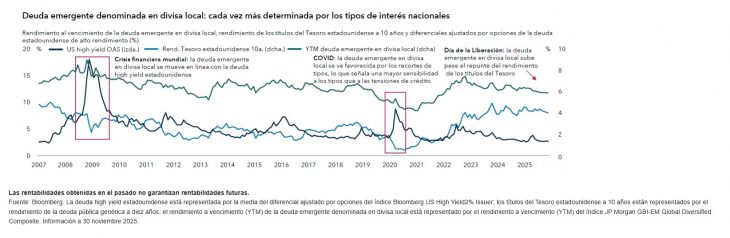
According to Capital Group, it is important to remember that emerging market debt denominated in local currency is increasingly determined by domestic interest rates, reflecting structural changes taking place in the composition of markets and policy frameworks. “The lower participation of foreign investors has reduced external influence, allowing the monetary policy of the respective countries to play a dominant role in price setting. This trend shift has been supported by monetary and fiscal credibility, the greater depth of capital markets, and the rise of institutional investment, which provides stable demand even in markets that previously relied heavily on foreign financing,” they explain.
Currently, central banks in many emerging markets are already well advanced in their respective rate-cutting cycles and, although a slowdown in the pace of cuts is expected in 2026, the cycle is not yet over, and the room for further cuts will vary significantly between regions. “The yield premium offered by local currency emerging market debt remains attractive, which can provide protection against bouts of volatility and an appealing level of income even in a context of declining global yields. Investor exposure to local currency emerging market debt has been steadily recovering after several years of capital outflows, supported by improved fundamentals and the attractive level of real yield. Nonetheless, it remains below pre-pandemic levels, creating a favorable technical backdrop for the asset class. Emerging market currencies could also contribute to returns, as some benefit from high U.S. dollar valuations and the narrowing of yield advantages,” they explain from Capital Group.